How Lazada Calculates Seller Cancellation Rate (And Why It Can Limit Your Daily Orders)
Erra16 Feb 2026 05:41ENCopy link & title
For many sellers, cancellations feel like a small operational mistake. But on Lazada, Seller-Fault Cancellations are treated as a serious performance issue because they directly impact customer experience and platform trust.
If not managed properly, cancellations can reduce your visibility, limit how many orders you receive daily, and even block you from campaigns or LazMall onboarding.
Here’s a clear breakdown of how Seller Cancellations work, how they are calculated, and what Malaysian sellers must do to stay compliant and competitive.

What Is a Seller Cancellation?
On Lazada, an order cancellation can happen in three ways:
-
Buyer-Initiated Cancellation – The customer cancels the order.
-
Seller-Initiated Cancellation – You manually cancel the order.
-
System-Initiated Cancellation – Lazada cancels the order automatically, usually because the seller failed to ship within the required fulfilment SLA.
However, only Seller-Fault Cancellations affect your store’s performance metrics. These include:
-
Cancelling the order yourself (e.g. no stock, pricing mistake).
-
Orders cancelled by Lazada because you did not ship on time.
Buyer cancellations do not impact your Cancellation Rate, unless Lazada finds evidence that the seller asked the buyer to cancel to avoid penalties.
Why Lazada Closely Monitors Cancellation Rate
Lazada treats cancellations as a reliability indicator. Frequent cancellations signal operational problems such as:
-
Poor inventory management
-
Incorrect pricing uploads
-
Weak fulfilment processes
These issues damage buyer trust, so Lazada links your Cancellation Rate directly to key growth levers, including:
-
Seller Ratings
-
Product traffic exposure
-
Eligibility for campaigns
-
Daily Order Volume Limit (OVL)
-
Eligibility to join LazMall
How Cancellation Rate Is Calculated
Cancellation Rate is not measured in real time. Instead, Lazada uses a rolling observation window to evaluate seller performance.
Formula:
Number of cancelled items (seller fault) ÷ Number of items sold
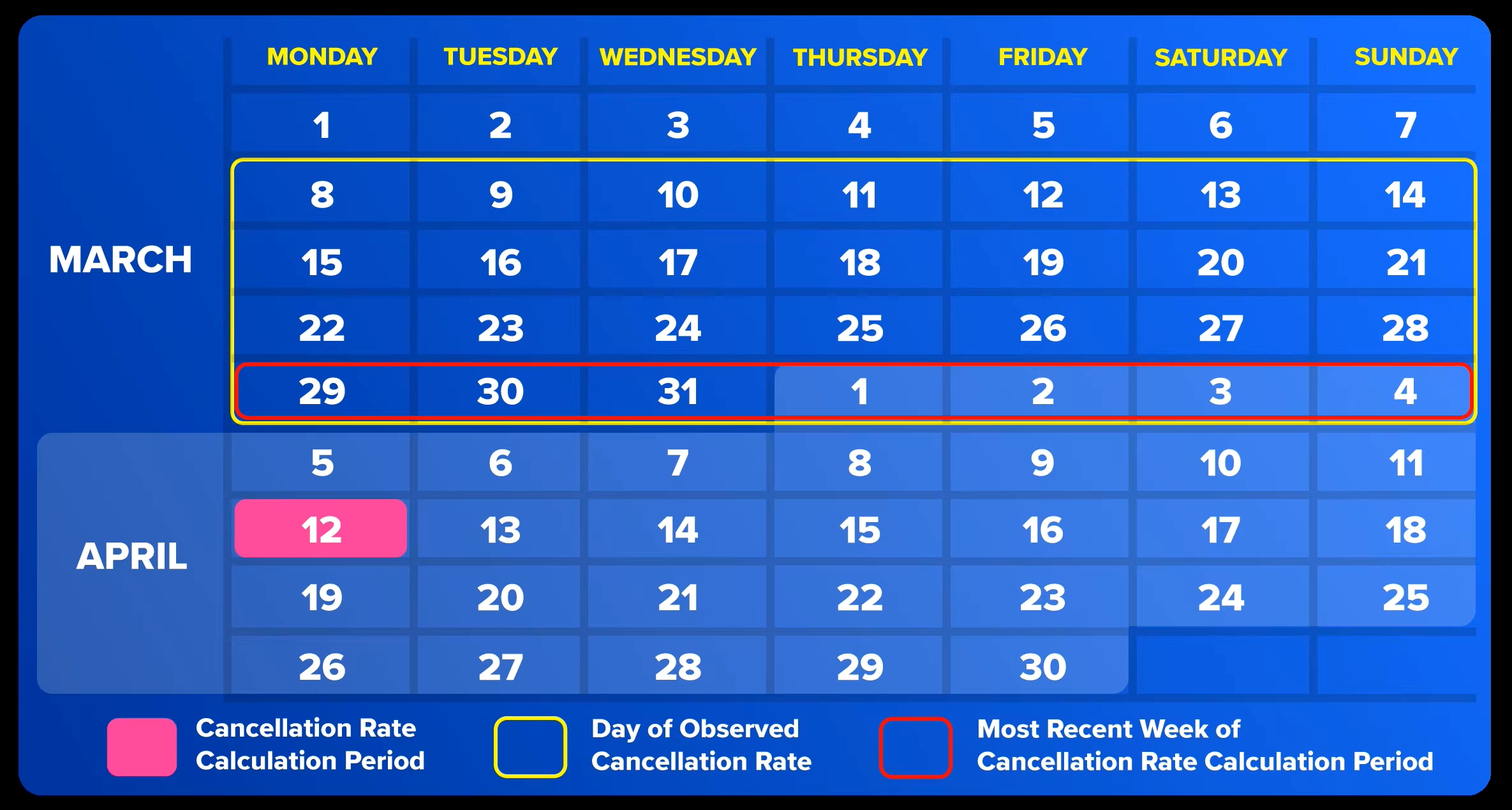
Measured from Day N-7 to Day N-35
This means your current Cancellation Rate reflects performance from roughly 1 to 5 weeks ago, not yesterday.
Example:
-
A rate shown on 12 April is calculated using orders from 8 March to 4 April.
-
Each week, this evaluation window shifts forward.
The most recently evaluated week plays an important role in deciding whether your Daily Order Limit increases or stays restricted. So improvements you make today will only show results after Lazada completes its evaluation cycle.
Item-Based vs Order-Based Calculation (Common Seller Misunderstanding)
Lazada calculates cancellations by item volume, not by number of orders.
Example:
|
Metric |
Value |
|
Orders received |
10 orders |
|
Items sold |
25 items |
|
Orders cancelled |
1 order |
|
Items cancelled |
2 items |
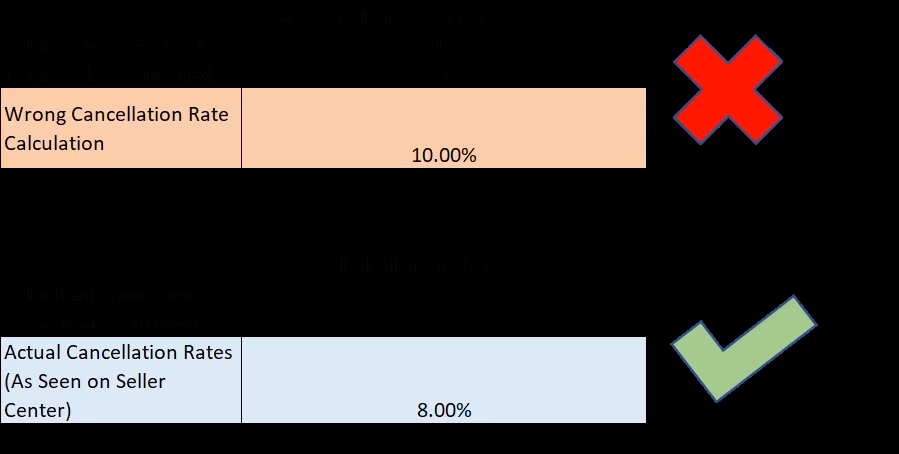
Many sellers assume:
1 cancelled order ÷ 10 orders = 10% CR
But Lazada calculates:
2 cancelled items ÷ 25 items = 8% actual CR
This is why cancelling a single order with multiple items can hurt more than expected.
What Happens If Your Cancellation Rate Is Too High?
Lazada recommends keeping your Seller Metrics indicator in the green zone. If your Cancellation Rate exceeds platform thresholds, enforcement actions may include:
1. Daily Order Volume Limit (OVL)
If CR exceeds 5%, Lazada may cap how many orders you can receive daily, directly limiting revenue growth.
2. Campaign Participation Restrictions
You may become ineligible for:
-
Platform-wide campaigns
-
Mega sale events
-
Promotional tools
This reduces visibility during high-traffic periods.
3. LazMall Ineligibility
Sellers with CR above 2% may not qualify to join LazMall.
4. Order Breach Fee
Lazada may charge:
30% of the item’s listing price per cancelled item
This turns cancellations into a direct financial cost.
5. Product-Level Traffic Suppression
Lazada also monitors cancellations at the SKU level.
If a product records:
-
Product-level CR ≥ 20%, and
-
At least 5 cancelled items in a week
The listing may be pushed down in search results, reducing exposure.
Product-Level Monitoring Window
Unlike overall Cancellation Rate, product-level performance is measured over a shorter timeframe:
Orders created between D-8 and D-14 (8–14 days ago).
Orders from the most recent 7 days are excluded because they may still be within fulfilment SLA. This allows Lazada to fairly assess whether cancellations are due to fulfilment failure rather than timing.
How OVL (Order Volume Limit) Is Determined
On Lazada, the Order Volume Limit (OVL) is a control mechanism used to protect customer experience when a seller’s Cancellation Rate becomes too high. Instead of suspending the store, Lazada may limit how many orders you can receive per day until performance improves.
Key Conditions for OVL to Apply
OVL enforcement is only triggered when all of the following are met:
-
The store has been active for more than 90 days
-
Performance is evaluated based on the last 4 weeks (28 days)
-
The most recent week is excluded to allow time for fulfilment completion
-
The seller breaches the acceptable Cancellation Rate threshold
This ensures Lazada evaluates sustained performance, not short-term fluctuations.
How OVL Is Calculated
Lazada determines your capped order volume using the following formula:
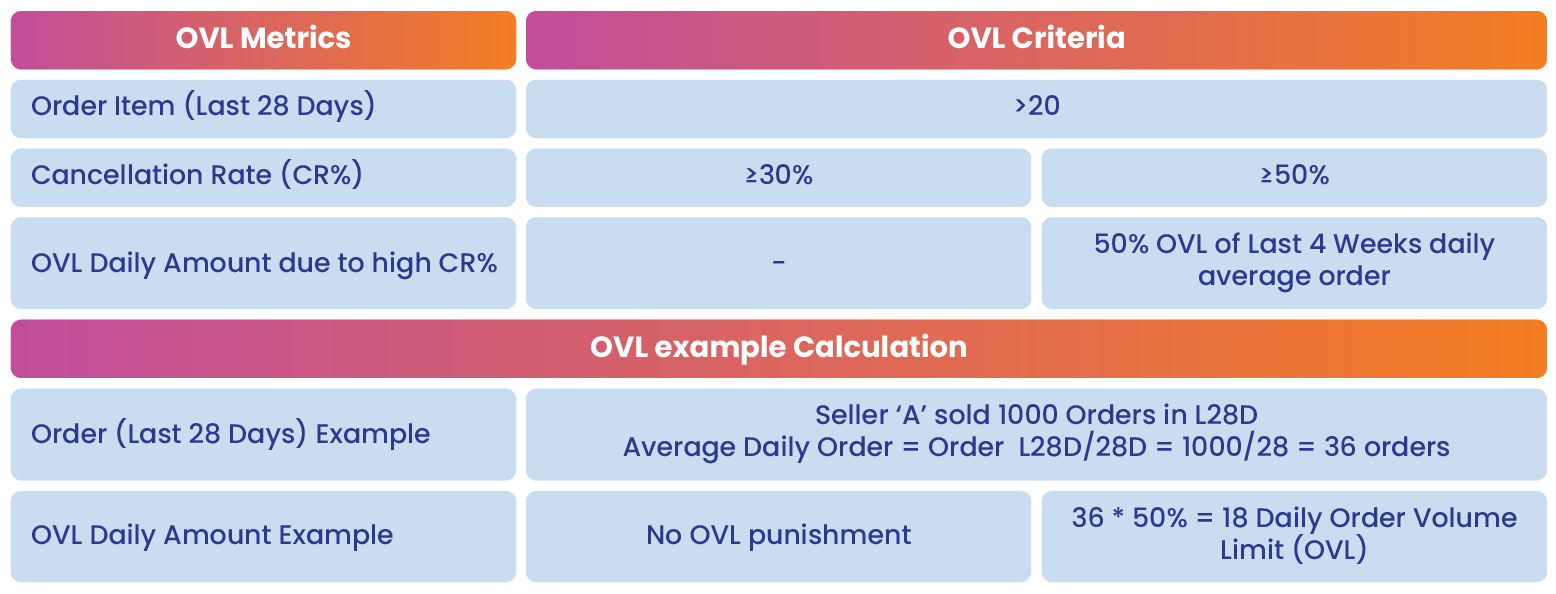
OVL Daily Amount = Last 4 Weeks’ Average Daily Orders × OVL %
This means the platform limits you relative to your own historical capacity, not a fixed number.
For example:
If you averaged 100 orders per day over the past 4 weeks and Lazada applied a 50% OVL factor, your store may only receive 50 orders per day until performance stabilises. To trigger OVL, Lazada evaluates three factors together:
-
Order volume over the last 28 days (L28D)
-
Seller-Fault Cancellation Rate
-
OVL criteria table set by Lazada
If these thresholds are met, Lazada enforces a minimum daily order cap automatically. OVL status is reviewed and refreshed every Wednesday in Seller Center, meaning recovery is possible, but only if cancellation behaviour improves.
What Is the “Auto Zero Stock” Feature?
To prevent repeated Seller-Fault Cancellations, Lazada introduced Auto Zero Stock, an automated safeguard that temporarily removes problematic SKUs from sale. When triggered, the system automatically:
-
Sets the affected SKU stock to 0
-
Takes the listing offline
-
Hides it from search results
-
Blocks new orders for that SKU
The goal is not punishment, it is to stop further failed orders while you correct stock or pricing errors.
When Auto Zero Stock Is Triggered
This feature activates when sellers cancel orders due to operational mistakes such as:
-
Item is out of stock
-
Listing has incorrect pricing
It applies to:
-
Single-SKU cancellations
-
Orders containing only one SKU
-
All fulfilment models, including Delivered-By-Seller (DBS)
When Auto Zero Stock Does NOT Apply
Auto Zero Stock will not be triggered in these situations:
-
You cancel an entire order containing multiple SKUs
-
The SKU exists across multiple warehouses (only the affected warehouse is adjusted)
-
The item is part of a Flash Sale or campaign
-
Cancellation reason is listed as “Unable to fulfil order”
Even if Auto Zero Stock is not triggered, the cancellation will still impact your Cancellation Rate.
Can You Restore the Stock After That?
Yes. Sellers can manually reactivate the SKU at any time through:
Lazada Seller Center → Products → Manage Products
Important to understand:
-
Only the cancelled SKU is set to zero, other variations remain active.
-
The product moves to “Out of Stock” only if all SKUs under it reach zero.
-
Existing orders are not automatically cancelled; sellers must manage them separately if needed.
Why Malaysian Sellers Must Treat Cancellation as an Operational KPI
Many sellers focus heavily on ads, pricing strategy, and campaigns. However, Lazada’s algorithm prioritises operational reliability first. High Cancellation Rates can quietly:
-
Reduce product visibility in search
-
Restrict how many orders your store can receive
-
Block access to campaigns and growth tools
-
Increase financial penalties such as breach fees
Meanwhile, sellers with consistently low Cancellation Rates are treated as more dependable and may receive stronger traffic allocation and scaling opportunities.
Reduce Lazada Cancellations with Smarter Operations
Seller-Fault Cancellations usually come from operational gaps like unsynced stock, manual listing errors, delayed fulfilment updates, or managing too many channels separately. Fixing these issues manually takes time and still leaves room for mistakes.
BigSeller helps Lazada sellers manage everything in one system so those risks are reduced at the source. Inventory updates sync across platforms in real time, orders are consolidated into a single workflow, and restocking, fulfilment, and reporting are handled with automation instead of spreadsheets or manual checks. This makes it easier to stay within Lazada’s performance requirements while running multi-channel sales more efficiently. BigSeller is free to use and built specifically for Southeast Asian sellers, supporting platforms like Lazada, Shopee, TikTok Shop, and more.
Try BigSeller for free today and activate the 7-day VIP trial to test the full features and see how it fits into your daily operations.
Source: