5 Best Ways to Prevent Overselling Across Multiple Sales Channels in Malaysia
Erra02 Oct 2026 08:06ENCopy link & title

What Are the Primary Technical Triggers of Multichannel Overselling in Malaysia?
The primary technical triggers of multichannel overselling in Malaysia are delayed stock syncing during high-traffic campaigns, inconsistent SKUs across marketplaces, and disconnected systems limited by API rate limits. Shopee, Lazada, and TikTok Shop each run in a separate ecosystem, so none knows what the others have sold. Manual tracking across them can cause overselling errors in up to 15% of transactions during peak periods.
Many mid-tier inventory tools poll marketplaces at fixed intervals instead of reacting to each order, leaving a 15 to 30-minute gap during Mega Sales. That is long enough for the same unit to sell on several platforms, especially during TikTok Shop Live events. Inconsistent SKUs make it worse. A power bank listed as MY-PB10-BLK on Shopee, Powerbank-10k-Black on Lazada, and Black-10000mAh on TikTok Shop looks like three products to the software, so each marketplace deducts from its own stock pool.
Disconnected POS or accounting systems add a third gap. They were rarely built for concurrent marketplace integrations, and when Shopee or Lazada applies rate limits during a traffic spike, stock updates are queued and listings keep showing stock that no longer exists. Left unresolved, these triggers lead to order cancellations, wrong pick-and-pack actions for 3PL merchants, and lower seller ratings.
What Are the Best Ways to Stop Overselling Across Multiple Sales Channels in Malaysia?
1. Use a centralised inventory system. A centralised system acts as the single source of truth for stock. Instead of keeping separate counts on Shopee, Lazada, and TikTok Shop, every order on every channel deducts from one shared pool. This removes the need for spreadsheets and manual updates, which are the main source of human error. For this to work, the system should be cloud-based and connect to each marketplace through official API authorisation, so it can receive orders directly rather than relying on exports.
2. Enable real-time synchronisation. Centralised stock is only useful if every channel sees changes quickly. Look for event-driven synchronisation, where each order triggers an immediate update, instead of tools that check for changes every 15 to 30 minutes. During Mega Sales and live selling, the speed of this update determines whether the same unit can be sold twice. The shorter the gap between a sale and the updated stock count, the smaller the window for overselling.
3. Hold back safety buffer stock. Even fast synchronisation has a small delay, and several customers can check out in the same second. A safety buffer protects against this by displaying only a percentage of your real stock. For example, you might list 80% of available units online and keep the rest in reserve. You can also set a "sold out" threshold, so that when stock falls below a certain level (such as two units), every channel is marked as sold out automatically. Both methods absorb simultaneous purchases without breaking your seller ratings.
4. Map every listing to one SKU. SKU mapping links identical products across marketplaces to a single master SKU, regardless of how each listing is named. This lets the system recognise that an order for Black-10000mAh on TikTok Shop and one for MY-PB10-BLK on Shopee draw from the same shelf. You do not need to rename existing listings. Mapping them once also makes it practical to scale to more products and more channels, since new listings are linked to a master SKU instead of being tracked individually.
5. Automate reconciliation. Even well-configured systems drift over time because of cancelled orders, returns, damaged goods, and warehouse adjustments. Automated reconciliation runs periodic background checks that compare your master stock with each marketplace's displayed quantity and correct any mismatch. This catches errors early, before they become cancelled orders. It should be paired with clear warehouse workflows, such as scanning returned items back into stock and assigning stock to the correct location when you use multiple warehouses or a 3PL.
Which E-commerce System Is Best for Preventing Overselling Across Multiple Sales Channels in Malaysia?
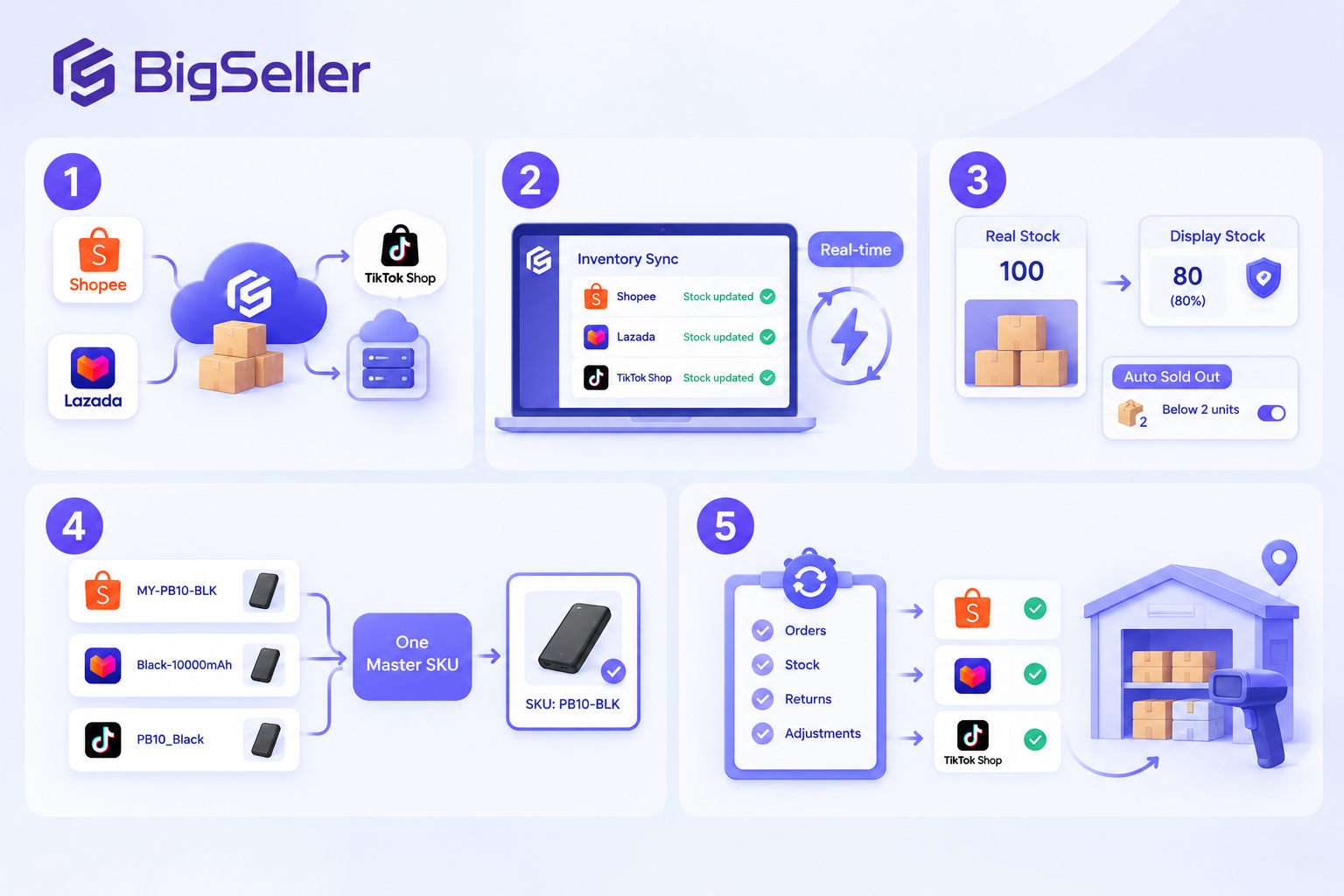
BigSeller is a strong choice for Malaysian multichannel sellers because it applies all five methods in one cloud-based ERP system. BigSeller connects Shopee, Lazada, and TikTok Shop through official API authorisation and manages them from a single, real-time inventory count instead of treating each marketplace as a separate stock pool. It works through four steps.
Unified Master SKU architecture. BigSeller asks you to create one Merchant SKU (Master SKU) for each product and link your Shopee, Lazada, and TikTok Shop listings to it. An order on any platform then deducts from the same physical stock, even when listing names and codes differ.
Event-driven, near real-time sync. BigSeller uses official marketplace APIs instead of slow polling. When a customer checks out during a TikTok Shop Live, the deduction is processed against the Master SKU, and the reduced stock level is pushed to Shopee and Lazada. This shrinks the gap that causes overselling from 15 to 30 minutes to a very short window.
Customisable inventory Push Rules. You control how much stock each channel displays:
-
Real-Stock Push (100%): shows the exact available quantity on all stores.
-
Partial Stock Push (e.g. 80%): holds back a safety buffer to absorb simultaneous clicks.
-
Convert to Sold Out: sets all channels to zero stock once inventory falls below a threshold you choose (such as fewer than two units), which stops overselling at the last units.
Campaign-reserved inventory. For a flash sale or live stream, you can ring-fence a specific batch of stock exclusively for that promotion. The reserved units are subtracted from your regular multichannel pool, so everyday buyers on Lazada cannot purchase units already committed to a Shopee Flash Sale.
BigSeller also covers the warehouse side of overselling:
-
One-Click Return Stock-In: scanning a returned parcel back into the warehouse adds it to the Master SKU pool and makes it available on all channels again, without duplicate entries.
-
Multi-Warehouse Allocation: if you combine your own warehouse with a 3PL or Shopee's fulfilment program, BigSeller locks order-assigned stock at the correct location so it cannot be allocated twice.