Blog>Seller Tips>Best Third-Party Warehouses in the Philippines for 2026: What Online Sellers Need to Know
Best Third-Party Warehouses in the Philippines for 2026: What Online Sellers Need to Know
Jayson08 Apr 2026 12:22ENCopy link & title
Running an online store on Shopee or Lazada is exciting — until your living room fills up with boxes and your packing table doubles as your dining table. As order volumes grow, managing storage, packing, and same-day dispatch from home becomes a real bottleneck. That is where a third-party warehouse — or 3PL (third-party logistics) provider — comes in.
This guide breaks down what 3PL warehousing is, what to look for, which providers are worth considering in 2026, and how much it typically costs.

A third-party warehouse is a company that stores your inventory, picks and packs your orders, and ships them to your customers — all on your behalf. You pay for the service; you do not own the physical space or hire the warehouse staff.
How it works: store, pick, pack, ship
The basic flow is straightforward. You send your products to the 3PL's facility. When a customer places an order, the 3PL's system receives it (usually by syncing with Shopee, Lazada, or your own website), a staff member picks the item from the shelf, packs it, and hands it to a courier — often J&T Express, Ninja Van, or SPX Express. You get a tracking number, and so does your buyer.
3PL vs. doing it yourself
Self-fulfillment works fine at low volumes — say, under 100 orders a month. Beyond that, the hidden costs of your own time, rented space, packing materials, and missed SLAs start to add up. A 3PL converts that unpredictable overhead into a predictable per-order fee, which makes your margins easier to plan.
Key terms to know
Location and geographic coverage
The Philippines has over 7,100 islands, which makes nationwide delivery one of the hardest logistics problems in Southeast Asia. Prioritize providers with multiple hubs — at minimum, Metro Manila, Cebu, and Davao. Pre-staging inventory in those three cities can cut delivery windows significantly, especially for buyers in the Visayas and Mindanao who currently wait 5–8 days for Metro Manila-based sellers.
Platform integration
Check whether the 3PL can connect directly to Shopee, Lazada, TikTok Shop, or your Shopify store via API or a built-in connector. Without integration, your team has to manually upload orders — a time sink that defeats much of the purpose of outsourcing. Most serious providers in 2026 offer plug-and-play connectors for the major local platforms.
Pricing model: what to watch for
3PL pricing in the Philippines typically has four components: inbound receiving, storage (charged per pallet, cubic meter, or SKU per day), per-order fulfillment, and returns handling. The first three are expected; the fourth often catches sellers off guard. Always ask for a complete fee schedule before signing anything.
The table below covers providers most frequently discussed among Filipino e-commerce sellers. Pricing ranges are indicative — actual quotes depend on your volume, SKU count, and product dimensions.
Typical cost ranges
For a small seller processing 200–500 orders per month, expect to pay roughly ₱35–₱85 per fulfilled order (pick, pack, and handoff to the courier), plus storage fees of approximately ₱8–₱25 per cubic meter per day depending on the provider and location. Inbound receiving — when you send new stock to the warehouse — is often charged per carton or per SKU onboarded.
Hidden fees to ask about upfront
A useful rule of thumb: if your monthly storage cost (rent + utilities allocated to goods) plus the value of your packing time exceeds what a 3PL charges for storage and fulfillment, it is worth making the switch. For most sellers, this crossover happens somewhere between 150 and 300 orders per month. Sellers processing 1,000+ orders monthly can typically negotiate 15–25% discounts on standard rates.
Q1: Is a third-party warehouse suitable for very small sellers with under 100 orders a month?
Generally not cost-effective at that volume. Most providers have minimum fees that make the per-order cost very high at low volumes. Self-fulfillment or a shared co-warehousing arrangement is usually better until you cross 150–200 orders per month.
Q2: Can a 3PL provider handle Shopee and Lazada orders at the same time?
Yes, most established providers in the Philippines support multi-channel fulfillment. They receive orders from both platforms via API, fulfill from the same inventory pool, and generate the correct shipping label for each platform's courier.
Q3:Who is responsible if an item is lost or damaged inside the warehouse?
This depends on the contract. Reputable providers carry goods-in-storage insurance and have a defined claims process. Always confirm liability limits and turnaround time for claims before signing.
Furthermore, if you are a seller who operates multiple platforms and needs to use third-party warehouses, ERP tools like BigSeller can effectively help you manage order processing efficiently.
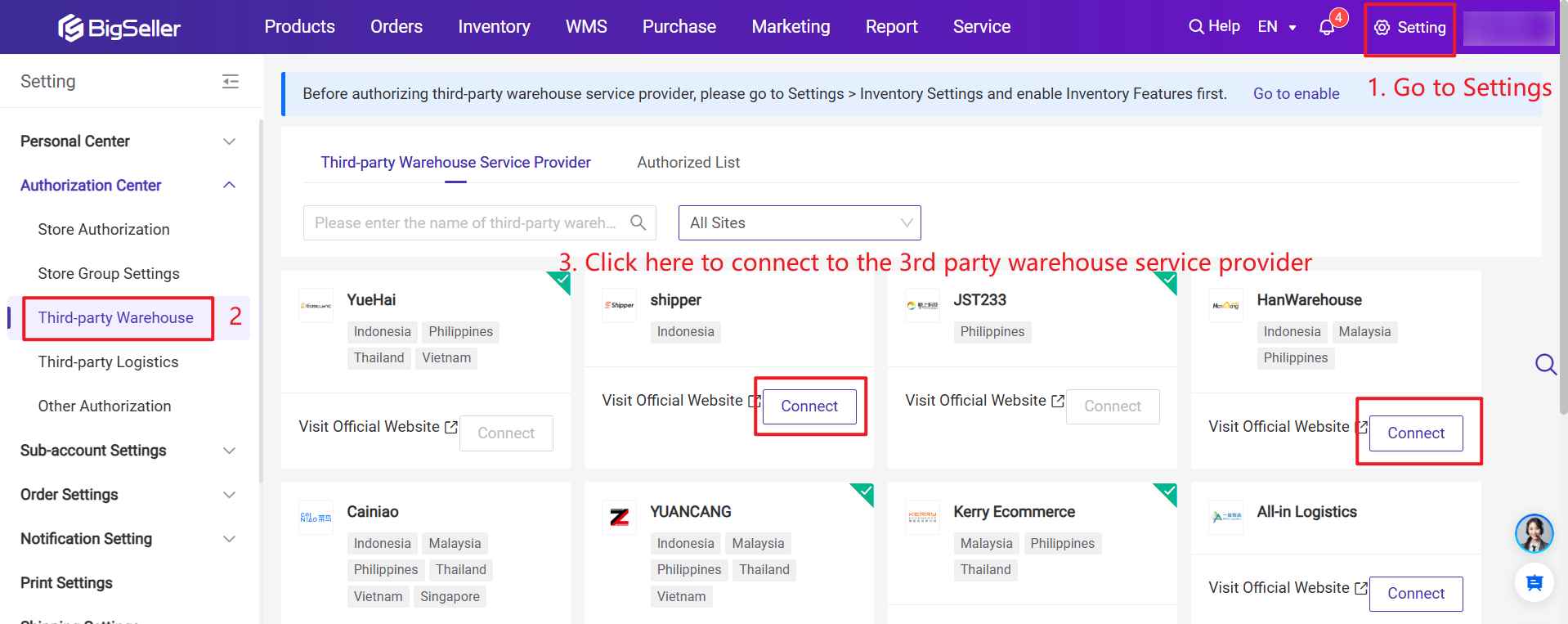
🔍Connect Third Party Warehouse to BigSeller
BigSeller currently supports multiple third-party warehouses, you can connect the third party warehouse to BigSeller to manage orders and stocks.
This guide breaks down what 3PL warehousing is, what to look for, which providers are worth considering in 2026, and how much it typically costs.
1. What Is a Third-Party Warehouse and Why Does It Matter for Online Sellers?
A third-party warehouse is a company that stores your inventory, picks and packs your orders, and ships them to your customers — all on your behalf. You pay for the service; you do not own the physical space or hire the warehouse staff.
How it works: store, pick, pack, ship
The basic flow is straightforward. You send your products to the 3PL's facility. When a customer places an order, the 3PL's system receives it (usually by syncing with Shopee, Lazada, or your own website), a staff member picks the item from the shelf, packs it, and hands it to a courier — often J&T Express, Ninja Van, or SPX Express. You get a tracking number, and so does your buyer.
3PL vs. doing it yourself
Self-fulfillment works fine at low volumes — say, under 100 orders a month. Beyond that, the hidden costs of your own time, rented space, packing materials, and missed SLAs start to add up. A 3PL converts that unpredictable overhead into a predictable per-order fee, which makes your margins easier to plan.
Key terms to know
- Fulfillment center — the physical warehouse where goods are stored and dispatched.
- Pick and pack — the process of retrieving an item and preparing it for shipment.
- Last-mile delivery — the final courier leg from the warehouse to the customer's door.
- SKU — a unique code for each product variant you sell.
2. What Should You Look for in a Third-Party Warehouse in the Philippines?
Location and geographic coverage
The Philippines has over 7,100 islands, which makes nationwide delivery one of the hardest logistics problems in Southeast Asia. Prioritize providers with multiple hubs — at minimum, Metro Manila, Cebu, and Davao. Pre-staging inventory in those three cities can cut delivery windows significantly, especially for buyers in the Visayas and Mindanao who currently wait 5–8 days for Metro Manila-based sellers.
Platform integration
Check whether the 3PL can connect directly to Shopee, Lazada, TikTok Shop, or your Shopify store via API or a built-in connector. Without integration, your team has to manually upload orders — a time sink that defeats much of the purpose of outsourcing. Most serious providers in 2026 offer plug-and-play connectors for the major local platforms.
Pricing model: what to watch for
3PL pricing in the Philippines typically has four components: inbound receiving, storage (charged per pallet, cubic meter, or SKU per day), per-order fulfillment, and returns handling. The first three are expected; the fourth often catches sellers off guard. Always ask for a complete fee schedule before signing anything.
3. Top Third-Party Warehouse Providers to Consider in 2026
The table below covers providers most frequently discussed among Filipino e-commerce sellers. Pricing ranges are indicative — actual quotes depend on your volume, SKU count, and product dimensions.
| Provider | Best for | Key hubs | Platform integration | Approx. fulfillment fee/order | Scale tier |
|---|---|---|---|---|---|
| Locad | Growing DTC brands, multi-channel sellers | Manila, Cebu, Davao | Shopee, Lazada, Shopify, TikTok | ₱35–₱70 | SME to enterprise |
| 2GO Group | High-volume merchants needing island coverage | 48 warehouses nationwide | Custom API | Negotiated (volume) | Mid to large |
| Ninja Van Fulfillment | Sellers prioritizing last-mile speed | Manila, Cebu, CDO | Shopee, Lazada, Shopify | ₱40–₱85 | SME to mid |
| F2 Logistics | Domestic freight + warehousing combined | Manila (primary), Cebu | Custom API / EDI | Negotiated | Mid to enterprise |
| Inspire Solutions Asia | Small sellers needing flexible contracts | Metro Manila | Shopify, Lazada, Shopee | ₱30–₱60 | Startup to SME |
4. How Much Does Third-Party Warehousing Cost in the Philippines?
Typical cost ranges
For a small seller processing 200–500 orders per month, expect to pay roughly ₱35–₱85 per fulfilled order (pick, pack, and handoff to the courier), plus storage fees of approximately ₱8–₱25 per cubic meter per day depending on the provider and location. Inbound receiving — when you send new stock to the warehouse — is often charged per carton or per SKU onboarded.
Hidden fees to ask about upfront
- Returns processing: ₱20–₱50 per returned order
- Remote area surcharges on delivery (especially Mindanao and island provinces)
- Minimum monthly volume commitments — some providers charge a shortfall fee
- Special handling for fragile or oversized items
- Account setup or integration fees (one-time, ₱2,000–₱10,000)
A useful rule of thumb: if your monthly storage cost (rent + utilities allocated to goods) plus the value of your packing time exceeds what a 3PL charges for storage and fulfillment, it is worth making the switch. For most sellers, this crossover happens somewhere between 150 and 300 orders per month. Sellers processing 1,000+ orders monthly can typically negotiate 15–25% discounts on standard rates.
5. Frequently Asked Questions
Q1: Is a third-party warehouse suitable for very small sellers with under 100 orders a month?
Generally not cost-effective at that volume. Most providers have minimum fees that make the per-order cost very high at low volumes. Self-fulfillment or a shared co-warehousing arrangement is usually better until you cross 150–200 orders per month.
Q2: Can a 3PL provider handle Shopee and Lazada orders at the same time?
Yes, most established providers in the Philippines support multi-channel fulfillment. They receive orders from both platforms via API, fulfill from the same inventory pool, and generate the correct shipping label for each platform's courier.
Q3:Who is responsible if an item is lost or damaged inside the warehouse?
This depends on the contract. Reputable providers carry goods-in-storage insurance and have a defined claims process. Always confirm liability limits and turnaround time for claims before signing.
Furthermore, if you are a seller who operates multiple platforms and needs to use third-party warehouses, ERP tools like BigSeller can effectively help you manage order processing efficiently.
🔍Connect Third Party Warehouse to BigSeller
BigSeller currently supports multiple third-party warehouses, you can connect the third party warehouse to BigSeller to manage orders and stocks.
BigSeller is the ultimate e-commerce SaaS ERP system designed for Southeast Asian sellers, aiming to help you improve efficiency and expand more business channels. It simplifies all processes on one dashboard—from product listing and order processing to inventory management, financial tracking, and automated operations. Customized subscription plans are also available for different types of sellers.
Vist our website to know more 👉BigSeller ERP
Vist our website to know more 👉BigSeller ERP
BigSeller-Blog Senior Writer: Jayson
Sir Jayson has worked in well-known e-commerce companies such as Shopee and TikTok Shop, helping hundreds of sellers to deepen their e-commerce industry, expand their business, and eventually become high-quality sellers.