Why Malaysian Sellers Need a Centralised SKU System and Which Tool Handles It Better
Erra22 May 2026 10:02ENCopy link & title

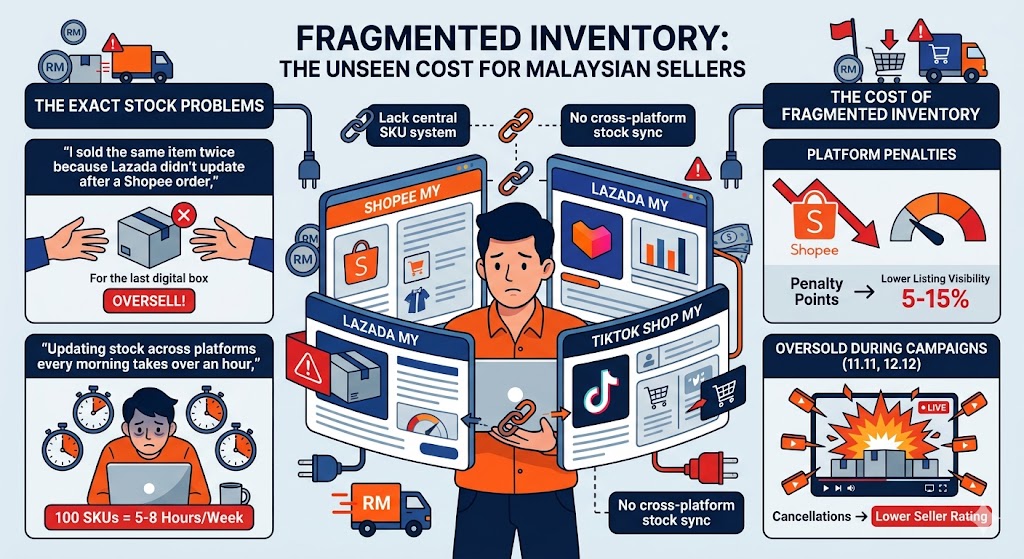
Are These the Exact Stock Problems Forcing You to Find a Better System?
If you recognise any of the following, your business is already paying the cost of fragmented inventory.
"I sold the same item twice because Lazada didn't update after a Shopee order."
Shopee, Lazada, and TikTok Shop have no native cross-platform stock sync. Every sale on one platform creates a window where the same unit still shows as available on another and during major sale events, that window produces multiple oversells within minutes. Manual inventory tracking generates up to a 15% oversell error rate, and each cancellation triggers Shopee's penalty system, suppressing listing visibility by 5–15%.
"Updating stock across platforms every morning takes over an hour."
Logging into each Seller Centre, locating each SKU, and entering a new quantity takes 3 to 5 minutes per SKU per platform. A seller managing 100 SKUs across three platforms spends 5 to 8 hours a week on stock updates alone, labour that scales with SKU count, not revenue, and compounds as the business grows.
"My account got penalised after a major sale event for too many cancellations."
Malaysian e-commerce transaction revenue reached RM 937.5 billion in the first nine months of 2025, and Malaysia's e-commerce calendar is packed with big campaigns all driving massive order spikes, often simultaneously across platforms. Running flash deals on multiple platforms at once without synchronised inventory almost guarantees overselling within the first minutes of going live. Shopee flags accounts exceeding its cancellation rate threshold; Lazada applies equivalent penalties through its Seller Rating system.
"TikTok Shop live sessions and bundle listings wipe out stock unexpectedly."
Live selling on TikTok Shop Malaysia can deplete fast-moving SKUs in under an hour. Malaysia had 34.9 million internet users with 97.7% internet penetration in 2025, a buyer base that moves fast during live events. The same problem surfaces with bundle SKUs: updating a bundle listing's stock separately from its component SKU means both figures diverge the moment either sells, creating phantom inventory that leads to overselling even when you think you've updated everything.
How Do the Available Inventory Tools for Malaysian Sellers Compare?
Not all inventory tools are built equally for the Malaysian marketplace ecosystem. Here is how the main options stack up against the problems above.
|
Feature |
BigSeller |
Ginee |
EasyStore |
SiteGiant |
|
Shared inventory pool |
✅ Real-time |
✅ Real-time |
⚠️ Basic |
⚠️ Basic |
|
Bundle SKU component deduction |
✅ Automatic |
✅ Yes |
⚠️ Basic |
⚠️ Basic |
|
Real-time inventory ledger |
✅ Full audit trail |
⚠️ Partial |
❌ |
❌ |
|
Alert stock levels + smart reorder |
✅ Yes |
⚠️ Basic |
❌ |
❌ |
|
Built-in WMS (wave pick, PDA, bin zones) |
✅ Scales with business |
❌ |
❌ |
❌ |
|
Multi-warehouse management |
✅ Yes |
✅ Yes |
❌ |
❌ |
Ginee handles real-time sync and multi-warehouse management well, making it a viable option for mid-to-large sellers at high volume. The gap is WMS depth, smart reorder capability, and scalability across business sizes.
EasyStore is well suited for brand-owned webstore sellers who treat marketplaces as secondary channels, but its inventory depth for complex multi-platform operations is limited.
SiteGiant fits omnichannel sellers with physical retail POS needs, but falls short on multi-platform inventory management for marketplace-first businesses.
BigSeller is the only tool in this comparison that covers real-time sync, automatic bundle deduction, smart restocking, multi-warehouse management, and a built-in WMS, all within one platform, for businesses at any scale.
What Does BigSeller Do to Fix These Inventory Problems?
BigSeller supports cross-platform inventory sharing through a single shared stock pool. One master stock count per SKU is maintained across all connected stores. Campaign-reserved stock, push rules, and push records ensure every platform reflects the same accurate figure after every order. Best for: Malaysian sellers on two or more platforms who need stock to update instantly across all channels after every order.
BigSeller supports bundle SKU deduction at the component level. Every bundle order automatically deducts the correct component unit quantity from the shared pool, keeping bundle and individual listings in sync without separate manual updates. Multi-unit conversion rules allow stock to be tracked by bottle, carton, or kilogram. Best for: Malaysian sellers in health, beauty, and F&B categories offering both individual and bundled options for the same SKU.
BigSeller supports proactive restocking through alert stock levels and smart purchase recommendations. When any SKU crosses a defined threshold, BigSeller flags it for restocking and generates recommendations based on sales velocity, removing guesswork from replenishment ahead of campaign seasons. Best for: Malaysian sellers who currently discover stockouts reactively through a cancelled order rather than proactively through a system alert.
BigSeller supports enterprise-level warehouse operations for high-volume Malaysian sellers. Wave picking, PDA barcode scanning, bin-location zone separation, and optimised pick paths increase throughput and reduce pick errors, scaling warehouse operations without adding headcount. Best for: Malaysian businesses processing high order volumes across multiple warehouses that need operational rigour to match their inventory scale.
Frequently Asked Questions (FAQs)
Q1: How does BigSeller prevent overselling across multiple platforms?
A: BigSeller maintains one shared stock pool per SKU across all connected stores. When any store receives an order, stock is deducted and updated across every other connected platform in real time. This keeps inventory accurate whether orders come in during a quiet Tuesday or a Hariraya Payday Sales campaign spike.
Q2: Does BigSeller work for Malaysian sellers managing multiple stores?
A: BigSeller supports multiple Shopee stores, Lazada stores, and TikTok Shop accounts under one login. All connected stores draw from the same shared inventory pool, so a sale on any store immediately updates stock across every other storefront, making it straightforward to manage separate stores for different categories or campaign strategies.
Q3: How does BigSeller handle bundle SKUs?
A: BigSeller deducts bundle orders at the component level automatically. When a bundle sells, the correct number of component units is deducted from the shared pool without any manual update, keeping individual and bundle listings in sync at all times.
Q4: Can BigSeller support a growing business without switching platforms?
A: BigSeller is built to serve businesses at every stage, from Malaysian sellers just starting out on a few platforms to enterprises running multi-warehouse operations. Core inventory features are accessible from the start, and more advanced warehouse capabilities become available as the business scales, all within the same platform.
Q5: Is BigSeller suitable for Malaysian sellers specifically?
A: BigSeller holds Best Partner status from Shopee, Lazada, and TikTok Shop, and has local offices and support teams in Malaysia. BigSeller is trusted by over 1,100,000 sellers across Southeast Asia and is built around the realities of the regional marketplace ecosystem, including Malaysia's dense sale calendar and multi-platform selling patterns.