Motolab: How BigSeller WMS Reshaped Warehouse Fulfillment for a 2,000+ Daily Order Motorcycle Parts Seller
Jayson11 Jun 2026 10:34ENCopy link & title
In the Philippine ecommerce market, motorcycle parts are a category with stable demand and frequent repeat purchases. But behind that demand lies a difficult fulfillment challenge.
Motorcycle parts often come with many models, specifications, and fitment requirements. Products may look similar, yet apply to different motorcycle models, installation positions, or sizes. For sellers, making the sale is only the first step. The real operational test is whether the warehouse can ship quickly and accurately under high order volume.
Motolab is a fast-growing motorcycle parts ecommerce seller in this market.
Founded in 2024, Motolab focuses on selling cost-effective motorcycle parts through brand partnerships and cross-border operations. The company operates across Shopee, Lazada, and TikTok Shop. By 2025, Motolab’s GMV had exceeded PHP 270 million, with daily order volume reaching more than 2,000 orders.
Growth brought opportunity, but it also exposed the pressure inside the warehouse.
1. As Orders Increased, Manual Fulfillment Started to Fall Behind
Before using BigSeller, Motolab mainly relied on manual work to process online orders. Orders from different platforms had to be checked and organized separately, while warehouse staff picked, checked, and packed goods based on experience.
When order volume was still manageable, this approach could keep the business running. But once daily orders exceeded 2,000, the warehouse workflow was frequently disrupted.
For motorcycle parts sellers, the risk of shipping the wrong product is especially high.
To confirm whether a part is correct, staff cannot rely only on the product name. They also need to check the SKU, specification, compatible motorcycle model, left-right position, and other details. Under pressure, manual checking can easily lead to wrong picking, wrong shipments, or missed items.
A wrong shipment is not just one after-sales issue. The buyer may be unable to install the product, the order may require return or exchange, customer service needs to explain the issue, and the warehouse has to process the item again. Platform reviews and store fulfillment performance may also be affected.
For Motolab, frontend sales were growing, but the warehouse was gradually becoming a bottleneck.
2. Choosing BigSeller: From Trial Use to Long-Term Partnership
Motolab first learned about BigSeller through a friend’s recommendation.
After repeated recommendations and comparing BigSeller with other products, Motolab started using the system and gradually became a long-term user. Today, Motolab has worked with BigSeller for two years.
For Motolab, BigSeller’s value is not only about centralizing orders from Shopee, Lazada, and TikTok Shop into one dashboard. More importantly, it connects order processing, warehouse operations, shipping workflows, and purchase replenishment.
Among these capabilities, WMS has brought the most visible change.
“After using BigSeller, our staff efficiency and shipping accuracy improved significantly. WMS has been the most helpful feature.”
- Motolab representative

3. Implementation: Starting from the Real Warehouse Workflow
Whether a system can truly create value depends not only on its features, but also on whether it fits the customer’s real warehouse operations.
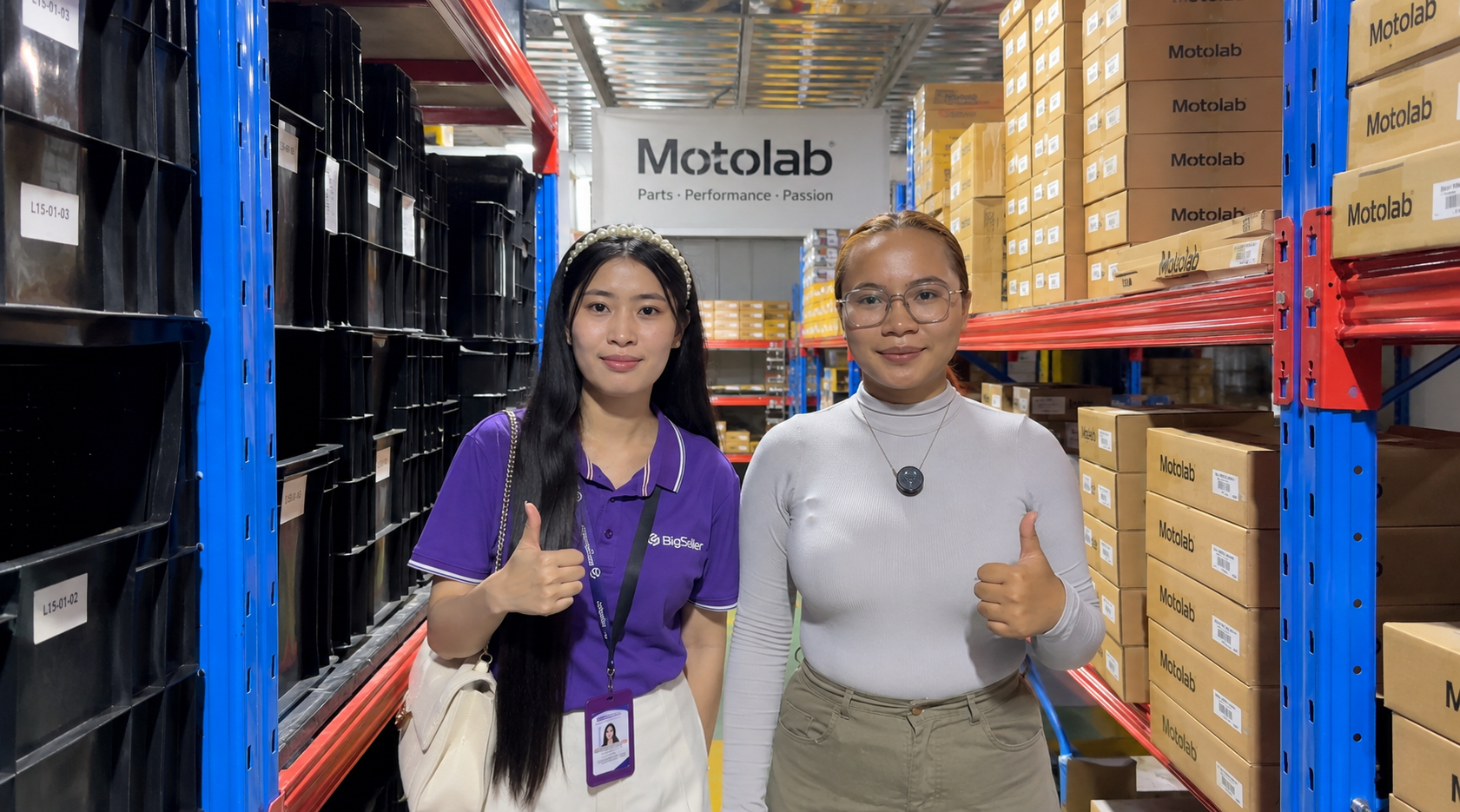
Motolab’s warehouse mainly handles labeled products, making it suitable for wave processing, scanning, sorting, and packing verification. Instead of only providing remote feature training, the BigSeller team went into Motolab’s warehouse to understand its layout, product types, staff habits, and order processing path.
The first question was not “how many features should be enabled,” but how Motolab’s 2,000+ daily orders could be processed steadily after entering the warehouse.
Which platforms do the orders come from? Which orders can be grouped into the same batch? Which products require extra error prevention? How do pickers know what to pick? How do packers confirm that the product matches the parcel? How can the warehouse reduce missed scans and wrong shipments before dispatch?
Based on these questions, BigSeller helped Motolab gradually transform its warehouse from an experience-based manual workflow into a standardized WMS-driven operation.
4. Core Mechanism: Wave Management
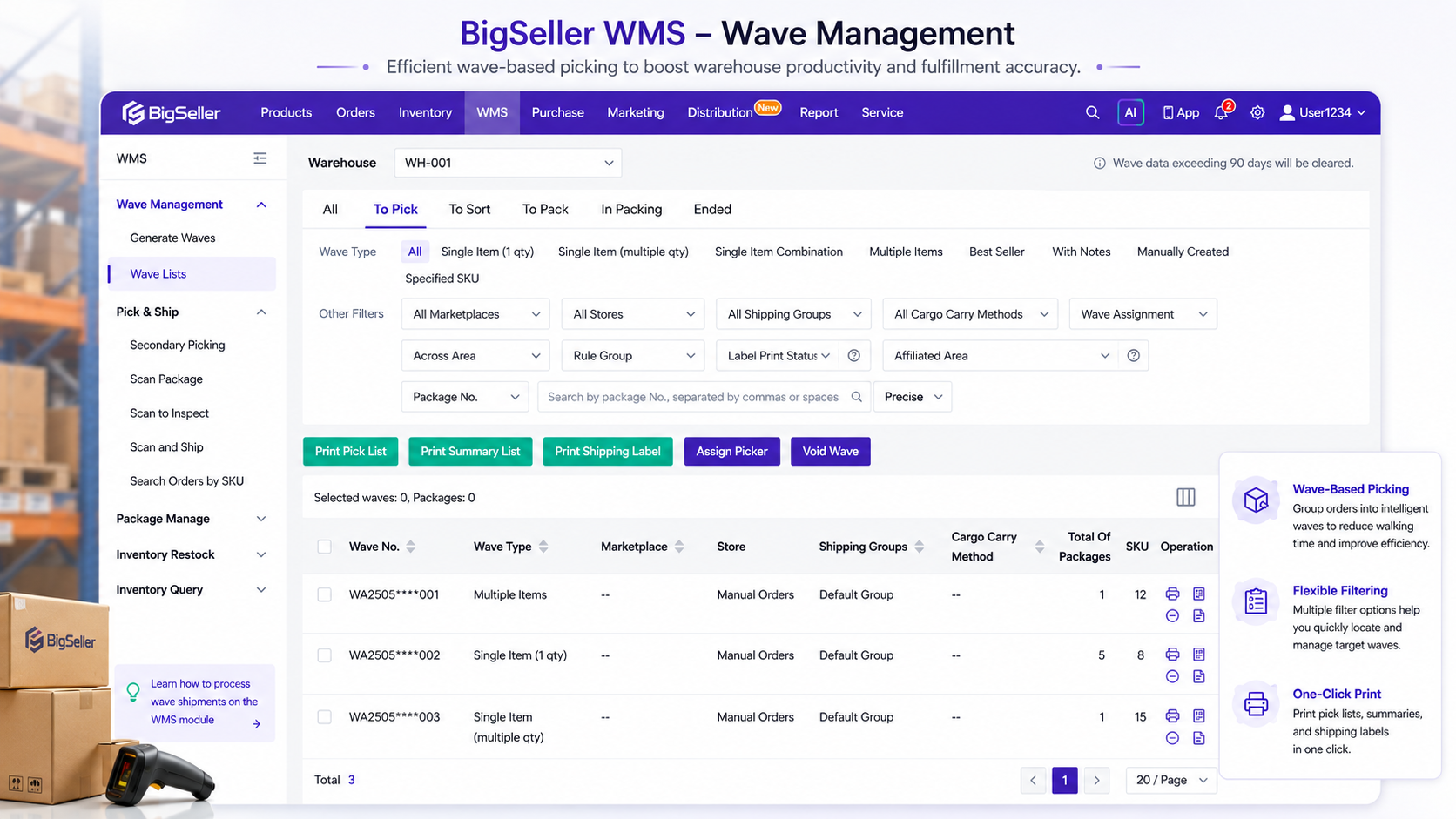
Wave management is the core logic of WMS. It groups orders with the same or similar attributes into batches, allowing warehouse teams to process picking, label printing, and packing in a centralized way.
For high-volume sellers, wave management is not simply putting orders together. It reorganizes the rhythm of warehouse operations through system rules.
Because Motolab mainly handles labeled products, the system can group suitable orders into different wave types. Motolab mainly uses the following wave scenarios:
| Wave Scenario | Why It Fits Motolab | Warehouse Efficiency Benefit |
|---|---|---|
| Single-item single-quantity wave | Many orders contain only one SKU and one unit | Faster picking and packing |
| Best-seller wave | Popular parts generate concentrated orders during campaigns | Same SKUs can be processed together, reducing repeated searching |
| Multi-item mixed-parcel wave | One order contains multiple motorcycle parts SKUs | Sorting and scan verification reduce missed or wrong shipments |
| Special product wave | Some products have special specifications or require extra checking | Higher-risk products can be managed separately |
| Manual wave | Special orders or temporary operational needs | Keeps the workflow flexible without disrupting the main process |
5. How One Order Moves Through the Warehouse
Take a typical Motolab motorcycle parts order as an example.
-
Order Sync and Wave Generation
A buyer places an order on Shopee. The order is automatically synced into BigSeller. The system processes it based on order status, inventory, and shipping warehouse. After the warehouse manager arranges the order, it enters the WMS wave page and is grouped into a batch task according to wave rules. -
Picking
The warehouse supervisor assigns the wave to the relevant picker. The picker starts picking based on the pick list, summary list, or app task. Staff no longer need to check orders across multiple platforms or decide manually which batch to process first. By grouping orders into waves, staff can pick by SKU and task, reducing repeated walking, missed picks, and wrong picks. -
Sorting
After picking, the order enters the sorting stage. Staff scan the product SKU, GTIN, or product code for secondary sorting. The system indicates which sorting bin the product should be placed into, reducing reliance on visual judgment. -
Packing and Checking
Packers scan the product label, parcel number, tracking number, or order number to match the product with the correct parcel. They can also print shipping labels and confirm packing within the workflow. For Motolab, this adds a system-based checking step before the product leaves the warehouse. -
Shipping
Once parcels enter the pending shipment list, the warehouse can complete shipment by scanning the tracking number or parcel number. Depending on the actual workflow, the team can also use automatic or manual shipment. After shipment is completed, the order moves to pending pickup, and inventory is deducted accordingly.
Throughout the process, every step is supported by system status updates, scanning actions, or task records. These controls reduce human error.
This is the core value of the WMS system BigSeller helped Motolab build: the warehouse moved from relying on memory, searching, and manual checking to a workflow driven by batches, tasks, scanning, and traceability.
6. Purchase Collaboration: Keeping Replenishment in Step with Warehouse Demand
Warehouse issues do not only happen during outbound fulfillment.
The more orders a seller receives, the faster inventory moves. If replenishment cannot keep up, best-selling products may go out of stock. If purchasing data and warehouse data are disconnected, inventory judgment becomes inaccurate and may affect future shipping.
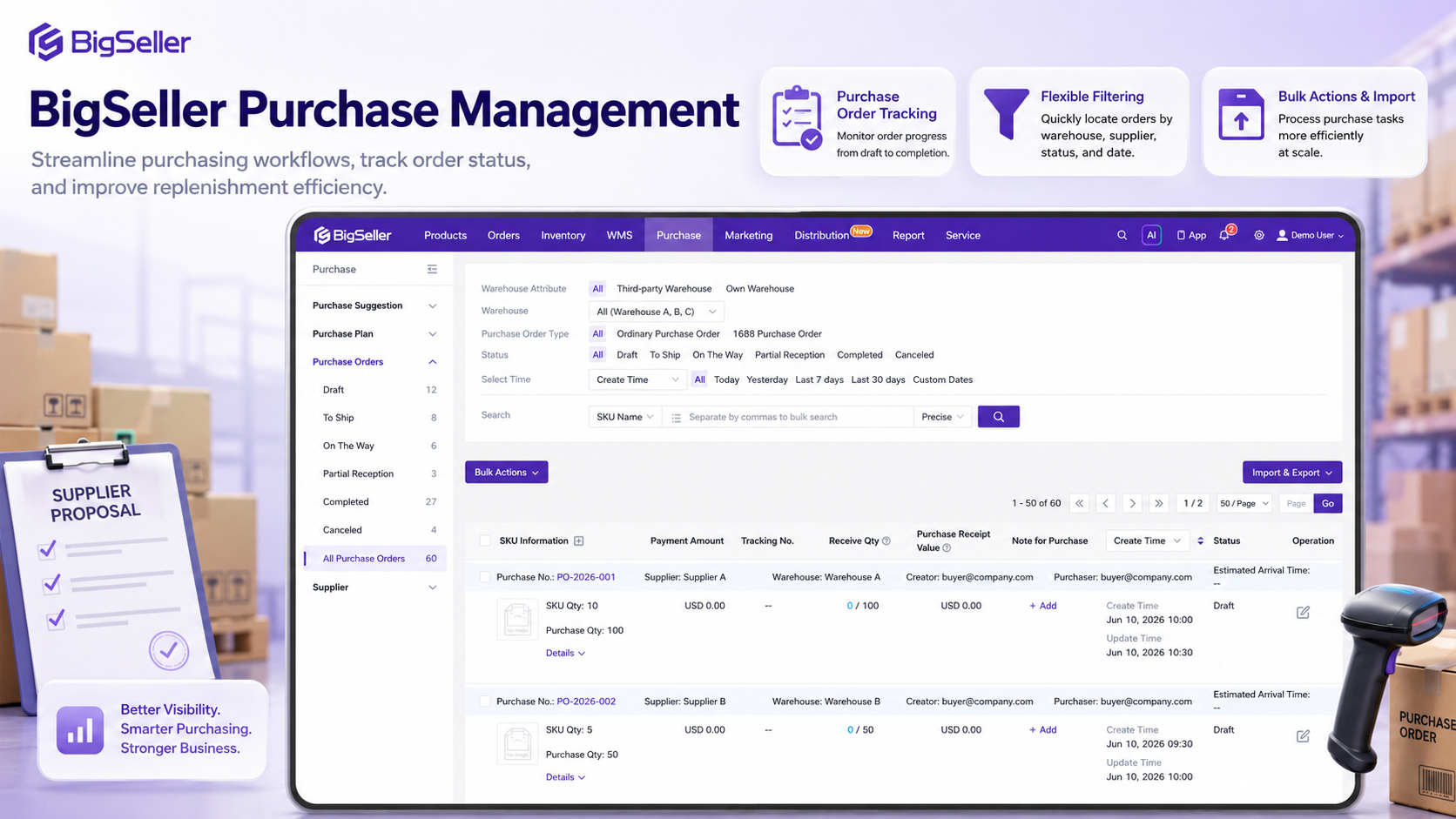
While using WMS, Motolab also uses BigSeller’s purchase module.
As sales orders continue to come in, inventory changes in the system provide clearer support for purchasing decisions. The team can more quickly see which motorcycle parts are being consumed rapidly, which SKUs need replenishment, and which products should be prepared before major campaigns.
Order processing, inventory changes, purchasing, and final shipment need to work together to support stable business growth.
7. Efficiency Improvements Beyond the Warehouse
After warehouse efficiency improved, the internal team felt the difference first.
Staff no longer needed to spend long hours manually checking orders, searching for products, and repeating verification. Work became clearer, order processing became faster, and the overtime, rework, and after-sales pressure caused by warehouse disorder were significantly reduced.
| Business Area | Before BigSeller | After BigSeller WMS |
|---|---|---|
| Multi-platform order processing | Orders were processed separately by platform | Multi-platform orders are synced and centralized into one fulfillment flow |
| Warehouse operation | Manual order-by-order processing | Waves are generated and orders are processed in batches |
| Picking | Staff manually searched and checked products | Picking is guided by pick lists, summary lists, or app tasks |
| Sorting | Staff relied on visual judgment | Staff scan SKU, GTIN, or product codes and sort by system prompts |
| Packing and checking | Staff manually matched products with labels | Product labels or parcel information are scanned to match orders |
| Shipping | Manual shipment confirmation, higher risk of omission | Scan-based or automatic shipment with clearer status flow |
| Wrong shipment rate | Manual picking error rate of 5%-10% | Reduced to less than 1% |
| Customer experience | Slow shipping and wrong shipments affected reviews | Faster and more accurate shipping brought better feedback |
Warehouse improvement ultimately affects customer experience.
When orders are processed faster and products are shipped more accurately, buyers wait less, wrong shipments decrease, and store reviews related to shipping speed and fulfillment reliability improve.
For Motolab, improved warehouse efficiency also brought additional sales through better customer feedback on shipping speed.
This shows that the warehouse is not just a hidden cost center. For high-volume ecommerce sellers, warehouse efficiency directly affects conversion, reviews, and repeat purchases.
8. Standardizing the Warehouse to Support the Next Stage of Growth
Motolab’s growth shows that once an ecommerce seller reaches a certain scale, competition is no longer only about traffic and product pricing.
When orders continue to come in from multiple platforms, the real question is whether the backend can steadily handle that volume.
After using BigSeller, Motolab gradually upgraded its manual warehouse fulfillment process into a standardized WMS-driven system. Through labeled-product waves, scan-based sorting, scan-based packing, scan-based shipping, and purchase collaboration, Motolab improved staff efficiency and reduced its manual picking error rate from 5%-10% to less than 1%.
More importantly, the BigSeller team went into the warehouse and helped Motolab build workflows based on its real business needs, instead of simply handing over a software dashboard.
For Motolab, BigSeller is not just an order processing tool. It is an operational foundation that keeps the warehouse running steadily, protects shipping accuracy, and supports continued growth.
When frontend sales grow quickly, backend fulfillment cannot become the bottleneck.
Motolab’s case shows that for high-volume sellers, standardizing warehouse management means systemizing growth capability.
BigSeller will continue helping more Southeast Asian sellers manage multi-platform operations and high-volume fulfillment with clearer, more stable, and more efficient system capabilities.
Related Articles
- Customer Story
Pawmised Land: Building a Data Foundation with BigSeller and Using AI to Guide Business Decisions
Jayson

- Customer Story
Enoda Home Increased Revenue by 70% by Standardizing Warehouse Operations with BigSeller
Jayson
- Customer Story
Toko Tekno Conquers a 4,000-SKU Maze: How BigSeller WMS Automation Rescued the Business from the "Human Error" Trap
Jayson