How Malaysian Sellers Can Build an Accurate Inventory Forecast Across Multiple Platforms
Erra23 Jun 2026 08:17ENCopy link & title

What Is the Reorder Point Problem for Multi-Platform Sellers in Malaysia?
Most Malaysian sellers restock based on gut feel or a single platform's numbers. The real problem is that Shopee, TikTok Shop, and Lazada all drain from the same warehouse, so if you only track one channel, you are already undercounting how fast stock is leaving.
According to a 2023 report by the Malaysia Digital Economy Corporation (MDEC), over 60% of Malaysian e-commerce SMEs identified inventory mismanagement as a top operational challenge with multi-channel sellers disproportionately affected. A separate industry study by Momentum Commerce analysing over 500 million marketplace transactions found that sellers using combined cross-platform velocity data reduced stockout incidents by 34% compared to those tracking channels in isolation.
Getting reorder timing wrong in either direction is costly:
-
Too late → stockouts, cancelled orders, dropped search rankings, platform penalty points from Shopee and Lazada's fulfilment SLA systems
-
Too early → cash tied up in warehouse, rising storage fees, dead stock risk when trends shift, especially relevant for TikTok Shop sellers riding short product cycles
How Do You Know When It Is Time to Reorder?
The right moment to place a new purchase order is when your current stock plus anything already on the way from your supplier can no longer cover demand until the next delivery.
For example, if your products sell across three platforms at a combined rate of around 8 units a day, and your supplier takes 14 days to deliver, you need at least 112 units in hand just to break even, before adding any buffer for delays or demand spikes. Most sellers who track only Shopee see a number that looks safe, while their TikTok Shop and Lazada orders are quietly draining the same shelf.
For Malaysian sellers sourcing from China, typical sea freight lead times run 10–21 days. Local suppliers average 3–7 days. These windows need to be factored in per SKU, not assumed as a blanket number across your whole catalogue.
Adjust for campaigns separately. Sales velocity on Shopee Payday Sale or during a TikTok Shop live session can spike 3–10× above your daily baseline. Malaysian sellers should set a higher temporary reorder threshold 6–8 weeks before major campaign dates and revert once the campaign window closes.
How Do Inventory Tools Compare for Malaysian Multi-Platform Sellers?
|
Feature |
BigSeller |
Manual Spreadsheet |
ERP (e.g. SAP B1) |
|
Shopee + TikTok Shop + Lazada sync |
✅ Native |
❌ Manual export |
⚠️ Custom integration |
|
Auto purchase suggestion |
✅ Yes |
❌ No |
⚠️ Module add-on |
|
Real-time stock deduction across platforms |
✅ Yes |
❌ No |
✅ Yes |
|
Sales Coefficient for promo smoothing |
✅ Built-in |
❌ No |
❌ Rare |
|
In-transit stock deducted from suggestion |
✅ Yes |
❌ Manual |
✅ Yes |
|
One-click purchase order generation |
✅ Yes |
❌ No |
⚠️ Multi-step |
|
Setup complexity |
Low |
None |
High |
|
Cost for SME sellers |
Affordable |
Free |
High |
|
Suitable for Malaysia marketplace sellers |
✅ Yes |
⚠️ Low volume only |
❌ Overkill for most |
How Does BigSeller's Purchase Suggestion Work?
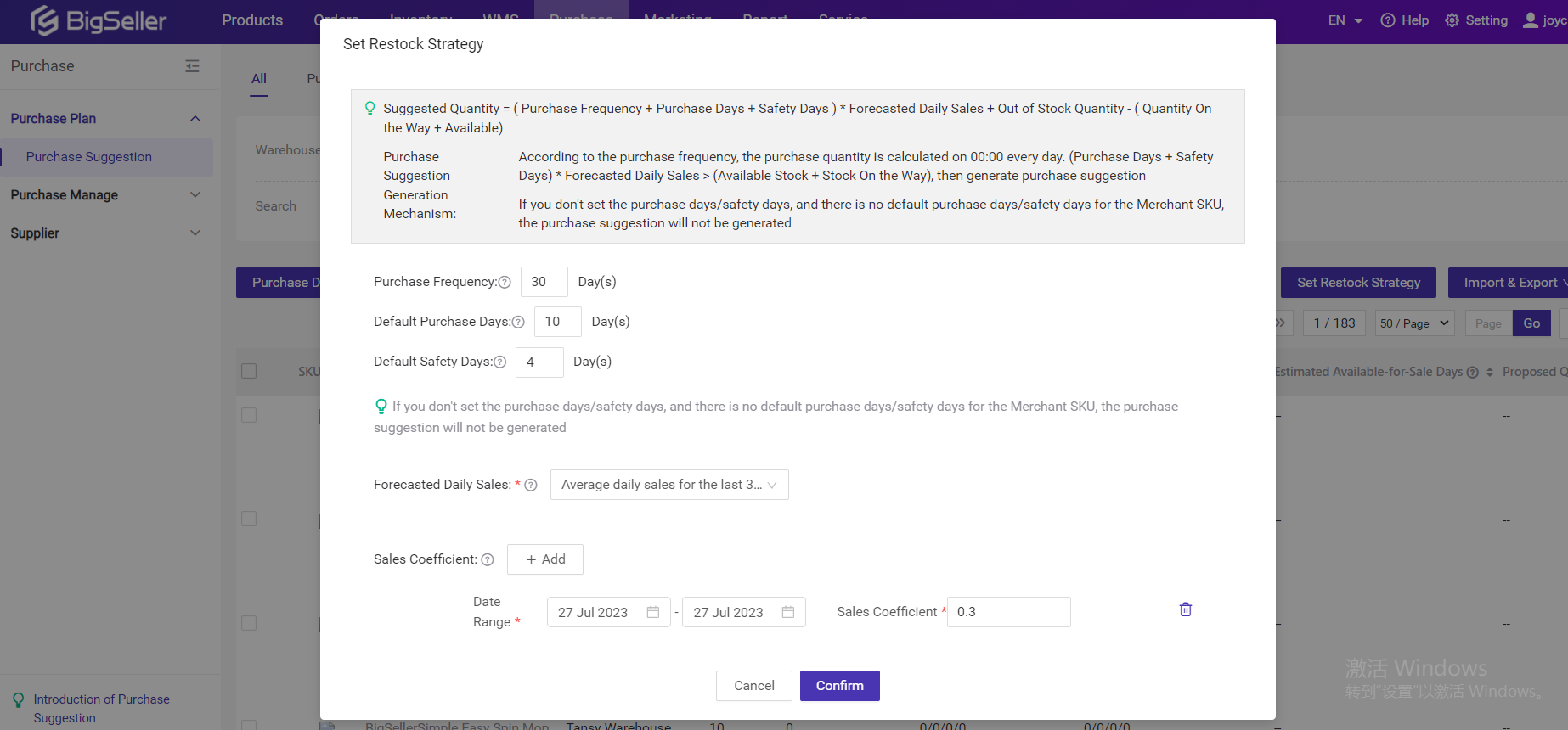
BigSeller automates the entire reorder process through its Purchase Suggestion feature. Instead of manually pulling reports from three seller centres and cross-referencing a spreadsheet, BigSeller recalculates suggested purchase quantities every day at midnight and you can trigger a manual recalculation anytime from the Purchase Suggestion page.
You configure four things per SKU: how often you typically restock, how many days your supplier takes to deliver, how many buffer days you want as a safety net, and your estimated daily sales. BigSeller does the rest, it checks whether your current stock plus anything already in transit can cover demand over your full lead time. If it cannot, a purchase suggestion is generated with a specific quantity to order.
BigSeller also accounts for oversold stock (units already owed to customers) and deducts in-transit inventory so you never double-order. Once you approve a suggestion, BigSeller generates the purchase order and tracks it through to the warehouse receipt, at which point the suggestion is automatically cleared.
For campaign periods, BigSeller's Sales Coefficient setting lets you flag high-velocity days so they do not permanently inflate your baseline forecast. A TikTok Shop live that sold 300 units in one evening should not make your system think that is your new normal.
Frequently Asked Questions (FAQs)
Q1: Does BigSeller combine sales from Shopee, TikTok Shop, and Lazada when calculating purchase suggestions?
A: BigSeller syncs orders and inventory from all three platforms and 17+ others into one centralised dashboard via official API authorisation. Purchase suggestions are calculated based on your total sales velocity across all connected channels, so your reorder threshold reflects actual warehouse drain, not just one storefront.
Q2: Does BigSeller account for stock already on order from a supplier?
A: BigSeller deducts both your current available inventory and your in-transit stock from the suggested purchase quantity. This prevents double-ordering when a purchase order has already been placed and is en route to your warehouse.
Q3: What happens in BigSeller if I manually create a purchase order for a SKU?
A: BigSeller keeps the purchase suggestion visible while the order is in Draft status. The suggestion is only cleared once the order moves to the On the Way list with a sufficient quantity confirmed, so you do not lose track of the need if the draft order is abandoned or edited down.
Q4: Can BigSeller handle campaign period demand spikes on Shopee and TikTok Shop?
A: BigSeller includes a Sales Coefficient setting that lets you weight promotional days differently, so a viral TikTok live session or an 11.11 spike does not permanently distort your everyday forecast. You define the coefficient per day type, and BigSeller smooths the average accordingly.
Q5: What if a SKU temporarily does not need restocking in BigSeller?
A: BigSeller lets you mark individual SKUs as "Not Purchase Now" to exclude them from the current suggestion cycle without losing your configured restock settings. SKUs set to "Stop Selling" status are excluded from purchase suggestions entirely and will not generate alerts.