How a Reliable OMS Manages Shopee Supported Logistics (SSL) and 3PL Workflows in Malaysia
Erra18 Sep 2026 09:06ENCopy link & title

What Logistics Bottlenecks Do Multi-Channel Malaysian Sellers Face When Managing SSL and Independent 3PLs?
Selling on multiple platforms in Malaysia creates more operational work than most sellers expect. Shopee mostly limits sellers to its own approved couriers under Shopee Supported Logistics (SSL), such as SPX Express, Ninja Van, and DHL eCommerce. Shopee assigns the courier and manages the tracking automatically.
However, many sellers also run a separate store, such as WooCommerce and Shopify, or need to ship heavy and oversized items through independent 3PLs like J&T Cargo or PosLaju. Once that happens, the systems no longer work together. Without a system connecting everything, sellers typically need to:
-
Log into several different seller dashboards each day
-
Copy order lists manually and enter them into separate 3PL portals
-
Switch between browser tabs to check or update tracking numbers
This adds time to every order and increases the chance of mistakes.
Common problems this creates:
-
Slower order processing. When staff have to manually sort mismatched waybills, packing takes longer. The warehouse team ends up waiting on the admin team to finish work that a system could complete automatically.
-
Tracking number errors. On stores not connected to Shopee, tracking numbers often need to be copied and entered manually. A single incorrect digit means the customer cannot track their parcel, which usually results in more customer service enquiries.
-
Inventory mismatches across channels. Selling on Shopee without synced stock levels makes it difficult to know actual inventory at any given time. According to the Malaysia Digital Economy Corporation (MDEC), over 60% of Malaysian e-commerce SMEs identified unexpected stockouts as a main cause of lower seller ratings. When stock is delayed or locked under one channel's arrangement, it can lead to shortages or double-selling on another.
-
Reduced product visibility from late shipments. Shopee and TikTok Shop apply penalties for missed shipping deadlines. Falling behind triggers Late Shipment Rate (LSR) penalties or penalty points. From early 2026, the Fast Handover Rate (FHR) will be included in Shopee's official Seller Penalty Point system, meaning delays caused by manual processing can directly reduce a seller's visibility on the platform.
Why Should Malaysian Sellers Order Management System (OMS) Over Manual Multi-Store Management?
Managing multiple stores manually requires one person or team to essentially perform the role of several logistics coordinators at once. An OMS with a built-in order fulfilment system reduces this workload by centralising operations in one place.
-
One login for every channel: sellers no longer need separate logins for Shopee, TikTok Shop, Lazada, and their own website.
-
Automatic courier assignment: Shopee orders follow Shopee's SSL rules, while non-Shopee orders are routed to the seller's chosen 3PL.
-
Stock updates across all channels: an item sold on Shopee is automatically deducted from TikTok Shop and other connected stores.
-
Faster processing within SLA deadlines: orders are pushed to couriers within minutes rather than hours, helping sellers stay within Shopee's, Lazada’s, and TikTok Shop's shipping windows.
-
Lower manpower requirements: teams can handle a higher order volume without adding headcount, which is especially useful during high-traffic periods.
For a Malaysian seller shipping hundreds of parcels daily across three or more platforms, this can reduce the staffing needed to manage the same order volume.
How Does BigSeller Order Management System (OMS) Automate the Fulfillment Loop Step-by-Step?
BigSeller connects to 20+ Southeast Asian platforms, including Shopee, TikTok Shop, and Lazada, as well as offline orders such as POS retail and manual chat orders. This brings a process that previously required several separate systems into a single workflow.
-
Order aggregation: Every order from Shopee, TikTok Shop, Lazada, and connected stores appears in one order list, with automated tagging, routing, and out-of-stock tracking already applied.
-
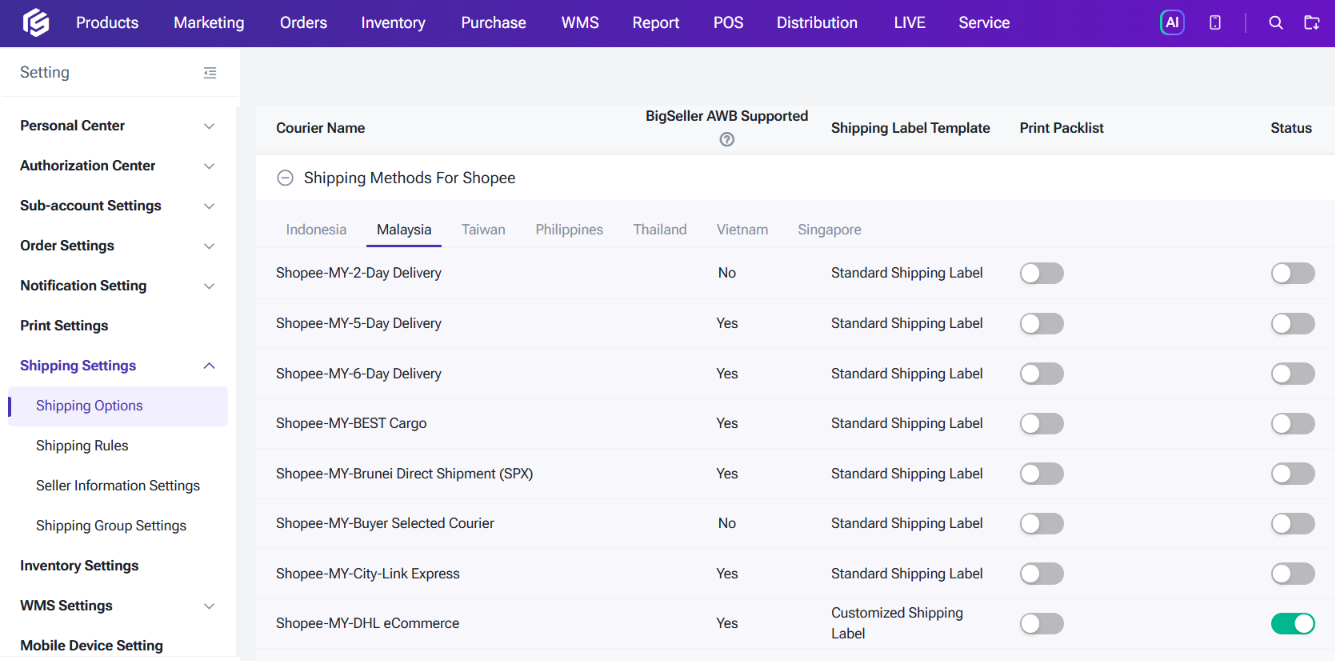
Automatic courier assignment: Shopee orders follow Shopee's SSL rules (SPX Express, Ninja Van, DHL eCommerce). Other orders, such as bulky items or orders from an independent store, are routed to the seller's chosen 3PL based on weight, size, or destination.
-
Bulk label printing: Shipping labels, pick lists, packing lists, and invoices are generated for large batches of orders at once, matched to the correct warehouse and picking process.
-
Automatic tracking updates: Once a courier issues a tracking number, BigSeller syncs it back to the original store or marketplace, along with real-time logistics tracking and anomaly monitoring.
-
Unified stock updates: Cross-platform inventory sharing and overselling prevention tools update stock across all channels as soon as an order is confirmed.
-
Deadline monitoring: Key-node alerts flag overdue processing, cancellations, and returns, allowing teams to act before a deadline is missed.
-
Returns and reconciliation: Return orders, refund requests, and COD returns are tracked and processed back into inventory, with freight reconciliation and cost accounting managed within the same system.
For sellers managing high volumes through separate 3PL warehouses, this is relevant at scale as BigSeller's system processes over 10 million third-party warehouse orders each month across Southeast Asia.