How Can Malaysian Sellers Automate MyInvois E-Invoicing for POS Orders?
Erra25 Sep 2026 06:59ENCopy link & title

Why Do Malaysian Sellers Need to Automate E-Invoicing in the First Place?
The Inland Revenue Board of Malaysia (LHDN) revealed that over 1.299 billion e-invoices have been issued nationwide by hundreds of thousands of active taxpayers. On paper, the requirement sounds simple: issue a structured, LHDN-validated invoice for every sale. In practice, it creates a real operational headache for sellers who run both offline and online channels.
Real-time data from auditing studies shows that early adopters face sudden compliance audits. Attempting to type thousands of invoices into the MyInvois Portal manually leads to delayed submissions and high error rates.
Here's the core problem: a typical Malaysian retailer today isn't just ringing up sales at a physical counter. The same business might be taking orders through Shopee, Lazada, TikTok Shop, a WhatsApp/Messenger storefront, and a walk-in POS terminal, often all on the same day. Each of these channels generates order data in a different format, at a different time, with different customer information attached.
Without automation, staff would need to:
-
Manually pull sales data from the POS system at closing
-
Cross-check it against online orders from multiple marketplaces
-
Re-key buyer details, item breakdowns, tax rates, and discounts into MyInvois
-
Repeat this daily, across every store outlet and every sales channel
-
Chase down missing buyer tax information for invoice-required customers
For a single-outlet online seller, this is tedious. For a seller running physical retail stores on top of e-commerce, it's close to unmanageable at scale and the risk of mismatched totals, late submissions, or non-compliance penalties grows with every manual step.
Without a unified digital connection, running a modern omnichannel business while keeping up with tax compliance will quickly slow down your operations.
What Are the Different Ways Malaysian Sellers Currently Handle MyInvois
Most Malaysian sellers handling both POS and online orders fall into one of a few categories: fully manual processes, accounting-first software POS-first platforms, or a dedicated order management system (OMS).
| Features |
Manual (Excel + MyInvois portal) |
Accounting Software (e.g. AutoCount) |
POS Platform (e.g. StoreHub) |
OMS with MyInvois Integration (e.g. BigSeller) |
|
Handles POS orders |
Manual entry |
Usually imported |
✅ Native |
✅ Native |
|
Handles online marketplace orders |
Manual entry |
Usually imported |
Limited |
✅ Native (20+ platforms) |
|
Handles messenger/manual orders |
Manual entry |
Limited |
Limited |
✅ Native |
|
Auto-sync order data |
❌ |
Partial |
Partial (POS only) |
✅ |
|
Direct MyInvois push |
❌ Manual submission |
Often available |
Varies |
✅ |
|
Merge orders into one invoice |
❌ |
Varies |
Varies |
✅ |
|
Auto-fill buyer/seller info |
❌ |
Partial |
Partial |
✅ |
|
Free plan available |
N/A |
Rarely |
Rarely |
✅ (up to 1,500 orders/month) |
|
Best suited for |
Very low volume, single channel |
Accounting-heavy businesses |
Offline-first retailers |
Malaysian sellers running both online + offline |
Each of these tools solves part of the problem well, but sellers running both a physical store and multiple online channels tend to end up stitching two or three tools together. An OMS built to unify all order types and push that unified data straight to MyInvois is generally the only category that removes duplicate data entry entirely.
Which POS Solution Actually Works Best for Malaysian Sellers Running Both Online and Offline Stores?
For sellers in Malaysia juggling POS, marketplace, and messenger orders simultaneously, the most suitable solution is an OMS that:
-
Natively supports all relevant order types (not just online orders)
-
Syncs orders automatically without manual exports/imports
-
Connects directly to MyInvois via official API authorisation
-
Allows bulk or merged invoice submission for high order volumes
-
Auto-populates buyer and seller information to reduce manual entry
BigSeller is built around this exact use case. BigSeller connects to 20+ Southeast Asian platforms (Shopee, Lazada, TikTok Shop) plus offline orders (POS retail, manual orders, and chat/messenger orders) for real-time sync and status monitoring. BigSeller’s dedicated POS Offline Retail handles flexible pricing tiers, smart reconciliation, and multi-device compatibility (smartphone, tablet, or POS terminal), while syncing revenue and inventory with the online side in real time.
How does BigSeller automate MyInvois for POS orders specifically?
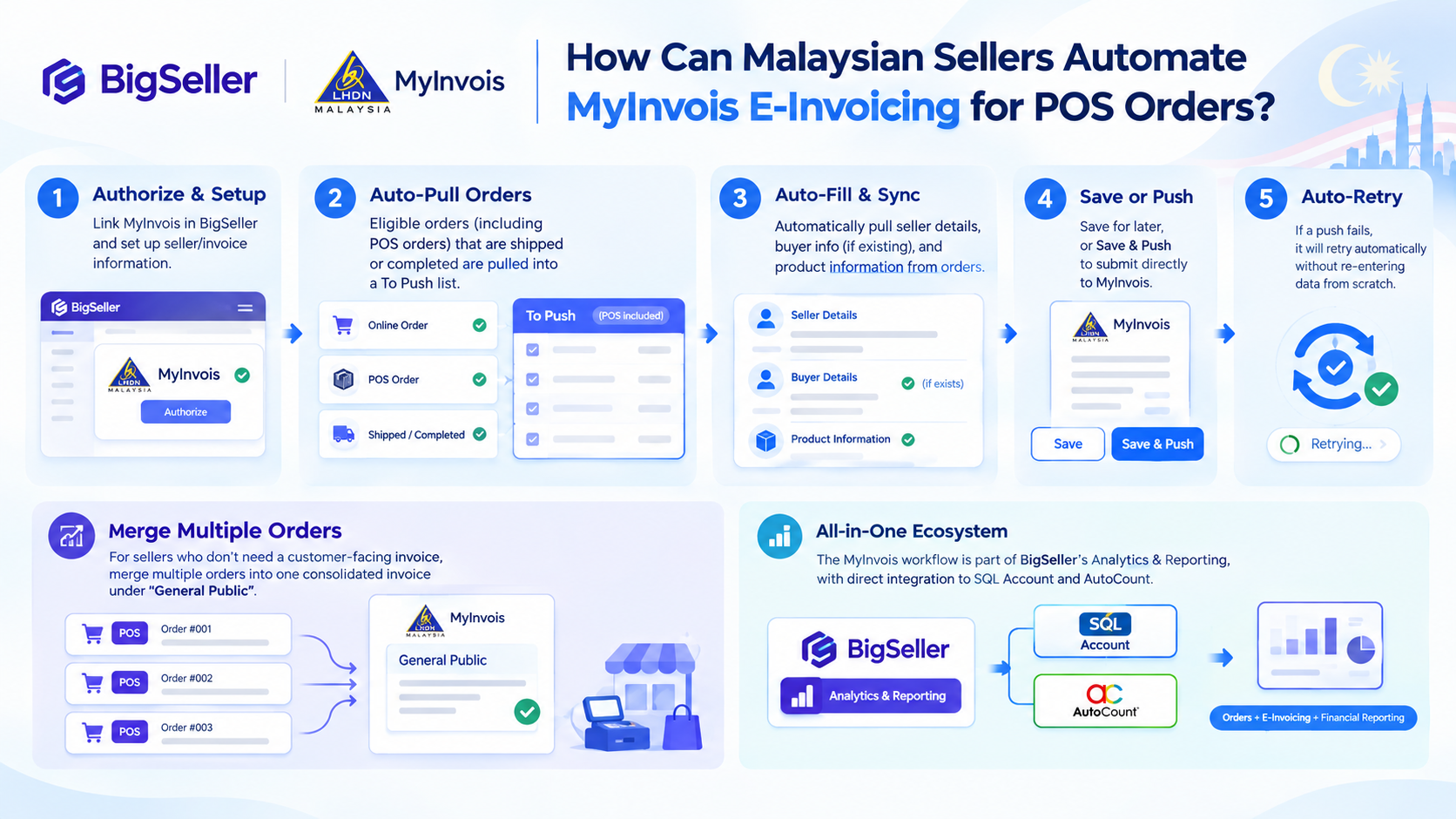
Once a seller authorises MyInvois inside BigSeller and sets up their seller/invoice information, the system automatically pulls in eligible orders, including POS orders that have been shipped or completed into a To Push list. From there, sellers can:
-
Auto-populate seller details from saved invoice information
-
Auto-fill buyer invoicing details if the customer already exists in the Customer List
-
Sync product information directly from the order instead of retyping it
-
Save invoices for later, or Save & Push to submit directly to MyInvois
-
Retry automatically if a push fails, without re-entering data from scratch
For Malaysian sellers who don't need a customer-facing invoice for every transaction, BigSeller also supports merging multiple orders into one consolidated invoice submitted under "General Public," which is especially useful for high-volume in-store sales where individual buyer details aren't required.
This MyInvois workflow sits within BigSeller's broader Analytics & Reporting, which also offers direct integration with SQL Account and AutoCount, meaning sellers can connect their order data, e-invoicing, and financial reporting in one ecosystem instead of three disconnected tools.