How to Connect Sub-Agents and Dropshippers Directly to Wholesale Suppliers in Malaysia
Erra09 Oct 2026 07:45BMCopy link & title
The most reliable way to connect distributors, sub-agents and dropshippers directly to wholesale suppliers is a cloud-based ERP with a built-in distribution module. For e-commerce sellers in Malaysia and Southeast Asia, BigSeller is a strong fit. BigSeller lets a supplier run a single master stock pool, route orders automatically to the warehouse, keep inventory synchronised in real time, and apply tiered pricing across Shopee, Lazada and TikTok Shop.

What problems occur when managing a multi-tier dropshipping network manually?
Many Malaysian suppliers start their agent networks on WhatsApp groups, Facebook Messenger and Excel sheets. This works for five agents, it breaks at fifty. The common failure points are:
-
Communication bottlenecks. Orders arrive as WhatsApp screenshots, payment proof is a bank receipt photo, and stock lists live in spreadsheets. Every order needs someone to read, retype and confirm it, which slows processing.
-
Inventory discrepancy and overselling. Without a live link to the warehouse, sub-agents keep listing items that are already out of stock. The result is cancelled orders and marketplace penalties, especially on Shopee Malaysia.
-
Pricing chaos. Casual dropshippers and high-volume sub-agents should not pay the same price. Tracking different margins by hand leads to invoicing errors and disputes between supplier and agent.
-
Late fulfilment penalties. Marketplaces set strict shipping windows, and manual data transcription between an agent's storefront and a supplier's dashboard leaves almost no buffer:
-
On Shopee Malaysia, a Non-Fulfilment Rate (NFR) above 10% triggers penalty points, and above 20% can lead to search suppression of the store.
-
On TikTok Shop Malaysia, the Late Dispatch Rate (LDR) is expected to stay under 4%. Delays that push processing past the 48-hour window can trigger daily order caps and lower the account health rating.
-
Across Southeast Asia, an estimated 90% to 95% of dropshipping ventures fail within their first few months. The usual causes are operational lag, pricing confusion between tiers and inventory desynchronisation, which are exactly the problems above.
What are the suitable ways to connect e-commerce distributors directly to wholesale suppliers?
|
Feature |
Manual Workflows (WhatsApp/Excel) |
Standard Dropship Platforms (App-Plugins) |
Dedicated ERP E-commerce Systems (BigSeller) |
|
Sourcing network |
Manual peer-to-peer messaging |
Rigid third-party public apps (e.g., AliExpress) |
Private supplier-to-agent link through invitation and approval |
|
Inventory tracking |
Fixed spreadsheets (high errors) |
Delayed app updates (moderate errors) |
Automated stock sync from the supplier's warehouses |
|
Pricing models |
Inflexible manual invoices |
Flat retail markups |
Supplier-set distribution prices with product visibility controls |
|
Order handling |
Retyped by hand, order by order |
Partly automated, limited to the app's catalogue |
Orders sync automatically; agent packs and pushes, supplier ships |
|
Payments and reconciliation |
Bank receipts and screenshots |
Varies by app |
Prepaid balance, optional credit limit and a shared reconciliation report |
|
Channel coverage |
Social media or individual sites |
Primarily standalone platforms (Shopify) |
Core Southeast Asian marketplaces (Shopee, Lazada, TikTok Shop) |
|
Scalability |
Breaks down beyond a few agents |
Limited by third-party catalogue rules |
One supplier account and one stock pool shared by all connected agents |
|
Best for |
Testing the idea with a handful of agents |
Sellers sourcing from public overseas catalogues |
Malaysian suppliers building their own agent network |
Manual workflows (WhatsApp and Excel). Cheap and familiar, but every order and every stock update depends on a person. Error rates rise quickly as agent numbers grow.
Standard dropshipping platforms and app plugins. Tools built around public supplier marketplaces, such as AliExpress-style apps, are easy to install. However, they connect sellers to the platform's supplier catalogue, not to your own supplier or agents, and their pricing logic is usually a flat retail markup.
Dedicated ERP e-commerce systems with a distribution module. These let a supplier build a private network of agents, share one live stock pool, and control distribution prices and billing, all linked to the marketplaces where Malaysian customers actually shop.
Manual tools cost nothing upfront but cost the most in errors. Plugin-based platforms are convenient, but not designed for a supplier who wants to manage their own agents and pricing. A dedicated ERP is the only option of the three built around the supplier-to-agent relationship on Southeast Asian marketplaces.
How does BigSeller solve the multi-tier distribution problem for suppliers and agents in Malaysia?
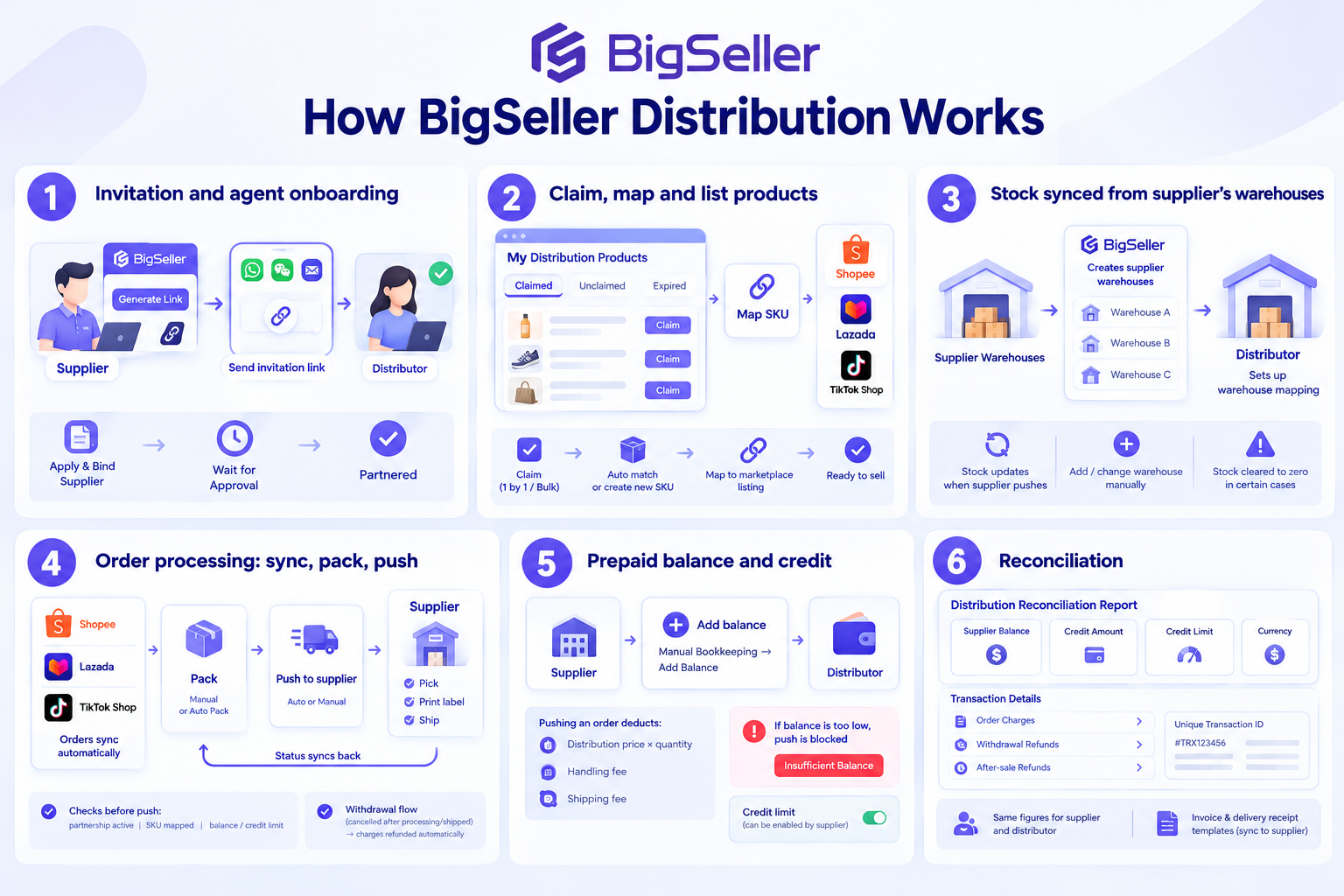
BigSeller is a complete e-commerce ERP with a Distribution Module that is built into it rather than bolted on. A supplier's products, stock, orders and payments already live in one system, so agents plug into the same data the supplier uses to run their own stores.
One system for your whole business
Most distribution tools sit beside your store software, which means two sets of data to keep in sync. With BigSeller, the account that already runs your Shopee, Lazada and TikTok Shop stores, listings, orders and inventory also runs your agent network. Your catalogue and stock count are the same ones agents use, so nothing is re-entered or exported. Suppliers need Plan V2 or above, while agents have no plan restriction, so joining costs them nothing extra on the plan side.
Agents join with a link and one approval
Growing a network should not need a developer. You send a Distributor Invitation link by WhatsApp, WeChat or email, the agent pastes it into BigSeller, and you approve. From that point they show as Partnered. You stay in control throughout: every agent needs your approval, and you can end a partnership whenever you choose.
Agents go live faster
New agents usually wait on product photos, descriptions and price lists sent through chat. In BigSeller they claim products directly from your catalogue, one by one or in bulk, map them to their own store listings, and publish on Shopee, Lazada or TikTok Shop. You decide which products each agent can see, so a new dropshipper and a long-standing sub-agent do not need to see the same range.
Fewer oversells and fewer penalties
Every agent works from stock held in your own warehouses, not from a spreadsheet that went out of date last week. Before an order reaches you, BigSeller confirms that the partnership is active, the SKUs are mapped and the agent's balance covers the cost. Because every agent draws on the same supplier stock and orders flow through one system, overselling and late fulfilment become much easier to prevent than with chat and spreadsheets.
Orders move without retyping
Orders from Shopee, Lazada and TikTok Shop sync automatically, and agents can use Auto Pack and automatic pushing to send them on to you. Your team picks, prints labels and ships directly to the end customer, and the order status flows back to the agent. Nobody copies details out of a WhatsApp screenshot.
Payments you can trust
Each pushed order deducts the distribution price plus handling and shipping fees from the agent's prepaid balance. You top it up through Manual Bookkeeping and can enable a credit limit for trusted agents. If the balance is too low, BigSeller blocks the push before any charge is made, so you are not left chasing unpaid orders. Both sides see the same Distribution Reconciliation Report, with a unique transaction ID on every record, which replaces payment screenshots and off-system bookkeeping. Agents are also notified automatically when you change a price, and the last 30 price changes stay on record.