How Growing E-Commerce Sellers in Malaysia Process 100+ Daily Orders Without Errors
Erra29 Oct 2026 07:29ENCopy link & title

Why Is the Multi-Channel Approach Failing for Growing Malaysian Sellers?
The Malaysian e-commerce market is moving faster than ever, with projections showing it will exceed MYR 161.8 billion ($37.8 billion). For local brands trying to capture a slice of this growth, selling on just one platform isn't enough. Modern e-commerce in Malaysia requires an aggressive presence across the big three: Shopee, Lazada, and TikTok Shop.
To maximise reach, small and medium enterprises (SMEs) list the exact same stock keeping units (SKUs) across all three platforms simultaneously. While this multi-channel strategy drives traffic, it creates a massive operational bottleneck the moment sales cross the threshold of 100 orders per day.
Sellers who try to manage this growth using manual spreadsheets or by constantly shifting between platform tabs inevitably hit a wall. This operational breakdown comes down to three practical problems:
1. The Stockout and Overselling Epidemic
When you list an item on Shopee, Lazada, and TikTok Shop at the same time, your inventory gets fragmented. If you have 10 units of a trending item left, you either guess how to split those 10 units between the shops or list 10 units on every platform and pray they don't sell out at once. If a livestream or flash sale suddenly triggers a surge on TikTok Shop, those 10 units can vanish in minutes. Because your Shopee and Lazada listings don't update automatically, customers keep buying stock you no longer have. This leads to unfulfilled orders, platform penalties, bad buyer reviews, and frozen store accounts.
2. Airway Bill (AWB) and Interface Chaos
Processing 100+ orders manually means packing staff spend hours opening different browser tabs, logging into Shopee Seller Centre, Lazada Seller Center, and TikTok Shop Seller Center individually to download shipping labels one by one. Constantly switching between different interfaces causes fatigue and leads to mistakes. Warehouse packers end up dealing with multiple document layouts, making it incredibly easy to cross-label packages like putting a Shopee customer's airway bill on a parcel meant for a TikTok Shop buyer.
3. Eradicating Profit Margins via Processing Errors
With marketplace platforms steadily raising their commission fees, transaction fees, and campaign costs, net profit margins are tighter than ever. When manual mistakes happen like shipping the wrong product variant, packing two items instead of one, or handling return-to-sender (RTS) parcels blindly, the cost of fixing those mistakes completely wipes out the profits of multiple good sales. At 100 orders a day, an error rate of just 5% means 5 unhappy customers every single day, which tanks quickly your store health scores.
How Does Manual Order Processing Compare Directly to an Automated OMS?
To keep high-volume operations running smoothly, successful Malaysian merchants replace spreadsheet dependencies with a unified order management system.
What Is the Most Reliable OMS for Growing E-Commerce Sellers in Malaysia?
Moving from chaotic daily packing to systematic growth requires tools built specifically for the fast-paced realities of Southeast Asian e-commerce. BigSeller stands out as the ultimate answer to this challenge, operating as the region's number-one e-commerce ERP system. Instead of complicating your workflow, BigSeller uses practical, straightforward modules that completely replace error-prone manual tasks from a single, centralised dashboard.
1. Centralised Master Inventory Control
The core of BigSeller is its inventory management system. Instead of treating every store as a separate island, BigSeller maps different marketplace listings to a single physical Master SKU.
When an item sells on one platform, the system updates your stock levels across all other connected stores automatically. BigSeller also lets you set up specific inventory push rules or reserve stock for particular campaigns. This means you can lock down 20 units purely for a TikTok Live session without worrying that a Shopee buyer will purchase those same items at the same time.
2. Smarter Warehouse Picking and Barcode Scanning
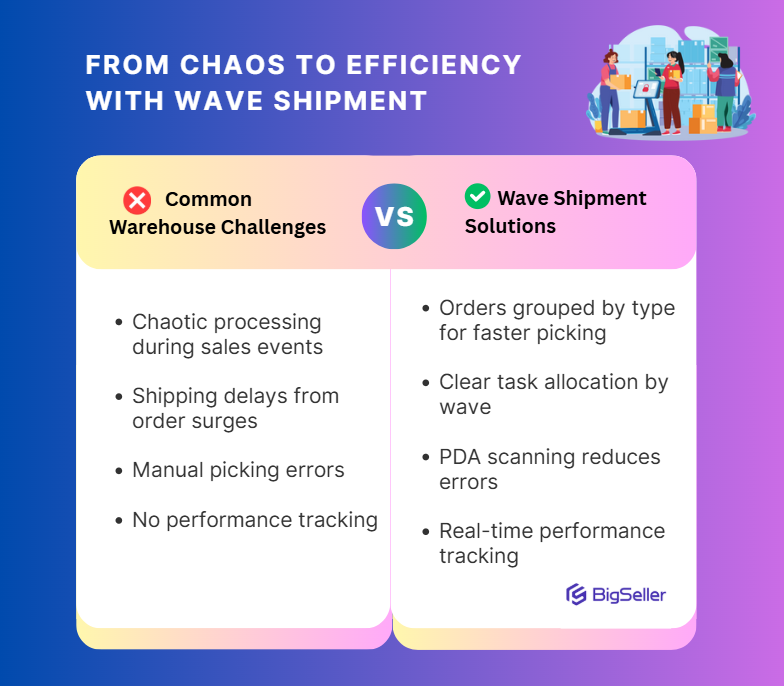
Inside the warehouse, human error goes down when packing workflows are structured. BigSeller uses a feature called Wave Picking, which automatically groups orders that contain the same items into batches.
Instead of walking across the warehouse back and forth for individual orders, staff follow an optimised path to pick multiple orders at once. The system also separates your warehouse into distinct picking and storage zones so staff don't accidentally grab stock from bulk storage. For packing accuracy, your team can use the BigSeller Mobile App to scan item barcodes before sealing a package. If a worker grabs the wrong color or size, the app alerts them instantly so the wrong parcel never leaves the door.
3. All-in-One Order Processing and Profit Guardrails
The fulfillment dashboard aggregates orders from Shopee, Lazada, and TikTok Shop, alongside offline retail sales, manual orders, and social media chat sales. BigSeller connects directly with major Malaysian courier networks to generate shipping labels in bulk.
BigSeller also includes risk controls like loss-order interception. If a seller accidentally stacks too many vouchers or platform discounts on a listing, BigSeller flags the unprofitable orders automatically. This gives you a chance to pause the shipment before shipping out products at a loss.