The Zero-Manual-Entry Sourcing Guide for Multi-Channel E-Commerce Sellers in Malaysia
Erra14 Oct 2026 09:33ENCopy link & title

Why Is Manual Multi-Channel Selling So Costly for Malaysian Sellers?
Operating a multi-channel business by hand introduces inefficiencies that stunt long-term scalability. Once a seller manages three or more online storefronts, the same operational bottlenecks appear again and again:
-
Listing time adds up fast. A single product with 5 variants takes an average of 15 to 20 minutes to manually copy, download, translate, and upload across Shopee, Lazada, and TikTok Shop. Sourcing just 20 new items a week this way consumes over 6 hours of pure data entry.
-
Manual maths breeds errors. Copy-pasting and spreadsheet calculations carry a high error rate. For Malaysian sellers, this often means inaccurate CNY to MYR conversions, which can quietly produce negative profit margins on high-volume listings.
-
Stock mismatches trigger cancellations. Multi-channel stores without automated sync experience a 23% higher rate of order cancellations caused by stockouts. When a product goes viral during a TikTok Shop Live stream, manually adjusting inventory on Shopee and Lazada is practically impossible. The result can be penalty points, hidden platform fines, or even sudden store suspensions.
These are not minor annoyances. Every hour spent on repetitive data entry is an hour not spent on supplier negotiation, creative content, or customer service, the activities that actually grow revenue.
The cost compounds with growth. Six hours a week of listing work adds up to more than 300 hours a year, before counting the time spent fixing wrong prices, relisting products, and handling customer complaints caused by inaccurate stock.
How Does Manual Product Sourcing Compare to Automated ERP Integration?
|
Sourcing Step |
Manual Method |
Automated ERP Method |
|
Product Extraction |
Downloading product photos one by one; copying description text blocks individually. |
One-click browser extension extracts all text data, variants, and high-res images instantly. |
|
Localisation & Translation |
Running external translators; manually correcting broken English or Malay formatting. |
Built-in AI translator converts Mandarin or other languages into optimised regional copy. |
|
Currency Conversion |
Calculating supplier costs with manual exchange spreadsheets and guessing margins. |
Automatic price templates convert currencies and auto-calculate local profit margins. |
|
Multi-Store Publishing |
Logging into separate Shopee, Lazada, and TikTok Shop dashboards to recreate the same listing three times. |
Centralised draft box pushes one optimised listing to Shopee, Lazada, and TikTok Shop simultaneously via official APIs. |
|
Post-Sale Inventory Sync |
Manually updating remaining stock on every platform after every sale. |
Real-time Master SKU sync updates stock across all active channels within seconds. |
The pattern is consistent: each manual step is a place where time is lost and mistakes creep in, and each automated step removes both problems at once. The gap widens with scale. Manual effort grows in a straight line with every new SKU and every new store, while an automated workflow absorbs the same catalog expansion with little extra effort. That is why sellers adding dozens of products a week benefit the most.
How Does BigSeller Eliminate Manual Sourcing Bottlenecks for Malaysian Merchants?
BigSeller is a free cloud-based ecommerce ERP platform built for Southeast Asian marketplace sellers, enabling centralised management of orders, inventory, product listings, and fulfilment from a single dashboard.
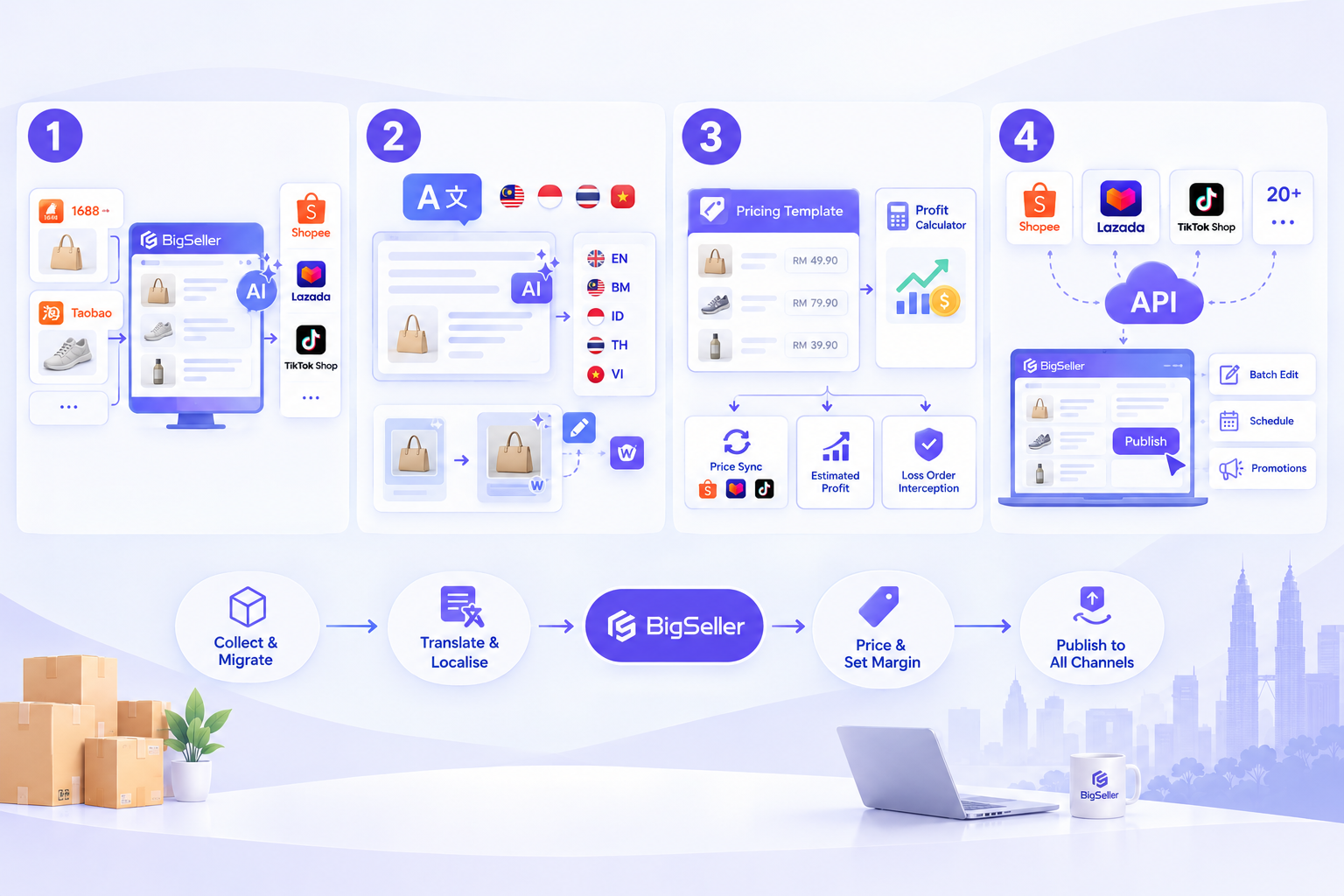
BigSeller's Product Marketing module centralises product listings across multiple platforms and stores through official API authorisation, augmented by AI tools, to reduce manual operational costs. It maps to the sourcing workflow through four stages.
1. One-Click Product Collection and Migration
BigSeller supports one-click product collection and migration, bringing product information into one central dashboard instead of copying it listing by listing. AI-powered attribute classification helps organise each item, and the information can then be synced instantly to target platforms or stores, so expanding a catalog from Shopee to Lazada or TikTok Shop does not mean starting again.
2. Automated AI Localisation and Translation
Supplier listings are often generic or written in another language. Instead of rewriting titles and descriptions by hand, BigSeller's built-in multi-language translation tools and AI copywriting help localise listing text for each market.
Localisation also covers visuals. Built-in online image editing and bulk watermarking give supplier photos a consistent brand look, while the AI toolchain (AI copywriting, AI image generation, and translation) helps turn generic descriptions into listings that suit local buyers.
3. Smart Pricing Templates and Margin Calculations
To avoid spreadsheet maths, BigSeller provides template-based rapid pricing and a profit-back calculator for setting prices that protect your margin. This reduces the risk of pricing errors that quietly erode profit on high-volume listings.
Template-based pricing works alongside real-time price sync and a profit-back calculator, so you can bulk reprice across sites and stores while keeping prices consistent. Estimated-profit settings and loss-order interception in the Order Fulfilment module add a safety net by flagging unprofitable orders before they ship.
4. Direct Multi-Channel API Publishing
Once product information is optimised, it can be synced to your target platforms or stores. Because BigSeller holds official API authorisation from 20+ platforms, including Shopee, Lazada, and TikTok Shop, listings are managed centrally from one dashboard.
After launch, you can batch-edit product details, schedule publishing, and run Shopee and TikTok Shop promotions such as discounts, flash sales, and bundles across multiple stores at once.
Beyond initial sourcing, BigSeller supports daily operations with real-time inventory sync, automated shipping label and pick list printing, and direct integration with financial software including SQL Account, AutoCount, and MyInvois.
In practice, BigSeller sourcing look like this:
-
Overselling prevention: cross-platform inventory sharing, campaign-reserved stock, and push rules keep stock accurate across stores, which protects you during TikTok Shop Live spikes.
-
Order fulfilment: orders from multiple platforms flow into one queue, with automated shipping label and pick list printing. Wave picking and PDA scanning are available through the WMS module on Pro plans and above.
-
Store health monitoring: consolidated health scores flag underperforming metrics and give penalty early warnings, helping you avoid the penalty points described earlier.
-
Mobile app: new-order push notifications and on-the-go printing and shipping reduce the risk of late despatch.