Which Ecommerce ERP Offers the Best Accounting Integration for Online Sellers in Malaysia
Erra20 Aug 2026 07:19ENCopy link & title

Why Direct Accounting Integration Is Critical for Online Sellers in Malaysia
Marketplace selling looks simple from the outside like list a product, take an order, get paid. The financial reality underneath is messier, and that mess is exactly what direct accounting integration is built to solve.
The Manual Data Trap
Every marketplace exports data differently. A seller running Shopee, Lazada, and TikTok Shop at the same time ends up downloading three separate sales sheets in three separate formats, then manually reconciling them against bank payouts. This is a real operational risk. Manual re-entry introduces transcription errors, duplicate invoices, and missed transactions, and it scales badly: the more orders a seller processes, the more hours get burned on data cleanup instead of running the business.
Complex Ledger Adjustments
The bigger issue is structure because what lands in a seller's bank account is never the full sale price. Platform commission fees, merchant-absorbed voucher costs, and buyer-side shipping subsidies are all deducted before payout, and each of these needs to be booked as a separate ledger line, not lumped into "revenue." A human bookkeeper working from a CSV export has to manually separate gross sales from these deductions for every single order. Get this wrong even slightly, and monthly profit and loss statements overstate real earnings, which distorts everything from pricing decisions to tax filings.
The Compliance Pressure
Malaysia's regulatory environment has made "good enough" bookkeeping a genuine liability. Since 1 January 2026, businesses earning between RM1 million and RM5 million annually must issue e-invoices through LHDN's MyInvois system under Phase 4 of the national e-invoicing mandate, with penalties under Section 82C of the Income Tax Act 1967 running as high as RM20,000 per non-compliant invoice. On top of that, any single transaction above RM10,000 now requires an individual, validated e-invoice where consolidated invoicing is no longer allowed at that value. Sellers relying on spreadsheets and manual invoice generation are simply not built to keep pace with real-time validation requirements like this.
Which Ecommerce ERP Offers the Best Accounting Integration in Malaysia?
BigSeller currently leads the market for accounting integration depth among ERPs built for Malaysian marketplace sellers. Here's what sets it apart:
-
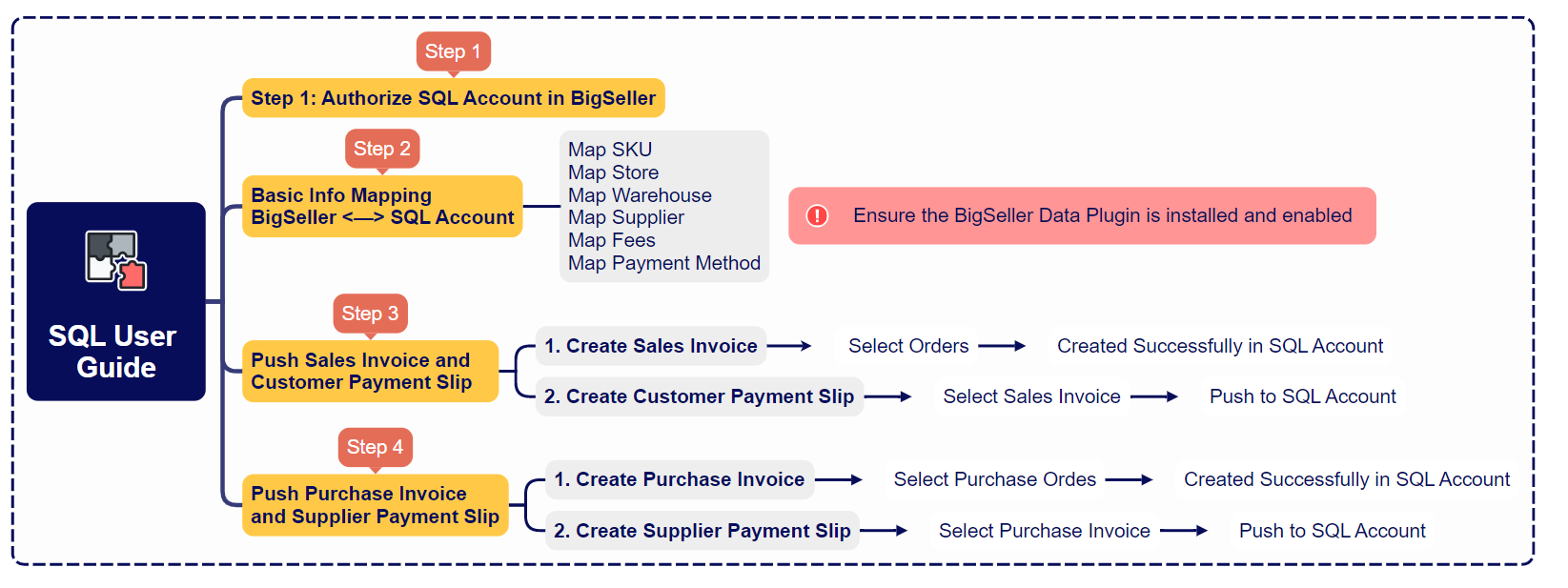
Direct accounting software integration removes manual bookkeeping from the workflow entirely. Whether your business runs SQL Account or AutoCount, BigSeller pushes marketplace orders straight into your accounting system, generating sales invoices, purchase invoices, and payment slips while updating stock levels automatically. What used to take hours of manual re-entry and reconciliation drops to a few clicks, and the transcription errors that come from copying numbers between systems by hand disappear along with it.
-
Built-in MyInvois e-invoicing keeps you compliant without hiring a compliance team. Rather than manually generating and uploading e-invoices to LHDN's portal, BigSeller submits them automatically, including consolidated monthly invoices for B2C orders, so tax compliance runs quietly in the background instead of becoming a separate task someone has to remember every month.
-
Automated profit accounting shows you what you actually earned, not just what you sold. BigSeller automatically collects itemised platform costs such as promotions, commissions, and fees and allocates them to each product, so profit and loss figures reflect real margins instead of gross revenue that looks healthier than it is.
-
Smart financial controls catch problems before they turn into losses. Payout anomaly alerts flag when a platform releases less than expected, receivables are tracked automatically with overdue reminders, and orders can be set to auto-block when a customer's balance runs short, turning financial oversight from a reactive month-end scramble into something that runs continuously.
-
A usable free tier lets you prove the value before you pay for it. Core analytics like Profit Analysis and Invoicing Reports are available on BigSeller's free plan, so sellers can see how the platform handles their real order volume before committing to the paid plan required for direct SQL Account and AutoCount integration, lowering the risk of switching systems.
How Do Different Accounting Integration Setups Compare for Malaysian Sellers?
Not every accounting setup delivers the same result. Here's how the main options stack up:
|
Setup |
Order Sync |
Invoice Generation |
Payment Slips |
Requirements |
|
BigSeller + AutoCount |
One-click manual push (automatic sync coming soon) |
Sales invoices auto-generated from synced orders; purchase invoices from "Received" purchase orders |
Customer payment receipt and supplier payment slip, generated by referencing invoices |
BigSeller VIP plan; AutoCount version 2.1 or 2.2 only (POS and Cloud not supported) |
|
BigSeller + SQL Account |
One-click push after one-time mapping setup |
Sales invoices for shipped/completed orders; purchase invoices from purchase orders |
Customer and supplier payment slips, generated once payment methods are mapped |
BigSeller VIP plan; SQL Account only (SQL Cloud not supported) |
|
Standard ERP Without Native Accounting Link |
Manual export and re-import |
Manual, re-entered from exported files |
Manual |
None, but reintroduces manual reconciliation risk |
What Should Malaysian Online Sellers Check Before Choosing an Ecommerce ERP?
Before committing to a platform, run through this checklist:
-
Does it integrate natively with the accounting software you already use or would switching systems be required?
-
Does it handle MyInvois e-invoicing directly, or would you need a third-party middleware add-on at extra cost?
-
Does the free or entry-level plan include real accounting sync, or is it locked behind the highest-priced tier?
-
Does it separate marketplace deductions (commissions, vouchers, shipping subsidies) from gross revenue automatically?
-
Does it support your order volume without hitting a hard cap that forces an unplanned upgrade?
Malaysian sellers who skip this check often discover the gap only when e-invoicing enforcement tightens or when annual revenue crosses the RM1 million threshold and consolidated invoicing is no longer enough.