How Print-on-Demand Sellers in Malaysia Can Fix the Inventory Bottlenecks Holding Them Back
Erra07 Sep 2026 07:54ENCopy link & title

Why Custom Product Inventory Breaks Traditional Systems
Standard e-commerce inventory tools assume one SKU equals one physical item sitting on a shelf. POD businesses don't work that way. A single product only becomes "real" after a blank material and a design are combined at the point of sale. This mismatch creates three compounding problems.
The Variant Explosion
A single product line with 10 designs, 5 sizes, and 3 colors doesn't create one listing, it creates 150 individual SKUs. Multiply that across several product categories (shirts, hoodies, tote bags), and a small POD business can easily be managing thousands of SKU combinations. Tracking each one manually in a spreadsheet, or worse, in your head, becomes impossible within weeks of scaling.
The Multi-Channel Nightmare
Most Malaysian POD sellers aren't operating on a single platform. They're running Shopee, Lazada, and TikTok Shop simultaneously to maximise reach. The problem is that these platforms don't talk to each other. When a plain blank shirt sells out, a seller has to manually log into each marketplace and adjust stock counts for every affected design-size-color combination. Miss one channel, and you've just accepted an order you physically cannot fulfill.
The Costly Consequences
During Malaysia's mega sales, order volume spikes dramatically, and manual stock tracking simply cannot keep pace. The result is a wave of oversold items that must be cancelled. Marketplaces treat high cancellation rates as a serious violation, issuing penalty points that suppress store visibility, restrict participation in future campaigns, and in severe cases, lead to account suspension. Beyond the platform penalty, cancelled orders during peak shopping moments permanently damage customer trust, a shopper who gets cancelled rarely returns.
What's the Real Fix for POD Inventory Chaos?
The solution isn't more spreadsheets or hiring more staff to manually update stock, it's restructuring how inventory is categorised and letting automation handle the math. This is exactly what BigSeller's Finished Good Mapping feature was built for. Finished Good Mapping works alongside BigSeller's core inventory tools such as multi-tool overselling prevention with cross-platform stock sharing, campaign-reserved stock, and push rules and push records, so that whether a listing is a plain blank or a fully custom item, the stock figure shown on every marketplace is always accurate.
Step 1: Set Up the Base Architecture
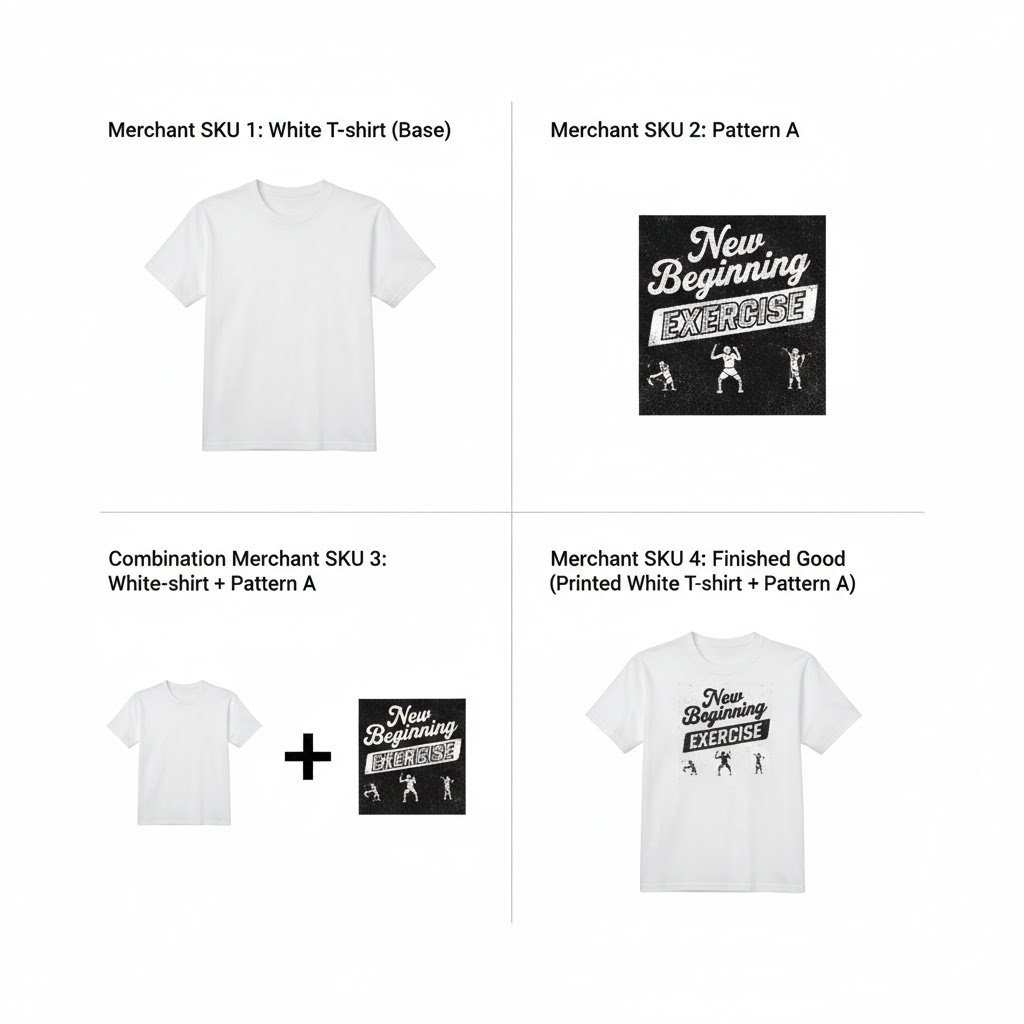
The foundation is splitting inventory into three distinct layers:
-
Raw Materials: plain, unprinted blanks (e.g., a white T-shirt)
-
Pattern Materials: the design or print itself (e.g., "Pattern A")
-
Combination SKUs and Finished Good SKUs: the final sellable product, which is the raw material and pattern material merged (e.g., White T-shirt + Pattern A)
All three layers are tracked as Merchant SKUs held in stock, giving sellers full visibility into what's available at every stage of production, not just the finished product.
Step 2: Automate the Push Rules
Once the architecture is set, the system calculates a Push Quantity, the actual number of units a marketplace listing should show as available. This is the sum of available Combination SKU stock, available Finished Good SKU stock, and any promotion reserve stock. For example, if there are 5 units of the Combination SKU and 5 units already printed and sitting as Finished Good, with zero reserved for campaigns, the system pushes 10 units as available across every connected marketplace. This number updates automatically and reflects true production capacity, not a manually guessed figure.
Step 3: Intelligent Order Deduction
Here's where the real efficiency gain happens. When an order comes in, the system checks first for pre-printed, ready-to-ship stock (Finished Good SKU). If enough is available, it deducts from that pool, clearing existing finished inventory before anything new gets printed. If Finished Good stock isn't sufficient to cover the order quantity, the system automatically shifts to deduct from the Combination SKU instead, signaling that a fresh print job is needed. Critically, stock is never locked or deducted from both pools simultaneously for the same item, the logic is clean and sequential, eliminating the double-counting errors that plague manual tracking.
How Does Finished Good Mapping Compare to Standard Inventory Tracking?
|
Metric |
Standard Inventory Tracking |
BigSeller Finished Good Mapping Framework |
|
SKU Complexity |
Struggles beyond a few dozen variants; manual entry required for each combination |
Handles hundreds of design-size-color combinations through layered raw, pattern, and finished mapping |
|
Multi-Channel Stock Accuracy |
Requires manual updates on each platform; high risk of overselling |
Automatically pushes accurate, calculated stock to Shopee, Lazada, and TikTok Shop simultaneously |
|
Peak Campaign Readiness |
Prone to errors and stockouts during big sales surges |
Stock calculations update in real time, reducing cancellation risk during high-volume sales |
|
Manual Labor Hours Saved |
High, staff must recalculate and re-enter stock across platforms daily |
Significantly reduced, automated push rules and order deduction logic remove repetitive manual work |
The gap widens further as a POD business scales. What's manageable at 20 SKUs becomes unworkable at 500, and standard tracking systems simply weren't built to bridge raw materials, design layers, and finished products in one coherent view.