How to Automate E-Commerce Bookkeeping & LHDN E-Invoicing with AutoCount (Malaysia)
Erra14 Sep 2026 09:35ENCopy link & title

Why a Direct Marketplace-to-AutoCount Connection Doesn't Work
On paper, connecting a marketplace straight to accounting software sounds like it should be simple: an order comes in, a line gets written into the books. In practice, the data each platform produces is messy in ways that trip up accounting software long before it ever reaches the ledger.
Every platform bills fees differently. Shopee, Lazada, and TikTok Shop each structure their commissions, payment processing fees, and voucher subsidies using their own internal logic. For instance, a discount that Shopee itself absorbs might be lumped in with a seller-funded promotion on TikTok Shop. AutoCount is built to receive tidy, categorised accounting vouchers, not raw exports from three different platforms that don't even agree on what to call the same charge. Wiring this together manually usually means someone on the team writing custom scripts just to translate one platform's export into something AutoCount will accept and that script breaks the next time a platform changes its export format.
The same product doesn't look the same everywhere. A seller might list a product as "Blue Cotton T-Shirt (M)" on Shopee and "T-Shirt Blue Medium" on Lazada, with slightly different variation structures on each. When that mismatched data is pushed straight into AutoCount's stock ledger, the system either can't match it to the right item, records the sale against the wrong SKU, or rejects the entry outright, leaving a gap in the stock count that someone has to track down and fix by hand.
What actually solves this. None of these problems get fixed by connecting harder, they get fixed by putting something in between the marketplaces and AutoCount that can absorb the inconsistency before it reaches the ledger. That means a layer that pulls orders in from every channel, reconciles product listings back to one master SKU no matter what each platform calls it, and reformats each platform's fee breakdown into one consistent structure, so what eventually reaches AutoCount is a single, standardised voucher per order, not three different dialects of the same transaction.
What Makes AutoCount the Right Fit for Malaysian E-Commerce Compliance
Clean, standardised data only helps if the accounting system receiving it is actually built for what Malaysian sellers need. AutoCount pulls ahead of a generic accounting tool on a few specific fronts:
Built around LHDN's MyInvois requirements, not bolted onto them. AutoCount has established itself as one of the go-to accounting platforms for Malaysian tax compliance, with validation and direct submission to the IRBM (LHDN) MyInvois portal built into the software itself. As e-invoicing enforcement phases across revenue brackets, that built-in submission path matters, it's the difference between invoices flowing through automatically and a seller manually uploading data to a government portal order by order.
Handles Malaysia's tax rules and cross-border sales without extra plugins. SST calculation is native to the software rather than something layered on top, and for sellers shipping beyond Malaysia, AutoCount also manages multi-currency conversion so foreign-currency sales still land correctly in local-currency books.
Built to hold up under real transaction volume. Lightweight cloud accounting tools that work fine for a handful of monthly invoices can start to lag or time out once a seller is processing thousands of orders during a campaign period. AutoCount is designed as enterprise-grade accounting software, built to keep processing high transaction volumes reliably even during peak sale events when order counts spike hardest.
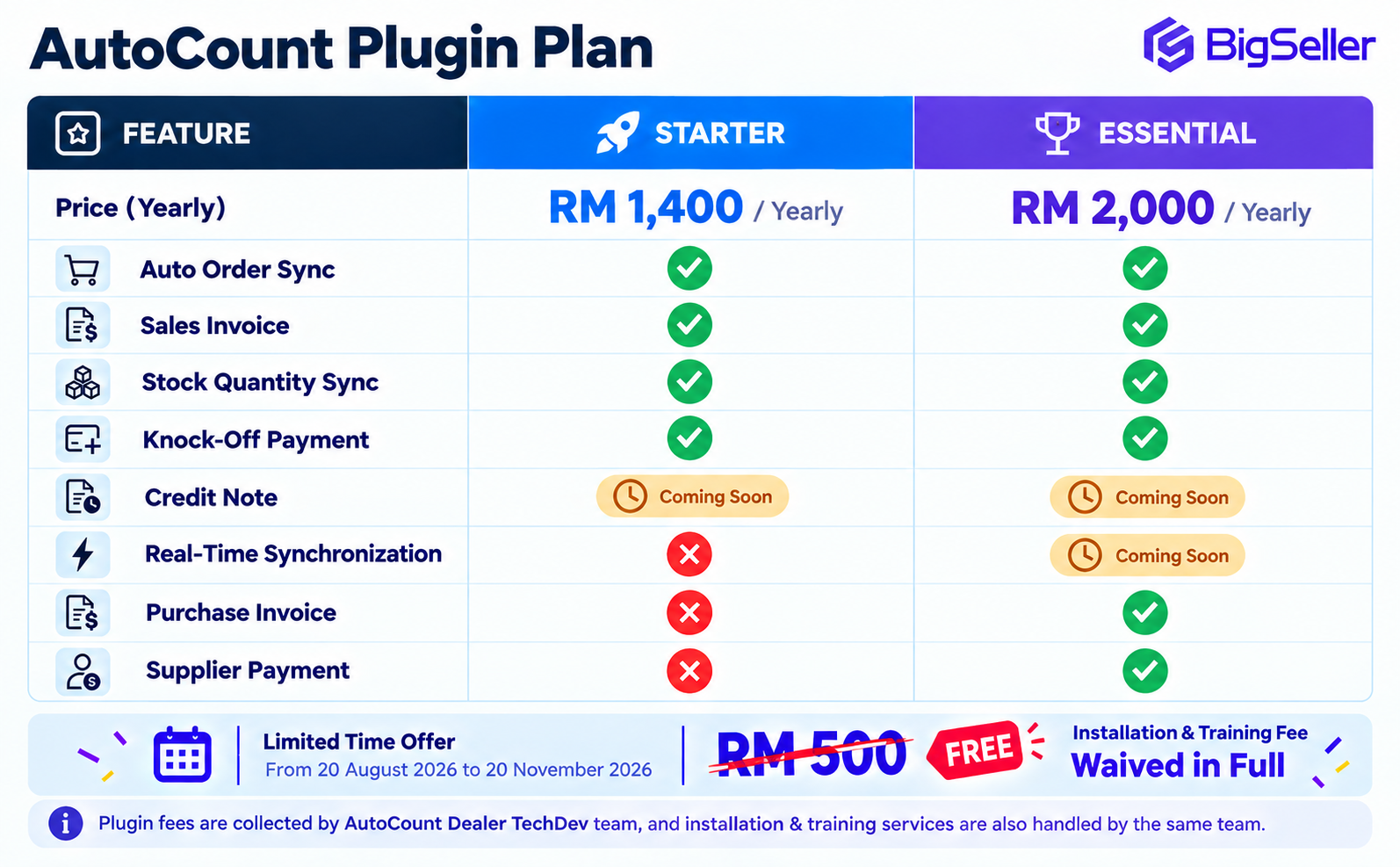
How the BigSeller + AutoCount Combination Fixes the Everyday Accounting Headaches
Once the two systems are connected, the day-to-day impact shows up in a few specific places that normally eat the most manual time:
-
Fee deductions land in the right account automatically. Marketplace payouts arrive as one lump figure with commissions, transaction fees, and absorbed vouchers already deducted. Instead of a bookkeeper trying to reverse-engineer what was taken out and where it belongs, BigSeller itemises each deduction and routes it to the matching entry in AutoCount's Chart of Accounts, so the breakdown is already correct by the time it's posted.
-
Shipping discrepancies get caught instead of absorbed as silent losses. What a buyer pays for shipping at checkout and what the courier actually invoices the seller are rarely identical. Sometimes the seller absorbs a small top-up, sometimes a shipping subsidy shifts the numbers. BigSeller tracks both sides of that gap and pushes the actual adjustment into AutoCount, rather than letting the difference quietly erode profit margins unnoticed.
-
E-invoicing data is collected once, at the source. The buyer information LHDN requires for a valid e-invoice gets captured during checkout on BigSeller rather than chased down afterward, and flows straight into AutoCount's e-invoicing module. That removes the awkward step of emailing a customer after the fact to ask for tax details needed to close out an invoice.
-
Stock and accounting numbers stay in sync across every channel. When a unit sells on Shopee, BigSeller immediately deducts that stock from Lazada and TikTok Shop listings at the same moment and the same update pushes through to the inventory asset value sitting inside AutoCount's ledger. Sellers don't end up with a stock count that matches BigSeller but a valuation that's a day behind in AutoCount.