Which ERP Is Best for Online Sellers to Prepare for Malaysia’s New E-Commerce Bill
Erra27 Oct 2026 07:45ENCopy link & title

How Will the Upcoming Malaysian E-Commerce Bill Impact Multi-Channel Online Sellers?
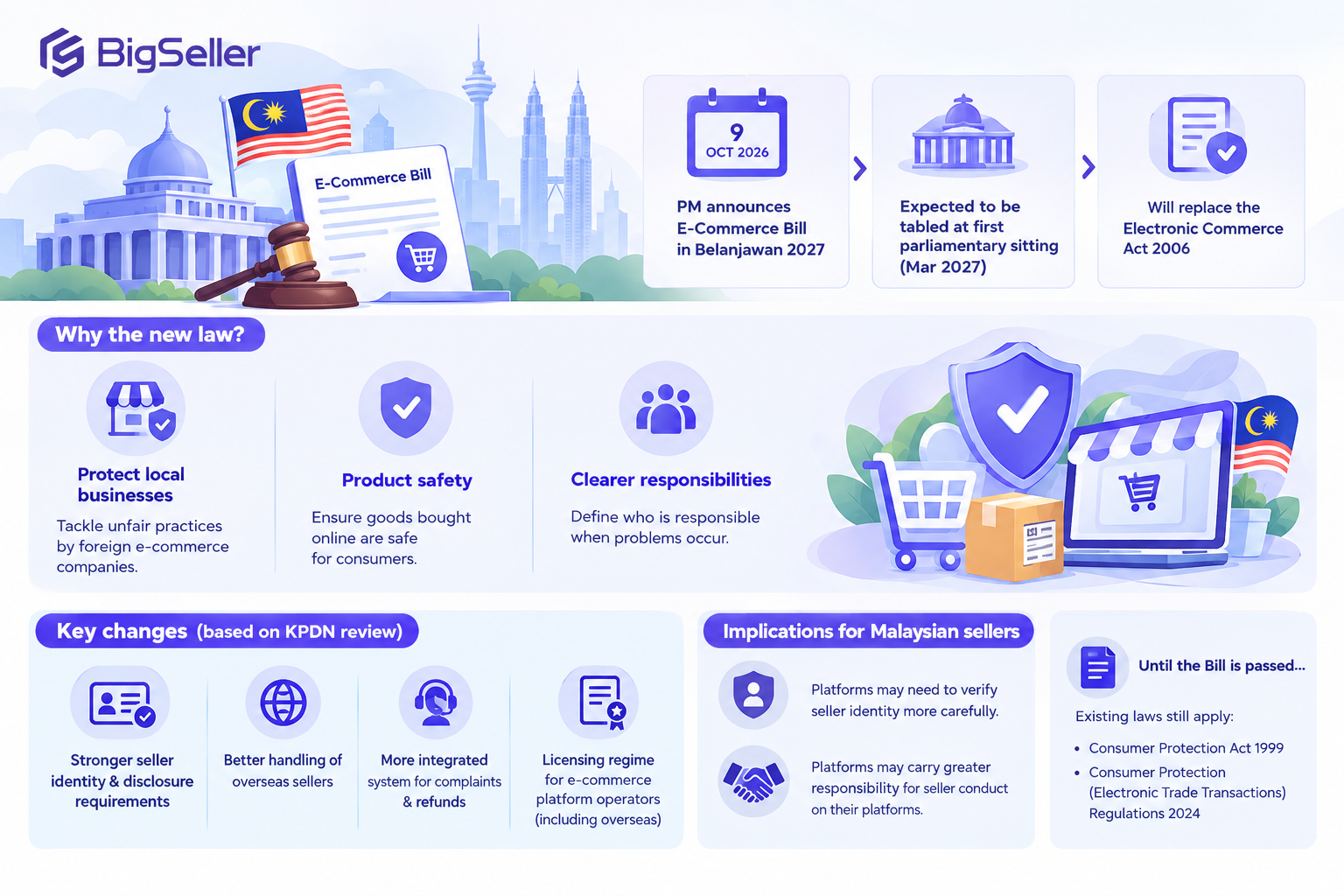
On 9 October 2026, Prime Minister Datuk Seri Anwar Ibrahim announced in Belanjawan 2027 that the government will table an E-Commerce Bill to strengthen accountability among online platforms and sellers. Reports indicate that the Bill is expected to be tabled at the first parliamentary sitting next year, around March 2027.
The Bill will replace the Electronic Commerce Act 2006 as it mainly provides legal recognition for online transactions, but does not set out the responsibilities of marketplaces nor the duties of sellers, and it does not adequately address overseas sellers.
The government has given several reasons for the new law:
-
Protecting local businesses. Small traders have raised concerns about foreign e-commerce companies operating in Malaysia without sufficient oversight.
-
Product safety. The government wishes to ensure that goods purchased online are safe for consumers.
-
Clearer responsibilities. Platforms and sellers should understand who is responsible when problems occur.
KPDN's review also considered stronger requirements for seller identification and information disclosure, better handling of overseas sellers, and a more integrated online system for complaints and refunds. On 14 October, the Minister announced that the government plans to introduce a licensing regime for e-commerce platform operators, including those based overseas.
For Malaysian sellers who operate on several platforms, the implications are significant. Platforms may be required to verify the identity of each seller more carefully, and they may carry greater responsibility for the conduct of sellers on their platforms. Until the Bill is passed, existing laws such as the Consumer Protection Act 1999 and the Consumer Protection (Electronic Trade Transactions) Regulations 2024 continue to apply.
How Does the Post-March 2027 Regulatory Framework Compare to Current E-Commerce Practices
The upcoming E-Commerce Bill may change the way online selling is carried out in Malaysia. At present, many sellers manage several stores manually, and minor errors are often tolerated. Once the Bill takes effect, there may be less room for such mistakes.
|
Area |
Current Practice (Before the Bill) |
Possible Changes (After the Bill) |
|
Seller identity |
Multiple stores can be opened easily, and platforms do not always verify the seller's identity thoroughly. |
Platforms may be required to verify seller identity more strictly. Stores with unclear or false details may be removed. |
|
Prices and tax |
Delays in updating prices after a tax change usually carry no serious consequences. |
Incorrect or misleading prices may be treated more seriously. Prices will need to be accurate and updated on time. |
|
Stock and orders |
Overselling or showing stock that is not available usually results in platform penalty points only. |
Misleading listings and unfulfilled orders may be treated as consumer protection issues. |
|
Platform responsibility |
Marketplaces often leave problems involving sellers or faulty goods to be resolved by the sellers. |
Platforms may carry greater responsibility, particularly for unverified overseas sellers and unsafe products. |
Managing several stores manually becomes more difficult under these conditions. A seller who operates five online stores must log in to five separate seller centres each time there is a tax change, a price update or a stock adjustment. The more tasks are done by hand, the higher the risk of error.
Platforms may also become stricter towards stores with weak records. This is a reasonable expectation, but it has not been confirmed. Repeated cases of incorrect listings, delayed price updates, or cancelled orders could put a store at risk. For this reason, it is safer to maintain one clear system that records what is being sold, at what price, and how much stock is available.
Why is an Omnichannel ERP Essential for Meeting New Local Compliance Standards?
When regulations become stricter, the more dependable approach is to reduce manual work. An omnichannel ERP brings all stores, orders and stock into one place, so that a seller has a single, reliable record of the business instead of several separate ones. BigSeller is designed for this purpose, connecting all your e-commerce stores through official platform authorisation and brings daily operations into one dashboard.
Accurate stock. BigSeller shares stock levels across all stores and platforms. When an item is sold in one store, the quantity is updated in the others. Campaign-reserved stock and inventory push rules help to prevent overselling. BigSeller also supports multiple warehouses, stock-takes, and batch and expiry date tracking.
Consistent pricing. Sellers can edit prices and product details in bulk across stores, use pricing templates, and check estimated profit before changing prices. A price is changed once instead of five times, which lowers the chance of an incorrect price remaining live.
All orders in one screen. BigSeller collects orders from 20+ platforms, as well as POS, manual and Facebook orders. BigSeller can also flag problem orders and issue alerts for overdue processing, cancellations and returns, so that issues are identified early.
Clear return records. Returns from all platforms are managed together. Sellers can track return parcels, process refund requests, and move returned items back into stock.
Actual profit and store health. BigSeller collects platform costs such as commissions, promotions and taxes, and assigns them to each product. BigSeller also displays a health score for each store and gives early warnings of possible penalties.
Local accounting tools. BigSeller integrates directly with SQL Account, AutoCount, and MyInvois, allowing sales data to flow into accounting records without manual re-entry. This feature is available from the Basic plan onwards.
Mobile app. Sellers receive push notifications for new orders and can print and ship from their phones. BigSeller’s app also shows sales and ad spend, and supports barcode scanning before dispatch to reduce wrong or missed items.