Top 4 WMS Options for Shopee Sellers in the Philippines (2026)
Jayson23 Oct 2026 08:53ENCopy link & title
For most Shopee-first sellers operating their own warehouse in the Philippines, BigSeller is the best overall WMS option. It connects authorized Shopee stores with Merchant SKUs, inventory, order processing, wave-based picking, secondary sorting, scan-assisted packing, and shipping preparation inside one ecommerce operating workflow.
Anchanto, Odoo, and Oracle NetSuite WMS are also relevant, but they begin from different operating models. Anchanto combines enterprise omnichannel order and warehouse management, Odoo offers a configurable modular ERP environment, and NetSuite WMS fits larger businesses already building operations around NetSuite. The best choice depends on how directly the system connects Shopee orders to the work employees perform inside the warehouse.
1. What Shopee Sellers Need from a Warehouse Management System
A WMS should make the sequence after a Shopee order arrives clear. The order must remain connected to the correct SKU and warehouse, become a picking task, move through checking or sorting, reach the right packing station, and stay matched with the correct parcel and shipping label until handover preparation is complete.
This matters throughout the year, but pressure rises before 11.11, 12.12, Christmas, and year-end dispatch. A warehouse may receive many more orders within a short period while also handling similar product variations, temporary staff, tighter shipping deadlines, and larger piles of printed labels. Without a defined workflow, pickers repeat the same routes, packers wait for missing items, and teams lose visibility over which parcels still require action.
Reliable product identity is the foundation. GS1's guidance for retail backend systems explains the role of warehouse management in controlling physical inventory handling and using identification data at warehouse touchpoints. For an ecommerce warehouse, this means software and scanning work best when every variation has a stable SKU, the physical label matches the system record, and storage locations are kept accurate.
A WMS does not replace those operating disciplines. It organizes them. Shopee sellers should compare how each system receives channel orders, creates warehouse work, keeps products and packages identifiable, exposes exceptions, and supports the people responsible for picking, sorting, packing, and shipping.
2. Top WMS Options at a Glance
| Rank | System | Best for | Shopee connection | Core warehouse workflow | Implementation fit |
|---|---|---|---|---|---|
| 1 | BigSeller | Shopee-first Philippine sellers running their own ecommerce warehouse | Built-in authorization for supported Shopee stores | Waves, picking, secondary sorting, scan-assisted packing, labels, and shipping processing | Direct fit for marketplace operations; requires SKU mapping, inventory setup, equipment, and staff preparation |
| 2 | Anchanto | Enterprise omnichannel brands, distributors, and ecommerce enablers | Shopee Philippines connection through its documented OMS workflow | Orders move from OMS into WMS for warehouse execution and shipping updates | Best assessed as a combined OMS and WMS deployment |
| 3 | Odoo | Businesses already using a modular ERP or requiring configurable warehouse routes | Connection depends on the selected app, partner, or custom integration | Barcode operations and configurable one-step, two-step, or three-step outbound routes | Suitable when the business can configure and maintain a wider Odoo environment |
| 4 | Oracle NetSuite WMS | Larger businesses already operating within NetSuite | Shopee orders require an appropriate connector or implementation route | Wave release, mobile picking tasks, task status, carton packing, and shipment processing | Enterprise implementation tied to the wider NetSuite architecture |
All four systems can participate in warehouse execution, but they do not start from the same place. BigSeller begins with marketplace stores and ecommerce orders. Anchanto begins with enterprise omnichannel orchestration. Odoo and NetSuite begin with broader ERP environments. For a Shopee seller, the connection between the channel and the warehouse is as important as the warehouse feature list itself.
3. A Closer Look at the Four WMS Options
1. BigSeller: Best Overall for Shopee-First Warehouse Operations
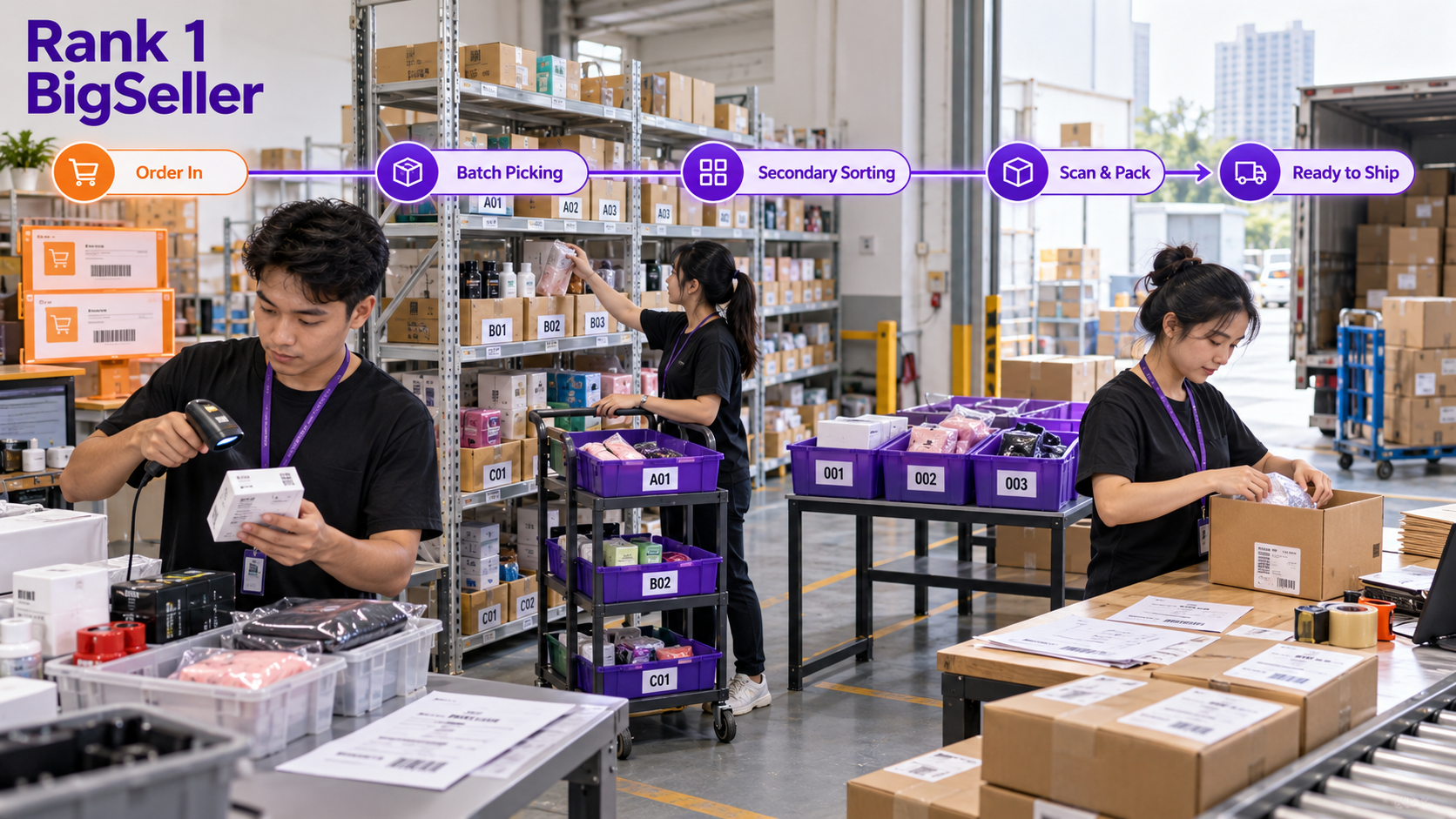
BigSeller ranks first because it connects the marketplace order with the warehouse workflow used to fulfill it. Sellers can authorize supported Shopee stores in BigSeller, map store SKUs to Merchant SKUs, manage warehouse inventory, and process synchronized orders without rebuilding the same order manually in a separate warehouse application.
The workflow can adapt to different order patterns. BigSeller's wave settings allow sellers to organize orders using different wave types and picking strategies. Repeated orders containing the same bestseller can be grouped differently from mixed-SKU orders that require employees to collect several variations. The goal is to organize warehouse work around the actual order mix instead of sending every picker through the same one-order-at-a-time routine.
Consider a batch of mixed-SKU Shopee orders during 11.11. Once the eligible orders enter the warehouse workflow, the team can generate a wave and use the resulting picking information to collect the required products. If the chosen process separates picking from sorting, employees first gather the batch and then divide the products into the correct packages. BigSeller's WMS wave shipment guide shows how wave generation, picking, secondary sorting, packing, and shipping processing connect under the selected strategy.
At the packing station, identification remains important. The Scan Package workflow can help the team retrieve the correct package, check products under the applicable mode, and print or match the shipping label. This creates a clearer handoff between the employee who collects products and the employee who prepares the final parcel.
The software still needs an operational foundation. Merchant SKU mapping, inventory settings, printers, scanners, labels, picking containers, product placement, and staff responsibilities should be prepared before the first large wave. The BigSeller warehouse preparation checklist helps teams review these requirements before rollout. The best time to test the process is before 11.11 or 12.12, not during the first hour of a major campaign.
The practical advantage is continuity. Order data, SKU identity, warehouse stock, picking work, packages, and shipment preparation stay within one marketplace-focused operating environment. BigSeller's published Motolab warehouse case from the Philippines also illustrates how a local seller can organize batch processing, picking, sorting, scan checks, packing, and shipping around one connected flow. Individual results depend on warehouse setup, but the case shows the type of operation the system is designed to support.
2. Anchanto: For Enterprise Omnichannel OMS and WMS Deployment
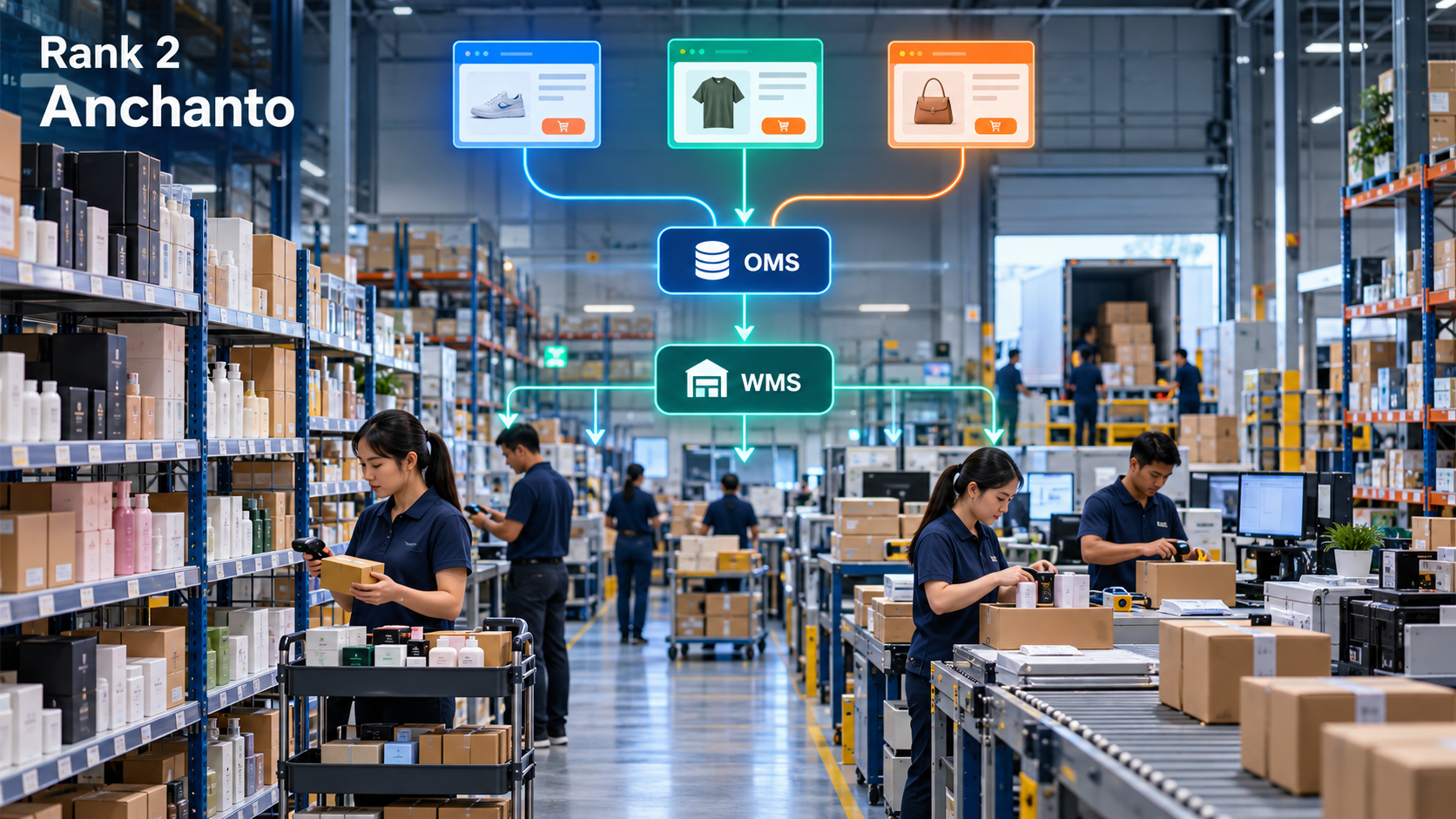
Anchanto is relevant for businesses managing a wider omnichannel network, such as multi-brand operators, distributors, and ecommerce service providers. Its warehouse product works alongside its order management environment rather than treating the WMS as the only system involved.
The official Anchanto OMS Shopee Integration Guide includes the Philippines and describes an OMS-to-WMS route in which order and shipping information move into the warehouse workflow. This gives Shopee sellers a documented channel path, while the required products and deployment should be considered together. Anchanto is therefore a stronger fit when enterprise omnichannel coordination is the main requirement, rather than when a smaller marketplace team only needs a direct warehouse workflow.
3. Odoo: For Modular ERP and Configurable Warehouse Processes
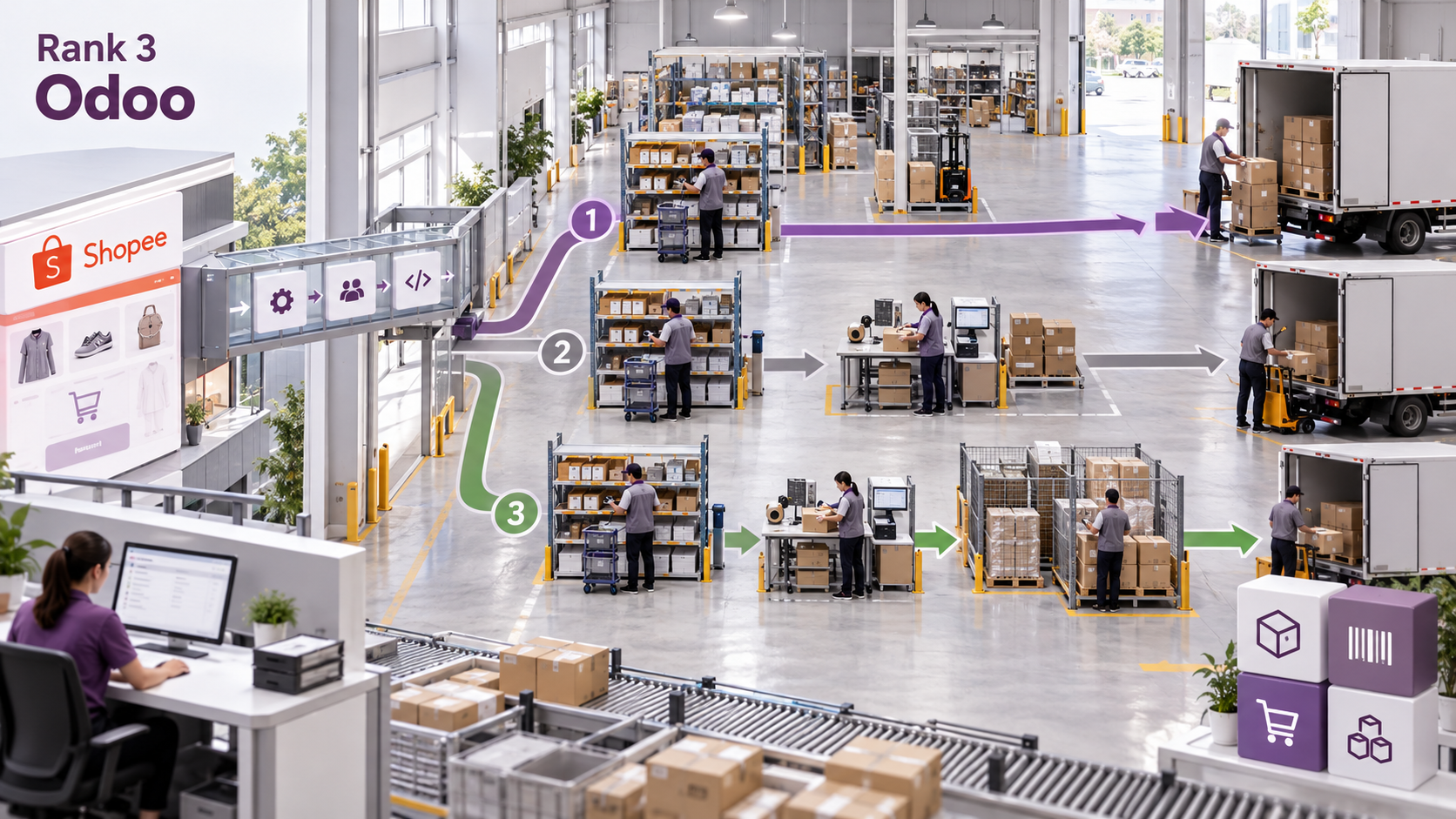
Odoo provides inventory, barcode, purchasing, sales, accounting, and other business applications within a modular ERP suite. Its Inventory and Barcode documentation covers configurable warehouse operations, including one-step delivery and two-step or three-step routes that separate picking, packing, and delivery.
This flexibility can suit a business that already uses Odoo or wants warehouse operations to follow a customized company-wide process. For a Philippine Shopee seller, the implementation also needs a defined route for marketplace orders, product records, and shipment information through an app, partner, or custom connection. Odoo is most compelling when modular ERP configuration is already part of the business plan.
4. Oracle NetSuite WMS: For Larger Businesses Already Using NetSuite
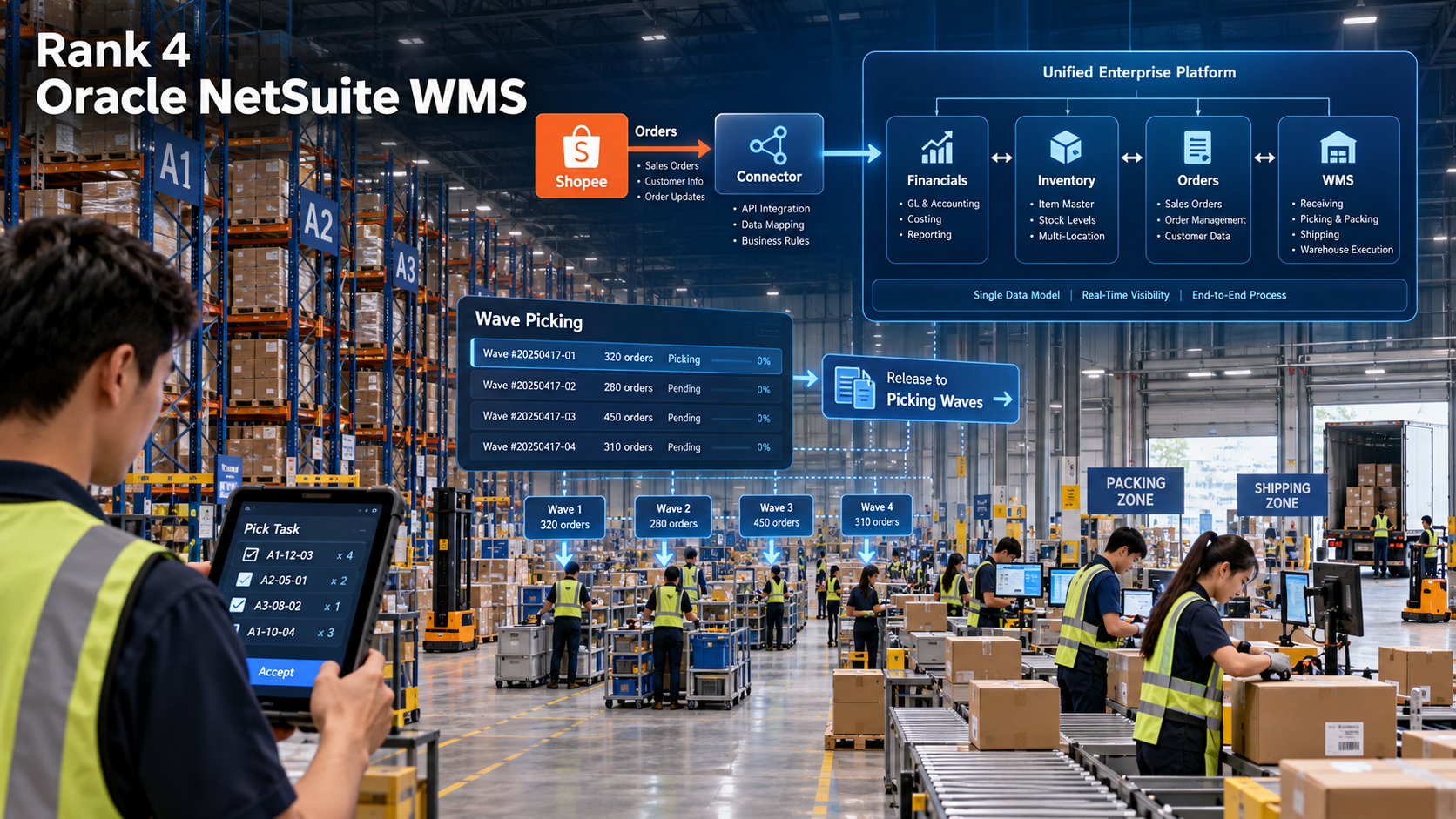
Oracle NetSuite WMS places warehouse execution inside a broader enterprise system. Its order release documentation covers wave creation, mobile pick tasks, and task progress, while its packing workflow covers carton details and packing lists for eligible orders.
NetSuite WMS is most relevant when a larger business already manages finance, entities, inventory, and operations through NetSuite and wants warehouse execution inside the same architecture. Shopee order intake must be included in the implementation design through the appropriate integration route. For a marketplace-first SME, this is usually a larger project than adopting a system that begins with Shopee operations.
4. How to Test a WMS with Your Own Shopee Workflow
A product demonstration should follow real warehouse work, not only show a dashboard. Begin with a normal single-SKU order and observe how it enters the system, reserves or references stock, becomes a picking task, receives a label, and reaches shipping preparation. Every employee should be able to identify the next action without reconstructing the order from several screens or printed sheets.
Next, test a mixed-SKU order containing similar colors, sizes, or variations. Follow the products through picking, sorting, checking, and packing. The trial should show whether the system keeps each item connected to the correct order and package when several employees participate.
Then introduce an exception: an unavailable item, a wrongly selected variation, an unreadable label, or a package that must return to the previous step. A useful WMS should make the exception visible and give the team a defined recovery path. Warehouse software is most valuable when the routine breaks, not only when every order is perfect.
Run this trial before peak season using the actual printers, scanners, labels, shelves, picking containers, and staff roles that will be used during 11.11, 12.12, Christmas, and year-end dispatch. A technically complete system can still fail if the physical warehouse and employee responsibilities are not prepared.
For most Philippine sellers whose main pressure comes from connecting Shopee orders with one self-operated warehouse, the trial will usually make BigSeller the most direct starting point. Businesses already centered on an enterprise OMS or ERP may place more weight on how a warehouse module fits their existing architecture.

For Shopee sellers preparing for late-year campaigns and everyday fulfillment, the next step is to test the complete warehouse journey with actual products and representative orders. BigSeller offers the most relevant starting point for marketplace-first teams because the channel connection and warehouse workflow can be reviewed together. Sellers can also compare how the warehouse layer fits within a broader ecommerce order management system for the Philippines before changing their operating process.