How to Sync Marketplace Inventory with a Physical Store in Malaysia
Erra18 Nov 2026 06:11ENCopy link & title

Which Inventory Features Matter Most for Malaysian Sellers Selling Online and Offline?
Managing stock across Shopee, Lazada, TikTok Shop, and a physical retail counter is now part of everyday life for many Malaysian sellers. PwC Malaysia's Omnichannel Readiness Study found that omnichannel shoppers have a 30% higher lifetime value and 90% higher retention than single-channel buyers. Even so, channel integration was the weakest area in 70% of the Malaysian retail segments studied.
When an item sells out at your physical counter but still shows as available online, you risk order cancellations, seller penalty points, and lost buyer trust, especially under strict marketplace fulfillment rules. To avoid these costly mistakes, sellers who connect marketplace inventory with a physical store need an ERP that prevents overselling, reduces manual work, and brings all their data together.
Core Synchronisation and Inventory Features
-
Real-time, order-driven stock sync: When an item sells in the store (via POS) or on a marketplace, counts on all other channels should update within seconds.
-
Sellable stock versus raw stock: The system should not simply push warehouse numbers. It should calculate sellable stock by factoring in open reservations, pending orders, and damaged goods.
-
Channel buffers and safety stock rules: You should be able to hold back safety stock for demand spikes, and keep a few units in reserve for high-margin or fast-moving channels.
-
SKU and variant mapping: Sizes, colours, bundles, and multi-packs should map correctly, so selling a component or bundle deducts stock from the parent SKU.
-
Multi-location and warehouse control: Shelf stock should be clearly separated from backroom or distribution centre stock, with support for store-to-store transfers and local pickup.
Operations and Management Features
-
Unified POS integration: The store's checkout register should connect seamlessly to the central ERP ledger, so sales, cash management, and barcode scans update stock instantly.
-
Automated returns and cancellations: An in-store return or marketplace cancellation should restore the item to sellable inventory and adjust financial records automatically.
-
Automated replenishment and purchase orders: Low-stock triggers should alert purchasing or draft a PO when inventory falls below a threshold based on sales velocity and lead times.
-
Audit trails and reconciliation tools: Detailed logs of manual adjustments, cycle counts, and discrepancies make it easier to find out why physical counts differ from system numbers.
-
Centralised reporting and financial sync: Integration with accounting modules (COGS, sales tax, margins per SKU or channel) and dashboards showing sell-through and aging stock.
What Is the Best Way to Sync Online and Offline Inventory in Malaysia
|
Aspect |
Manual Tracking |
Standalone POS Systems |
Accounting-First ERPs |
BigSeller |
|
Core focus |
Basic record-keeping at zero software cost |
Fast counter checkouts and receipt printing |
Tax compliance, general ledger, financial reporting |
High-speed marketplace syncing unified with offline POS |
|
Marketplace and POS stock sync |
Manual updates across Seller Centres and registers; high overselling risk |
Built for physical stores first; marketplace syncing often needs third-party plugins |
Mainly tracks warehouse and accounting stock; real-time marketplace sync is limited |
Real-time, two-way auto-sync across Shopee, Lazada, TikTok Shop, and physical POS |
|
Setup and learning curve |
Low setup, but hours of daily data entry as volume grows |
Easy for cashiers, but complex with online variants and bundles |
Steep learning curve; needs accounting knowledge and longer onboarding |
Fast, plug-and-play setup built for e-commerce and retail workflows |
|
E-commerce and live-stream tools |
None; manual order processing and airway bill printing |
Minimal; lacks bulk listing, scraping, or live-stream stock locking |
None; not designed for flash sales, bundles, or multi-account management |
Full suite, including bulk order processing, bundle SKU mapping, and live-stream stock reservation |
|
Cost and scalability |
Free upfront, but high hidden labour costs and overselling penalties |
Monthly hardware and register fees that grow with each outlet |
High upfront licensing and implementation costs |
Free plan (up to 1,500 orders/month) with POS included; affordable tiers as you scale |
How Does BigSeller Unify Marketplace Inventory with a Physical Store in Malaysia
The root cause of overselling is that online and offline sales are recorded in different places. BigSeller removes that gap by putting both into one system. BigSeller’s Inventory shares stock across all connected stores and platforms, using campaign-reserved stock, push rules, and push records to keep counts accurate. BigSeller’s POS Offline Retail extends that same inventory pool to your physical counter. When a customer buys the last unit at the register, the deduction is recorded in the shared pool, and the item no longer shows as available to the next online shopper.
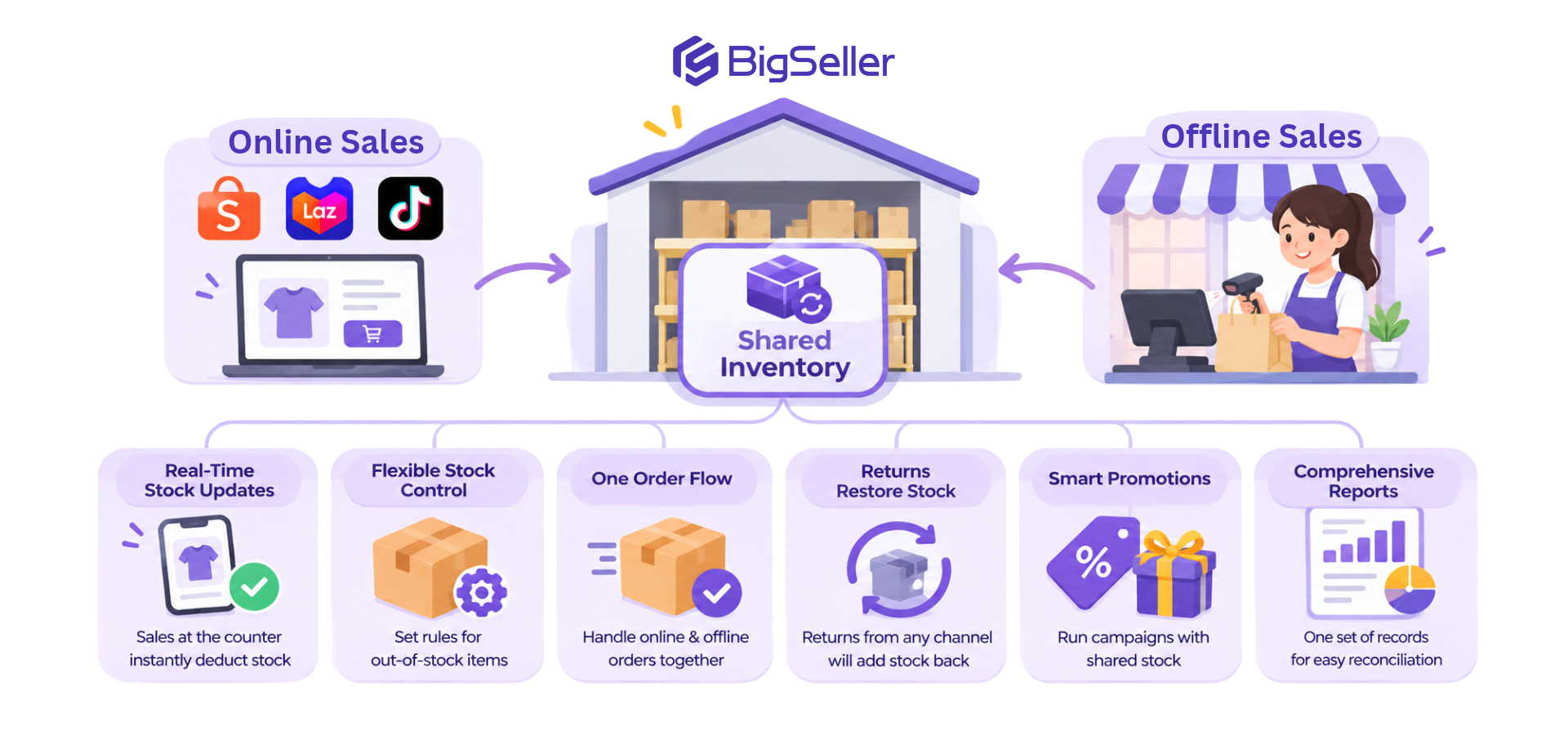
Counter sales update shared stock. When a cashier settles a POS order, the sale draws from the shared inventory, so the item no longer shows as available to the next online shopper. This is what stops the “last unit” problem: a walk-in purchase and a Shopee, Lazada, or TikTok Shop order are counted against the same number.
Inventory decisions shape the counter. Each POS store is linked to one BigSeller warehouse, and when you add POS prices, BigSeller only shows the SKUs held in that store’s warehouse. Stock transfers, manual adjustments, and stock-takes made in the Inventory module therefore change what each outlet can sell. If an item runs out, you decide what happens at the counter. By default, out-of-stock items cannot be sold. With “Allow selling out-of-stock products” turned on, the order goes to New Orders > Out of Stock so you can restock before fulfilling it.
One order flow for online and offline. In-stock counter sales settle straight to the Completed list. If the customer wants delivery, the POS order enters the same New Orders page as your marketplace orders and follows the normal fulfilment flow. Your team handles online and offline orders against one stock record, and one-click restocking or transfer helps when an item runs short. In the BigSeller mobile app, you can update stock after a stock-take, and the changes sync instantly with the desktop version. You can also create POS retail orders in the same app, with revenue and inventory data syncing online in real time. A count made on the shop floor and a sale made at the register both end up in one ledger.
Returns restore stock either way. Whether a return comes from a marketplace buyer or a shop customer, it is processed back into inventory, so the item becomes sellable again on every channel. You do not have to correct counts by hand.
Pricing and promotions sit on top of shared stock. You can set a unified selling price or a store selling price, and customer tier prices take priority over both. Offline promotions (SKU, order, and free gift) run from the same system as your online campaigns. Cashiers can settle with cash, card, or e-wallet, and for Malaysian shops, cash payments can use MY 5-Sen Rounding, which follows the official standard.
One set of records. Because inventory, POS, and online orders share a ledger, the Business Statement consolidates counter bills for period reconciliation, including rounding amounts. This replaces hours of matching cash and e-wallet slips against Seller Centre stock counts. BigSeller’s free plan supports up to 1,500 orders a month across 3 stores, with POS included, so you can try this setup before moving to a paid tier.
Together, all of these BigSeller features let a Malaysian seller work from one stock count and one set of reports, whether a sale happens on Shopee, Lazada, TikTok Shop, or at the shop counter.