How to Choose the Best Multi-Warehouse Inventory System in Malaysia
Erra12 Nov 2026 09:34ENCopy link & title

Why Is Managing Multiple Warehouses Difficult for Malaysian Sellers?
Moving from one storeroom to several locations, or splitting stock between a central warehouse and regional hubs, adds complexity that shows up in your marketplace rankings and margins. CAPS Research data cited by ETP Group puts average inventory accuracy at just 83%, so nearly one in five stock records is wrong. For Malaysian sellers, disconnected systems create four bottlenecks.
Cross-warehouse overselling during peak sales. Without instant, centralised syncing, surges during 11.11, 12.12 or Payday campaigns lead to stockouts and seller-fault cancellations. Under Shopee Malaysia's Non-Fulfilment Rate (NFR) policy, exceeding a 10% NFR threshold, or reaching 20% NFR with 10+ unfulfilled orders across two weeks in an 8-week cycle, triggers penalty points and possible account freezes.
Slow manual order allocation. Transit times differ sharply between Peninsular Malaysia (typically 1–3 working days) and Sabah or Sarawak (5–7+ working days). Choosing the right warehouse by hand, based on postcode and live stock, delays same-day dispatch cut-offs.
Mixed fulfilment queues between hubs. Each warehouse needs its own routing and stock allocation. Without clear separation, staff at one site may view, print or pick orders meant for another.
Untracked inter-warehouse stock transfers. Moving stock between hubs without structured transfers creates "phantom inventory": units the system shows as sellable that aren't physically there. ECR Retail Loss research finds over 60% of retail inventory records contain discrepancies, and correcting them can lift sales by up to 11%.
What Features Should You Look for in a Multi-Warehouse Inventory System?
To run multiple warehouses smoothly in Malaysia, look for five core capabilities.
-
Centralised stock sync: Updates available stock across all warehouses and channels within seconds of any order, cancellation or transfer.
-
Automated order routing: Assigns each order to the best warehouse using rules such as buyer region, courier coverage, warehouse priority and SKU availability.
-
Per-warehouse stock and queue isolation: Keeps balances, permissions and fulfilment queues separate for each location.
-
Location-specific WMS execution: Supports bin mapping, wave picking, PDA scanning and batch and expiry tracking.
-
Structured inter-warehouse transfers: Records stock movements between locations with a full audit trail.
A system that covers all five lets you add warehouses without adding manual checks.
How Do Top Multi-Warehouse Inventory Systems in Malaysia Compare?
When evaluating software specifically for multi-warehouse management in Malaysia, here is how the main options compare across multi-location features:
|
Software |
Best For |
Multi-Warehouse Architecture |
Routing & Transfers |
Starting Price |
|
BigSeller |
Multi-warehouse e-commerce sellers on Shopee, Lazada and TikTok Shop |
Self-owned, 3PL, and platform warehouses; per-SKU ledger; bin-location separation |
Automated order routing, inventory locking, one-click warehouse switching, inter-warehouse transfers |
Free (up to 1,500 orders/month); paid plans from RM129/month |
|
Odoo Inventory |
Complex multi-warehouse manufacturing and B2B distribution |
Hierarchical warehouse and internal location trees, push/pull routes |
Automated replenishment rules and inter-warehouse transit locations |
Custom/modular pricing |
|
AutoCount / SQL |
Offline retail and wholesale branches needing basic multi-location stock |
Multi-location stock balance tracking by branch or storeroom |
Manual stock transfer notes across offline branches |
One-time licence/subscription |
Which Multi-Warehouse Inventory System Fits Your Business Model Best?
The right choice depends on where your sales come from and how your warehouses work.
-
Choose BigSeller if most of your revenue comes from Shopee, Lazada, TikTok Shop or your own online store, and you want automated warehouse routing, 3PL separation, bin-level picking, and local courier and accounting sync, with a setup that gets you running quickly.
-
Choose Odoo Inventory if your warehouses mainly support raw-material manufacturing, complex B2B supply chains or heavily customised enterprise workflows, and you have the budget and technical resources to configure them.
-
Choose AutoCount or SQL if you run mostly offline retail shops or traditional wholesale distribution, where accounting-first stock transfers are your top priority.
How Does BigSeller Handle Multi-Warehouse Operations in Malaysia?
BigSeller is a cloud-based e-commerce ERP trusted by over 1,300,000 sellers across Southeast Asia, with a local office in Malaysia. It lets Malaysian sellers run self-owned warehouses, overseas 3PLs and platform warehouses from a single dashboard. Here is how BigSeller works in practice.
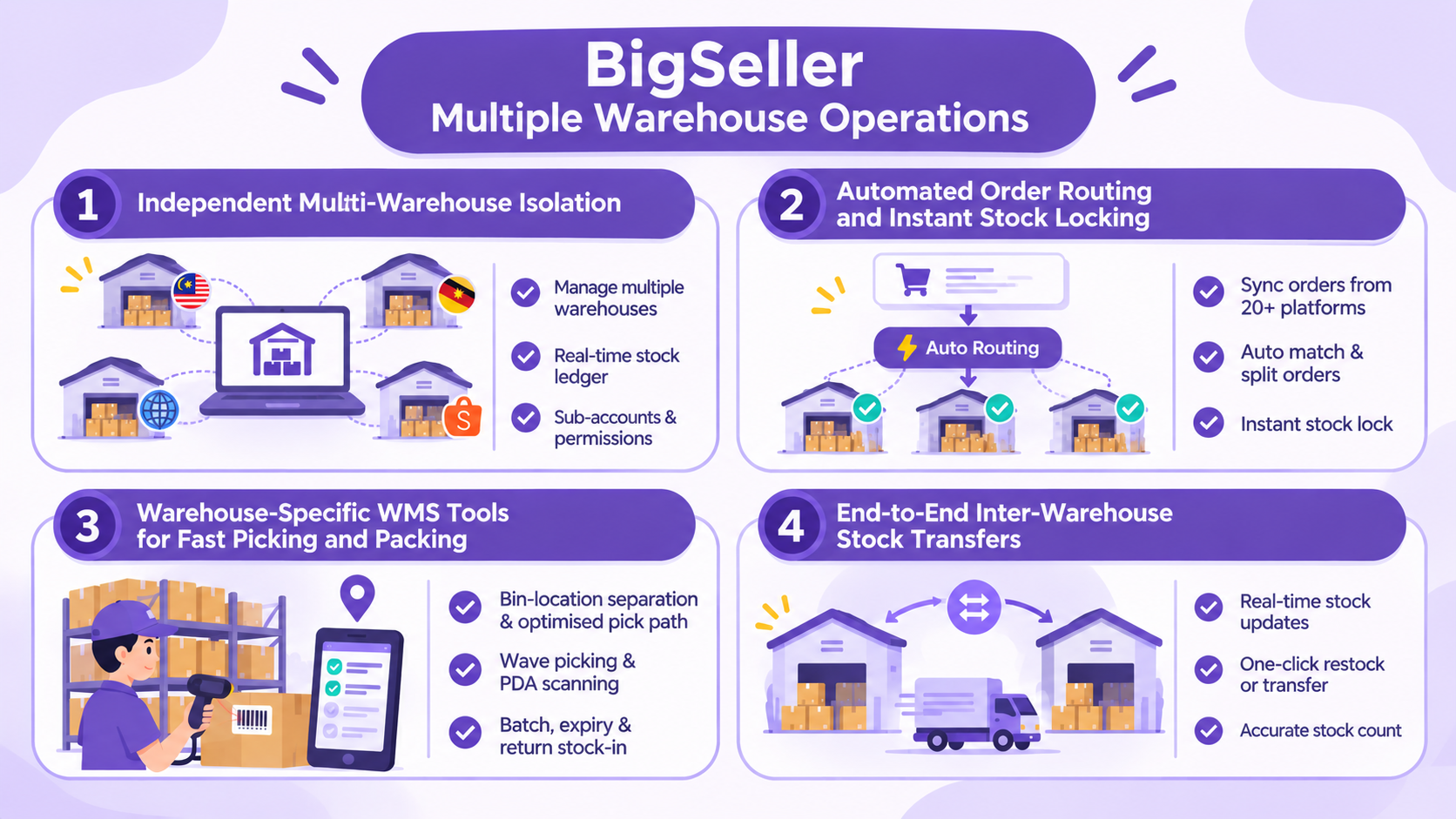
1. Independent Multi-Warehouse Isolation
You can manage every warehouse you operate in one BigSeller account, whether it is a self-owned warehouse in Peninsular or East Malaysia, an overseas 3PL, a local fulfilment centre or a platform warehouse such as Shopee pre-fulfilment. A real-time ledger records each SKU's cost, bin location and alert stock level, and 3PL stock levels sync in one click. Sub-accounts with configurable permissions let you control what each team member can see and do.
2. Automated Order Routing and Instant Stock Locking
BigSeller syncs orders from 20+ platforms in real time and routes each one automatically, matching it to a warehouse that has the stock. Auto address recognition speeds up processing, orders can be split across warehouses when needed, and you can switch the shipping warehouse in one click. The moment an order is allocated, stock is locked at that warehouse, which removes double-allocation during flash sales and helps protect your NFR.
3. Warehouse-Specific WMS Tools for Fast Picking and Packing
BigSeller's inventory and WMS modules give each warehouse these execution tools:
-
Bin-location separation: Assign one product to several bin locations and prioritise the pick zone, so staff don't pull from storage zones by mistake. Optimised pick paths cut walking distance.
-
Wave picking and PDA barcode scanning: Group similar orders into picking waves, choose pick-then-sort or sort-while-pick, and verify items by mobile app or PDA scanner. Task assignment and efficiency analytics help you manage teams during peak season.
-
Batch, expiry and return stock-in: Track stock per batch and expiry date to prevent expired products from being sold, and put returned parcels back into inventory with one-click return stock-in.
4. End-to-End Inter-Warehouse Stock Transfers
When you need to replenish regional hubs from a central warehouse, BigSeller supports inter-warehouse transfers with real-time stock updates and a searchable transaction history. Out-of-stock orders can trigger a one-click restock or transfer, and stock-takes and manual adjustments keep system counts in line with what is physically on the shelf, so phantom inventory has nowhere to hide.