Which System Automates Marketplace Payout Reconciliation & e-Invoice in Malaysia?
Erra13 Nov 2026 05:10ENCopy link & title

Why Is Manual Payout Reconciliation and e-Invoicing a Major Bottleneck for Malaysian Sellers?
Selling across several channels becomes an administrative burden when your order management system and accounting ledger do not communicate. Malaysia’s e-Invoicing framework, run by the Inland Revenue Board (LHDN), required businesses with annual revenue between RM 1 million and RM 5 million to begin issuing e-Invoices from 1 January 2026, with wider implementation from 1 July 2026. Many online merchants still depend on spreadsheets and manual bookkeeping, and four problems tend to appear as order volumes grow.
-
Complex payout deductions. When a shopper pays RM 100 on a marketplace, the seller never receives RM 100. Platforms deduct shipping fees, commissions, payment gateway charges, service fees, seller-funded vouchers, co-funded rebates and refund adjustments before releasing funds. Recording only the net bank deposit understates gross revenue and hides true operating costs, and breaking down thousands of orders by hand in Excel is not sustainable.
-
Repetitive data entry and human error. Without an automated link between order and accounting systems, finance teams export CSV files from each seller centre, reformat the columns and re-key invoices and receipts. This takes dozens of hours a month and often leads to typos, duplicates and missed transactions.
-
Inventory mismatches across channels. If sales and supplier restocks are processed in an order management tool but never reach the accounting records, stock quantities and valuations drift away from what is on the warehouse shelves. That complicates month-end closing and annual audits.
-
e-Invoice gaps on off-platform sales. Marketplaces handle buyer e-Invoice requests within their own ecosystems, but sellers remain responsible for issuing LHDN-compliant e-Invoices for WhatsApp and Messenger orders, walk-in POS sales and manual B2B orders. Keying each of these into the MyTax portal slows fulfilment and raises compliance risk.
How Do Different Reconciliation and e-Invoice Setups Compare?
|
Capability |
Manual spreadsheets |
Standalone accounting software |
BigSeller + accounting software + MyInvois |
|
Multi-channel order sync |
Manual CSV exports and reformatting from every seller centre |
Manual entry or custom file imports |
One-click sync across Shopee, Lazada, TikTok Shop, POS, Messenger and manual orders |
|
Fee and payout clarity |
Commissions, shipping subsidies and vouchers are easily missed |
Often booked as one lump-sum deposit, masking true margins |
Shipping, commissions, transaction fees, vouchers, discounts and refunds separated automatically |
|
Inventory synchronisation |
Updated by hand, prone to overselling |
Updated only after staff key in invoices |
Stock deducted on sales invoices and increased on received purchase orders |
|
Refunds and returns |
Tracked through ad-hoc adjustments |
Credit notes created manually for each return |
Built-in Credit Note (CN) support and automatic refund fee categorisation |
|
LHDN MyInvois filing |
Manual entry on MyTax for each order |
Ledger-based e-Invoices, but no direct e-commerce order sync |
Direct MyInvois API for individual B2B/B2C e-Invoices or one-click consolidated “Merge Push” |
|
Month-end closing |
Days or weeks of bank statement matching |
Moderate, slowed by manual data preparation |
Faster and audit-ready, with matched sales invoices and payment slips |
How Does BigSeller Automate Payout Reconciliation and e-Invoice Compliance?
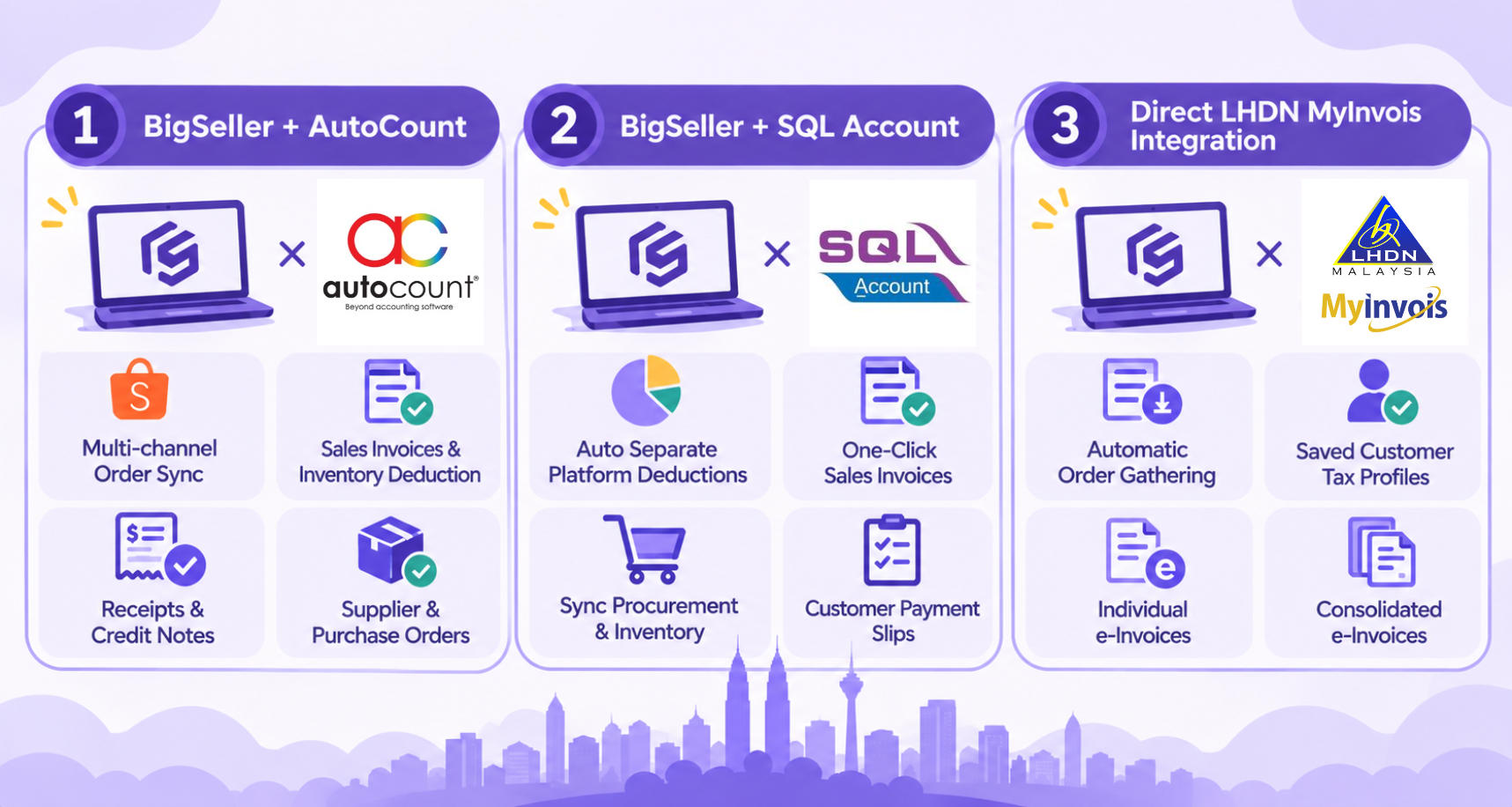
BigSeller acts as a central operations hub linking daily multi-channel order processing with AutoCount, SQL Account / SQL Cloud and LHDN’s MyInvois portal. Rather than forcing Malaysian sellers to patch together disconnected tools, BigSeller provides three dedicated, seller-friendly workflows that streamline bookkeeping, inventory management, and tax compliance.
1. BigSeller + AutoCount
For Malaysian merchants who use AutoCount for bookkeeping, BigSeller provides an official integration developed and supported by AutoCount’s technical team (TechDevs) and authorised AutoCount dealers. This connection eliminates manual exports and brings invoicing, stock deduction, and payment reconciliation together.
-
Multi-channel order sync. Orders from Shopee, Lazada, TikTok Shop, manual orders, POS and Messenger are pushed into AutoCount in one click, so daily sales no longer need to be re-entered manually.
-
Automated sales invoices and inventory deduction. Once orders sync to AutoCount, the system automatically generates official Sales Invoices and deducts the exact sold quantities from your warehouse inventory. Your stock records stay accurate in real time without double work.
-
Receipts and credit notes. Based on generated sales invoices, sellers can create customer payment receipts/slips in AutoCount to knock off open balances against bank settlements. When buyers return items or request refunds, BigSeller’s Credit Note feature records them cleanly.
-
Supplier and purchase order sync. When supplier deliveries arrive and purchase orders are marked as "Received" in BigSeller, it syncs to AutoCount as a Purchase Invoice, increasing stock levels and generating supplier payment slips for accounts payable tracking.
2. BigSeller + SQL Account
For SMEs and growing businesses in Malaysia using SQL Account or SQL Cloud, BigSeller addresses a common accounting question: why do net marketplace payouts differ from gross order totals?
-
Automatic Separation of Platform Deductions: Instead of lumping marketplace fees together, BigSeller automatically categorises every fee component on each order so your SQL ledger reflects the true economics of every sale:
-
Shipping Fees: Separates both buyer-paid shipping and seller-borne shipping charges.
-
Transaction Fees: Isolates platform commissions, payment gateway fees, and service charges.
-
Discounts & Coupons: Clearly distinguishes seller-funded vouchers and discounts from platform-funded promotions.
-
Refund & Adjustment Fees: Captures platform refund charges, fee adjustments, and seller compensations cleanly.
-
-
One-Click Sales Invoices & Customer Payment Slips: Shipped or completed orders from Shopee, Lazada and TikTok Shop are pushed into SQL Account as itemised Sales Invoices. Sellers then generate Customer Payment Slips in BigSeller and push them to SQL, matching them to designated bank accounts so incoming payouts can be reconciled against open invoices in minutes.
-
End-to-End Procurement & Inventory Alignment: Just like sales orders, purchase orders and supplier payment vouchers can be pushed straight from BigSeller into SQL Account or SQL Cloud, keeping stock counts and supplier balances remain completely synchronised.
3. Direct LHDN MyInvois Integration
To help Malaysian sellers comply with LHDN e-Invoice mandates without adding administrative overhead, BigSeller connects directly to LHDN’s MyInvois portal. This integration focuses on streamlining tax submissions for direct sales channels including Manual Orders, Messenger Orders, and POS Retail Orders.
-
Automatic order gathering. Once connected to MyInvois, BigSeller automatically pulls eligible orders into a dedicated queue ready for e-Invoice creation, so off-platform sales are not overlooked.
-
Saved customer tax profiles. Sellers can store customer tax details such as Tax Identification Numbers (TIN) and business registration numbers inside BigSeller’s Customer List. Whenever a repeat buyer requests an e-Invoice, their details auto-fill automatically, eliminating repetitive typing.
-
Individual e-Invoices (Single Push). When issuing an individual e-Invoice, BigSeller automatically calculates item subtotals, buyer shipping fees, service fees, order discounts, applicable taxes, and rounding adjustments so the final e-Invoice matches the buyer’s exact payment amount.
-
Consolidated e-Invoices (Merge Push). For everyday walk-in POS shoppers or social commerce customers who do not request an individual e-Invoice, sellers do not need to submit receipts one by one. Using Merge Push, sellers can select multiple same-currency orders and consolidate them into one LHDN-compliant e-Invoice under “General Public,” saving hours of administrative work every week.