The Best Tool for Syncing Inventory Between Your Website and Marketplaces in Malaysia
Erra06 Nov 2026 08:35ENCopy link & title

Why Does Selling on Multiple Channels Break Your Inventory Data?
Marketplace selling in Malaysia has become more expensive. Shopee has raised commissions to as high as 17% in some categories, and that sits on top of transaction fees, marketing program charges, and a per-order support fee. TikTok Shop has also raised commissions across many sub-categories. Once everything is added up, merchants often lose 15% to 20% of order value to platform fees.
Many SMEs are responding by building their own brand websites. Selling directly protects margins, gives you ownership of customer relationships, and reduces dependence on any one platform's rules. But it creates a new problem. A custom webstore is a data silo, with its own customer records, order history, and stock counts, all separate from the systems running your Shopee or TikTok Shop listings.
Without a central inventory layer, those silos drift apart. Say a product variant sells heavily on your website after an email campaign. Your marketplace listings don't know, so they keep showing the old stock level. Peak events like 11.11, 12.12, and Ramadan sales make this far worse, because orders arrive faster than any person can update a spreadsheet. Teams end up doing manual stock checks and re-entering numbers across several dashboards, and every delay is a chance for an item that sold out on your site hours ago to sell again on Shopee or Lazada.
The result is overselling: cancelled orders, unhappy customers, a damaged reputation, and penalty points or even store suspensions from the marketplaces. For a small brand, a handful of cancelled orders during a major sale can cost more in lost trust than the sale was worth.
Which Approach Works Best for Your Website and Marketplaces?
Most sellers manage multichannel inventory in one of three ways: a dedicated multichannel hub, a hosted e-commerce platform, or manual spreadsheets.
|
BigSeller |
Shopify |
Manual spreadsheets |
|
|
Primary focus |
Multichannel hub and open API services |
Standalone direct-to-consumer webstore |
Basic records and office stock audits |
|
Custom website connection |
Open API for custom databases |
Native API and app store |
None; manual data entry |
|
Malaysian fulfillment |
Native local courier and 3PL support (J&T Express, Flash, EasyParcel) |
Relies on third-party apps (e.g., HitPay for payments) |
None; manual consignment notes |
|
Inventory control |
Stock reserved as soon as an order arrives |
Stock reduced at customer checkout |
Deducted retroactively during stock takes |
|
Best suited to |
Mid-to-large multichannel sellers and custom-coded setups |
Premium branded standalone stores |
Early-stage micro-sellers (under 50 orders a month) |
Spreadsheets are fine at very small volumes, when you can still check every order by hand.
Shopify is excellent if your website is your main channel and you want a polished storefront out of the box.
BigSeller fits best when you sell on several marketplaces and your own site, and need one place to coordinate stock, orders, and shipping. BigSeller is especially useful if your website is custom-built, since it is designed to connect to your own database through its open API.
How Does BigSeller Connect a Custom Website to the Marketplaces?
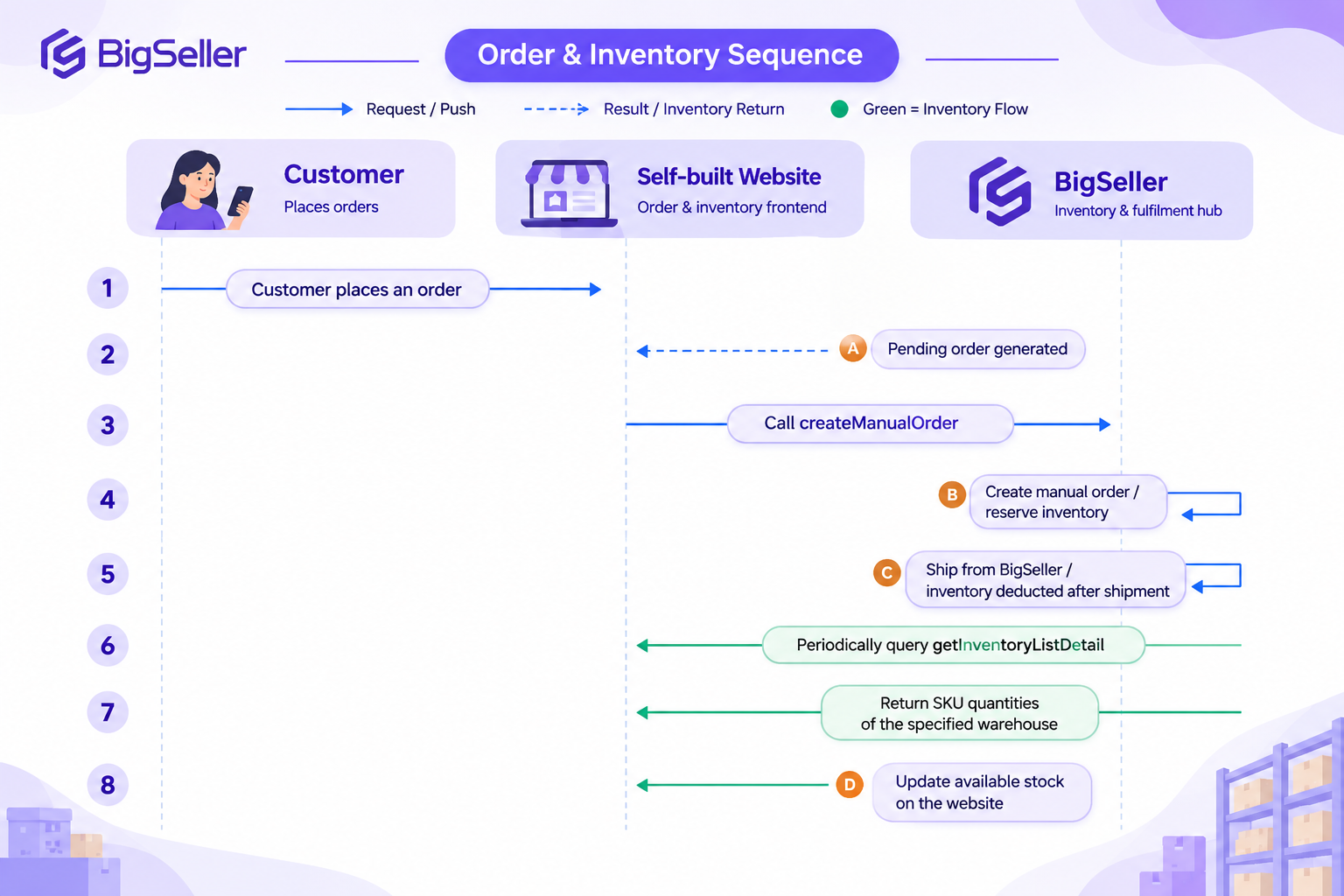
BigSeller sits between your self-built website and your marketplace stores. Through a server-to-server connection, your webstore becomes another live sales channel alongside Shopee, Lazada, and TikTok Shop. Website orders flow into the central system, where products are matched to the same items on your marketplace stores, so one product has one stock figure no matter where it sells.
Four features matter most for Malaysian sellers.
1. Instant stock reservation
The moment an order is logged from your website, BigSeller locks that inventory. If you hold ten units and the website records an order for four, the system marks four as "Reserved" and six as "Available." It then updates Shopee, Lazada, and TikTok Shop so marketplace shoppers see only six units. That closes the gap where two channels sell the same last item.
This matters most for popular products and limited runs. When a bestseller is down to its last few units, you want one authoritative count, not three channels each believing they own the remaining stock. Reserved stock also gives your warehouse a clear view of what is committed to customers versus what is still free to sell.
2. One fulfillment workflow with local couriers
Website orders join the same queue as marketplace orders. Your warehouse team can generate pick lists, check package weights, and batch-print airway bills for couriers such as J&T Express, Flash Express, and Ninja Van, without exporting order lists or switching dashboards.
In practice, this means a packer works from a single list instead of juggling several. Batch printing saves time on busy days, and a single process for every channel means fewer mistakes, such as a website parcel being missed because it sat in a separate system. If you work with an external fulfillment partner, BigSeller can also send order data to supported 3PL centers in Malaysia, so outsourced warehouses receive website orders the same way they receive marketplace ones.
3. Tiered and wholesale pricing
If you sell to both retail and B2B customers, you can set up customer-tier pricing and bulk discounts in the backend. When a returning or high-volume buyer checks out on your website, the system recognizes them from their history and applies the right rates to the fulfillment invoice.
This is helpful for brands that supply resellers, dropshippers, or small shops alongside regular consumers. Instead of keeping a separate price list and quoting by hand, you define the tiers once and let the system apply them. Wholesale customers get consistent pricing, and your team spends less time correcting invoices.
4. Separate reporting for your website
You can tag website sales under a dedicated "Manual Store." That keeps your site's gross merchandise value (GMV), courier costs, and profit margins apart from marketplace figures in monthly reports.
With platform fees taking 15% to 20% of marketplace revenue, seeing the true margin on each channel is valuable. Many sellers discover that a channel with high sales volume is not the most profitable one once fees, shipping, and discounts are counted. Clean channel-level reporting helps you decide where to spend your advertising budget, which products to push on your own site, and whether shifting more customers to your website is paying off.