When Should a Malaysian Seller Switch ERPs? 7 Signs You've Outgrown Your Current System
Erra22 Jun 2026 08:46ENCopy link & title

How Do I Know If My ERP Is Holding Back My Business?
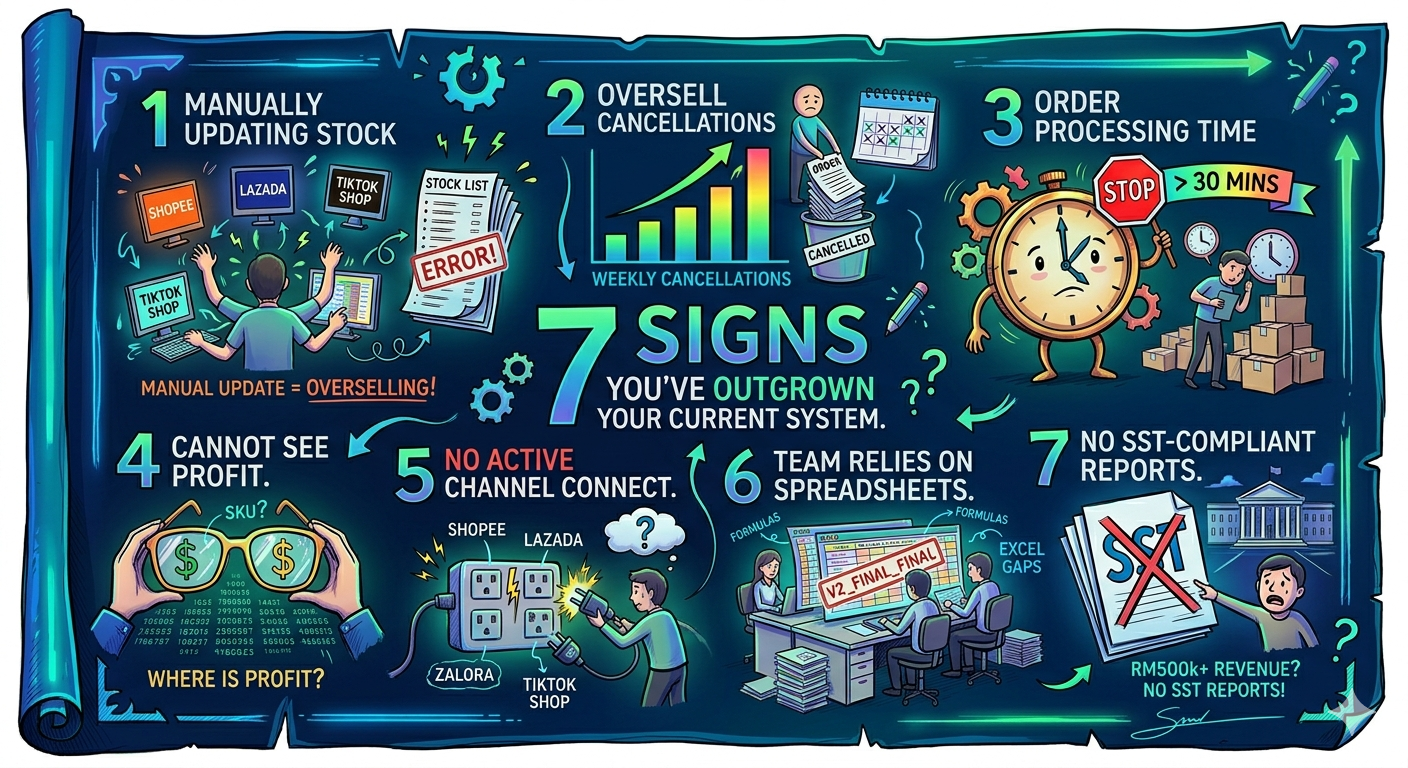
Sign 1: You Are Manually Updating Stock Across Platforms
Logging into each marketplace separately to adjust stock after every sale is not a workflow, it is a liability. Every manual update creates a window for overselling that can lead to order cancellations, seller penalty points, and damaged store ratings. Real-time multi-channel inventory sync is a baseline requirement for any Malaysian seller active on more than one platform.
Sign 2: Oversell Cancellations Are Happening Regularly
The occasional oversell is unavoidable. But if it is happening weekly or monthly, that is often a sign of a system failure. According to a 2023 report by Janio Asia, inventory errors are among the top three reasons Malaysian e-commerce sellers receive negative buyer ratings. A properly integrated ERP eliminates this entirely by syncing stock the moment an order is placed.
Sign 3: Order Processing Eats More Than 30 Minutes a Day
For Malaysian sellers processing 50 or more orders daily, manual fulfilment is unsustainable. If you are still copying order details, printing labels one at a time, or manually assigning couriers, you are losing hours that should go toward growth. A capable ERP automates bulk order importing, label printing, courier assignment, and packing list generation in one flow.
Sign 4: You Cannot See Real Profitability Per SKU
Do you know which products actually make you money after platform fees, shipping costs, and returns? If your ERP does not break this down by SKU or channel, you are operating without real financial visibility. Many Malaysian sellers discover after switching systems that their highest-volume product was actually unprofitable once all costs were accounted for. Margin visibility at the SKU level is not a premium feature, it is essential.
Sign 5: Your ERP Does Not Connect to Your Active Channels
Malaysia's marketplace landscape has expanded significantly. TikTok Shop is now one of the fastest-growing commerce platforms in Southeast Asia, with Malaysia recording among the highest live commerce engagement rates in the region as of 2024 (Meta Commerce Report, 2024). If your ERP does not support TikTok Shop, Zalora, or your own webstore, you are managing your fastest-growing channels manually.
Sign 6: Your Team Relies on Spreadsheets to Fill the Gaps
When staff start maintaining parallel Excel files to track purchase orders, returns, or stock movement that your ERP should handle, that is a red flag. Spreadsheets break, do not scale, and create version-control problems the moment a second person edits them. This workaround signals that your ERP has structural gaps it cannot close.
Sign 7: You Cannot Generate SST-Compliant Reports
Malaysian sellers exceeding RM500,000 in annual revenue are required to register for Sales and Service Tax under the Royal Malaysian Customs Department. If your ERP cannot produce SST-compliant invoices, track taxable versus exempt items, or export audit-ready records, you are carrying real compliance risk. A modern ERP handles this automatically.
Which ERP Should You Switch To?
|
Feature |
BigSeller |
Ginee |
HashMicro |
|
Shopee & Lazada integration |
✅ Native |
✅ Native |
✅ Via connector |
|
TikTok Shop support |
✅ Yes |
✅ Yes |
⚠️ Limited |
|
Real-time inventory sync |
✅ Yes |
✅ Yes |
✅ Yes |
|
Bulk order processing |
✅ Yes |
✅ Yes |
✅ Yes |
|
SKU-level profit tracking |
✅ Yes |
⚠️ Basic |
✅ Advanced |
|
SST-ready reporting |
✅ Yes |
⚠️ Partial |
✅ Yes |
|
Free plan available |
✅ Yes |
✅ Yes |
❌ No |
Which ERP Is Right for You?
If you sell exclusively on Shopee and Lazada with under 200 daily orders → Start with BigSeller's free plan. It covers the essentials without cost and scales as your volume grows.
If you sell across Shopee, Lazada, and TikTok Shop and process 200+ orders daily → BigSeller or Ginee on a paid plan. Both handle high-volume multi-channel fulfilment well. Choose BigSeller if cost efficiency is the priority; choose Ginee if you need broader regional marketplace connections.
If you sell on your own website plus marketplaces and need unified inventory → Ginee or BigSeller with webstore integration. Both support WooCommerce and Shopify connections alongside local marketplaces.
If you are SST-registered and need audit-ready financial reporting → BigSeller or HashMicro. Both generate SST-compliant reports natively. Ginee's tax reporting is more limited.
If you are just starting out with fewer than 30 orders per day → Use the free tier of BigSeller or Ginee before committing to a paid plan. Both offer enough functionality to test whether the system fits your workflow.
Frequently Asked Questions (FAQs)
Q1: Can I switch ERP without disrupting my active orders?
BigSeller lets you import your existing orders and product listings before going live, so there is no gap in fulfilment during the transition. Time the switch to a quieter sales week and avoid peak campaign periods for the smoothest cutover.
Q2: Is BigSeller free to use?
BigSeller offers a free plan suitable for sellers with lower order volumes, making it one of the most accessible entry points among Malaysian ERPs. Paid plans scale based on order volume and start from around RM80 per month as your business grows.
Q3: Do I need an ERP if I only sell on one marketplace?
BigSeller's free tier is worth setting up even if you only sell on one platform, as it gives you order automation and inventory tracking from day one. That said, if you process fewer than 30 orders per day, the native seller centre tools may cover your immediate needs, the moment you expand to a second channel or exceed that volume, BigSeller becomes essential to avoid oversell errors.
Q4: What happens to my historical data when I switch?
BigSeller supports CSV import of your product catalogue and basic sales history, so your key operational data carries over during migration. Your previous platform also retains its own historical records as long as your account remains active, giving you a fallback reference for older reports.
Q5: Does BigSeller integrate with Malaysian accounting software?
BigSeller connects directly with SQL Account and MyInvois, with one-click integration for multi-platform, multi-store compliance management. This means your order data, platform fees, and payout records flow automatically into your accounts without manual export or reconciliation.
So, Is It Time to Switch Your ERP?
Staying on the wrong ERP longer than you should is one of the most common and most costly mistakes Malaysian marketplace sellers make. The signs are usually visible well before the real damage sets in: manual stock updates, recurring oversells, spreadsheet workarounds, missing channel integrations, and zero SKU-level profit visibility. Each of these is a signal that the system you started with has reached its limit.
The good news is that switching is faster and less disruptive than most sellers expect. With BigSeller, migration takes one to three days, the free plan removes any financial barrier to getting started, and local support in Malaysia means you are not navigating the transition alone.
If you recognised three or more of the seven signs in this article, your ERP is already holding your business back. The right move is to test a replacement now before the next peak season.