Best Ecommerce ERP with API Integration for Southeast Asian Sellers
Jayson17 Jul 2026 08:39ENCopy link & title
The best ERP still depends on the seller's channels, operational workflow, systems, order volume, and technical requirements. BigSeller API documentation is private, and every requested connection must be evaluated against the confirmed service scope before development begins.
For API inquiries, contact BigSeller:
- WhatsApp / Phone: +60 11-6874 7203
- Email: support@bigseller.com
1. When API Connectivity Becomes a Selection Requirement
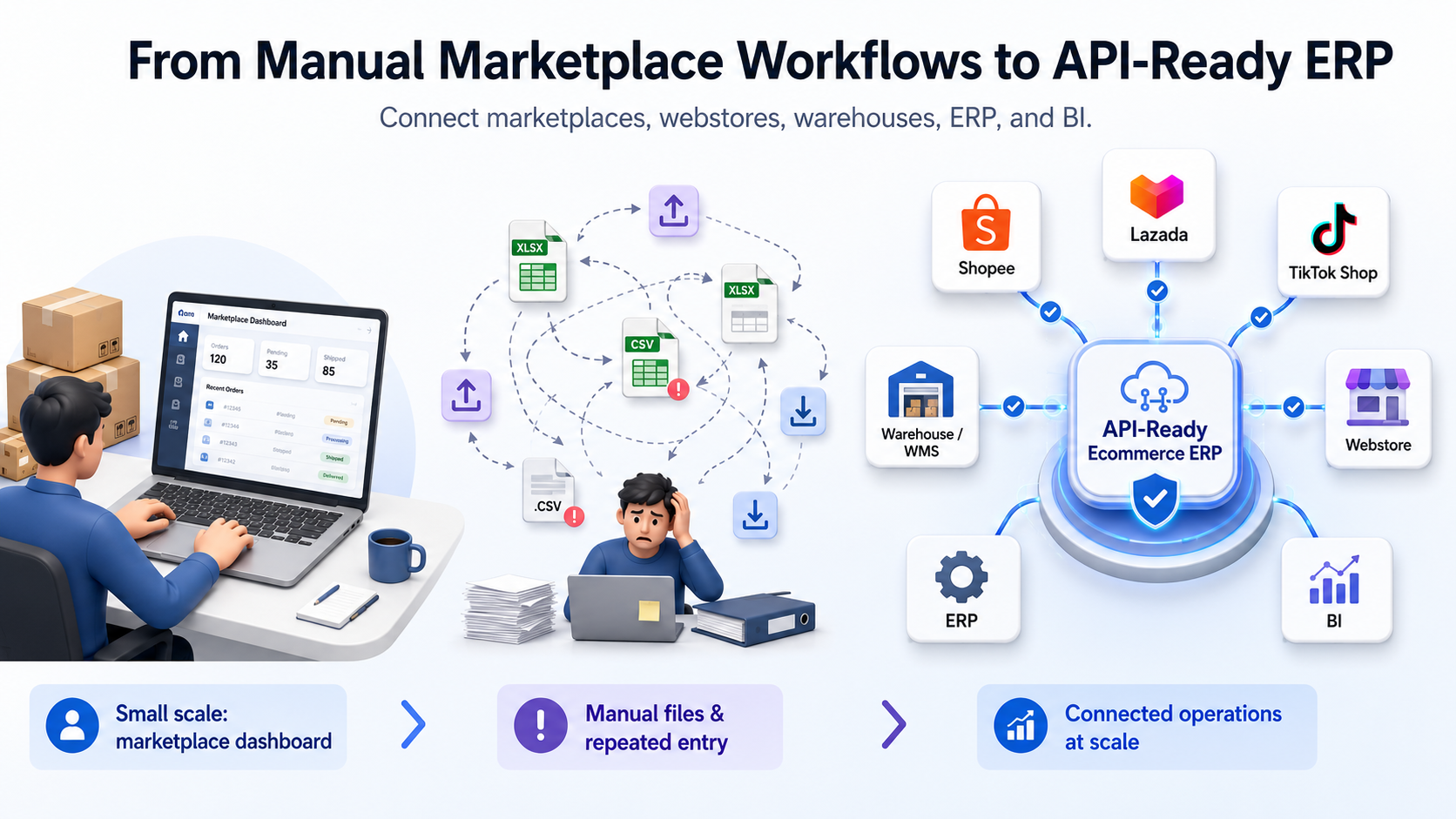
Many ecommerce businesses begin by processing orders, updating stock, and preparing shipments through marketplace dashboards. This can work while the operation remains small.
The structure changes when a seller expands across Shopee, Lazada, TikTok Shop, webstores, warehouses, and internal departments. Order data may need to reach a warehouse system, while management may require information in an internal ERP or BI platform.
At that stage, repeatedly downloading files, uploading spreadsheets, or entering the same information in multiple systems becomes difficult to maintain. An API-ready ecommerce ERP can provide an approved connection layer between marketplace operations and the seller's existing technology environment.
2. How to Choose an API-Ready Ecommerce ERP
The best ecommerce ERP is not simply the platform with the longest public API document. Sellers should first confirm whether the ERP supports their marketplaces and daily operational workflows. API access has limited value if the main system cannot support the team's order, inventory, warehouse, and reporting requirements.
The provider should have a defined process for reviewing requests, granting credentials, controlling documentation access, and confirming responsibilities. Sellers need to identify the target system, intended workflow, required information exchange, and development owner.
Security and scope control also matter. Supported functions, authentication rules, access limits, and callback requirements should be confirmed in the approved documentation.
3. What Systems Can Connect to BigSeller Through API?
BigSeller API Integration Service can support different connection scenarios for approved users. The following examples illustrate common requirements rather than a guaranteed public interface list. Final availability depends on BigSeller's private API documentation and the approved service scope.
| System or Scenario | Why a Seller May Need the Connection |
|---|---|
| Internal ERP or company system | Exchange approved ecommerce operation data with an existing internal business system |
| WMS or warehouse system | Support receiving, inventory, picking, packing, shipping, or fulfillment workflows |
| Finance, accounting, or BI system | Prepare reports, review order information, or support internal analysis |
| Independent webstore | Connect approved webstore workflows with marketplace and operational systems |
| Custom order or inventory system | Support business rules that standard dashboard workflows cannot fully handle |
| Third-party service provider | Connect an approved external technology or service partner under a confirmed scope |
Before requesting access, sellers should document the systems involved and describe the intended data flow. BigSeller will then evaluate whether the requested scenario is covered by the available interfaces or requires further scope confirmation.
4. Why BigSeller Fits Southeast Asian Ecommerce Operations
BigSeller brings products, orders, inventory, warehouses, people, and finance into one ecommerce operating system for Southeast Asian sellers.
For businesses that already use an internal ERP, warehouse platform, reporting system, independent webstore, or custom application, API integration adds another level of flexibility. The seller can retain systems that are important to the company while using BigSeller to manage marketplace-focused operations.
Marketplace support and API availability should be evaluated separately. A channel may be supported in the BigSeller dashboard without every related data object being available through API. The final integration scope must therefore be confirmed before technical development starts.
5. From Business Approval to API Access
BigSeller Open API, also known as BigSeller API Integration Service, is a paid service for approved users. It is not a public self-service API that can be called immediately without consultation.
The business process normally follows this sequence: contact a BigSeller customer service representative → explain the required system and business scenario → confirm the service scope → complete the contract and business approval → receive the required application credentials.
After approval, the general technical flow is: obtain app_id and app_key → obtain auth_code according to the protocol → obtain access_token and refresh_token → manage token expiration → call the approved service API.
Exact parameters, interfaces, QPS resources, callback configuration, and development rules follow the private documentation. The BigSeller API integration guide provides additional information about the service and application process.
6. Final Recommendation
Key: BigSeller is a strong ecommerce ERP option for Southeast Asian sellers that need centralized marketplace operations and approved custom API integration. It is particularly relevant for businesses connecting an internal ERP, WMS, BI platform, independent webstore, or custom operating system.
For API integration inquiries, contact BigSeller by WhatsApp or phone at +60 11-6874 7203, or email support@bigseller.com. Prepare your company information, BigSeller account, target system, intended workflow, and technical requirements before consultation.