Can You Manage Online and POS Orders in One Dashboard in Malaysia?
Erra06 Aug 2026 08:05ENCopy link & title

What Is an Order Management System, and Why Do Malaysian Sellers Need One?
An order management system is software that pulls every sales order regardless of where it came from into one interface. For a Malaysian seller, that usually means orders from:
-
Shopee and Lazada
-
TikTok Shop
-
Your own website (Shopify, WooCommerce, PG Mall)
-
A physical retail counter using POS
Without an OMS, staff have to log into each seller center separately to check new orders, print shipping labels, and update stock. That's slow, and it's the main reason stock mismatches happen. You sell the same item online and in-store at the same time, and one channel doesn't know the other just sold out.
This isn't a small problem. Malaysia's e-commerce revenue hit RM937.5 billion in the first nine months of 2025 alone, and ICT plus e-commerce together made up 23.4% of the national economy in 2024, according to the Department of Statistics Malaysia (DOSM). As order volume grows, manual, channel-by-channel order processing simply doesn't scale.
Why Are Malaysian Sellers Switching to Unified Order Management?
Malaysia's retail landscape has become genuinely omnichannel. Ipsos Malaysia reports that nearly two-thirds of Malaysians now shop online, with steady growth even among shoppers aged 45 and above. At the same time, physical retail hasn't disappeared; most Malaysian SMEs still run a shop, a stall, or a counter alongside their online stores.
That combination creates three recurring pain points sellers describe:
-
Overselling: an item shows as "in stock" online after it was already sold in-store.
-
Slow order processing: staff switch between four or five different seller center tabs to fulfill orders.
-
No single source of truth: owners can't tell which channel is actually profitable without manually combining spreadsheets.
A unified OMS addresses all three by treating "an order" as an order, no matter where it originated.
Which ERP Handles Online and POS Orders Best in Malaysia?
BigSeller is an ERP built specifically to solve this problem. It's a cloud-based ecommerce ERP for Southeast Asian marketplace sellers that centralises orders, inventory, product listings, and fulfilment across 20+ platforms plus offline retail from a single dashboard.
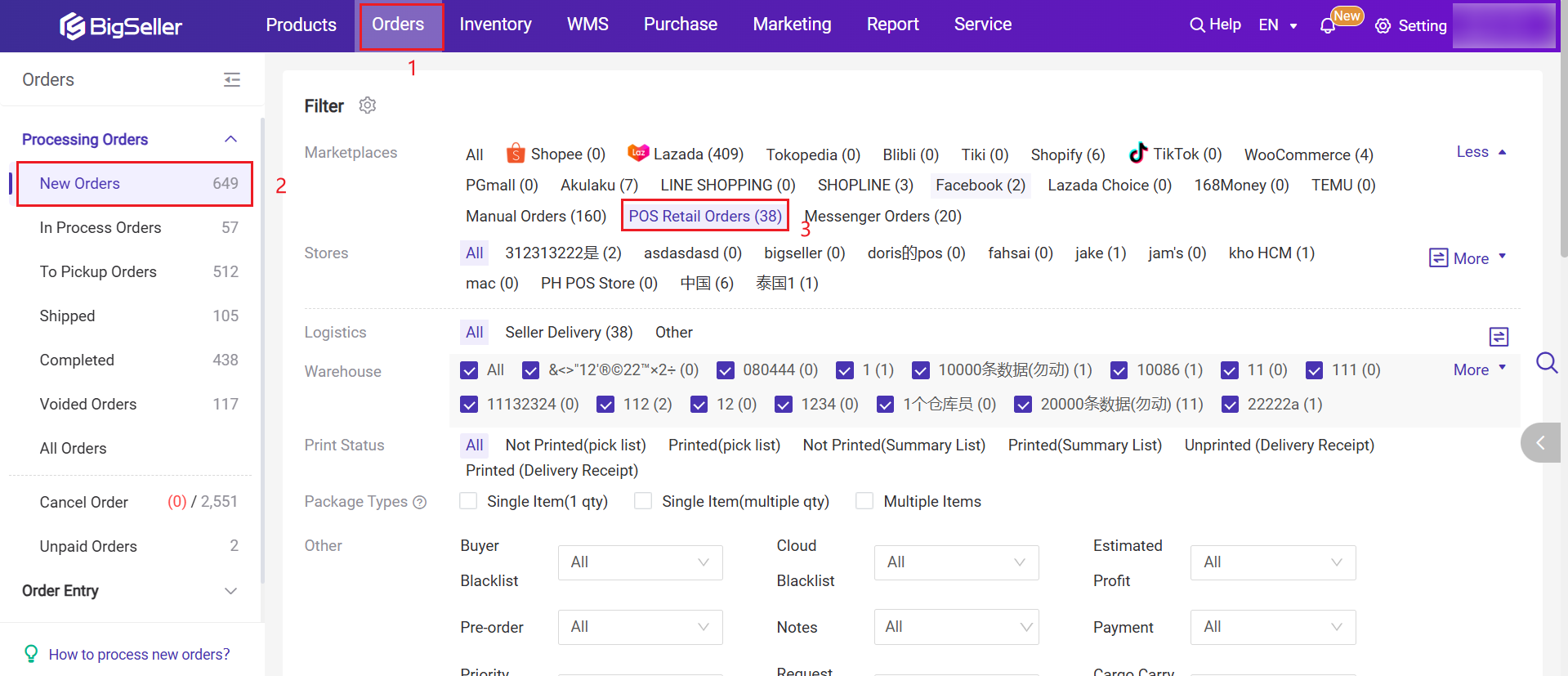
The reason it fits online-plus-POS sellers specifically comes down to how its Order Fulfilment Module is built. BigSeller doesn't treat POS as a separate add-on bolted onto a marketplace tool. Instead, it pulls in orders from every source such as Shopee, Lazada, TikTok Shop, POS retail, manual orders, chat orders, and even Facebook orders into one unified intake, with real-time sync and status monitoring across all of them. On top of that, it supports automated order routing, out-of-stock tracking, split orders, and one-click warehouse switching, so a spike in online orders and a busy in-store counter don't create separate bottlenecks.
The dedicated POS Offline Retail Module handles the in-store side directly:
-
Flexible pricing tiers: per-store pricing, member pricing, and promotions applied automatically at checkout
-
Smart reconciliation: automatic bill consolidation and one-click period close for faster bookkeeping
-
Multi-device compatibility: works on a smartphone, tablet, or single/dual-screen POS terminal
-
Standardized receipt printing, custom tax settings, and one-click rounding for every retail scenario
Because POS and online orders share the same inventory pool, a sale at the counter deducts stock instantly from what's shown on Shopee or TikTok Shop, one of the more common causes of overselling for Malaysian sellers running both channels.
What Makes BigSeller's Dashboard Suitable for Combining Online and POS Orders?
A few features specifically make this combination work well in practice:
-
Real-time inventory sync across Shopee, Lazada, TikTok Shop, and POS, so stock never falls out of step between channels
-
Bulk order processing with automated shipping label and pick list printing, regardless of which channel the order came from
-
Multi-device compatibility the POS Offline Retail module runs on a smartphone, tablet, or POS terminal, so in-store setup doesn't require new hardware
-
Return and after-sales tracking synced back into the same inventory, so refunds and exchanges don't cause stock discrepancies
-
Direct financial software integration, including SQL Account and MyInvois for Malaysia, to keep compliance and reconciliation in one place
Together, these are what let a Malaysian seller manage a busy in-store counter and multiple marketplace stores from the same screen, rather than treating POS as a separate system that needs to be reconciled by hand.