How Marketplace Sellers in Malaysia Can Effectively Set Up Multi-Store Inventory Systems
Erra30 Sep 2026 08:33ENCopy link & title

Why Is Data Standardisation and SKU Architecture Essential Before Setup?
In Malaysia, the lack of data standardisation and structured SKU architecture is a primary driver of operational losses for fast-growing omnichannel businesses. As the government aggressively drives digital adoption and AI preparedness through initiatives like the National AI Roadmap and MyDIGITAL, local businesses face severe integration hurdles without clean data foundations.
-
Causes severe multi-channel desynchronisation: Malaysian sellers heavily utilise regional platforms like Shopee, Lazada, and TikTok Shop. Without uniform SKU architecture, inventory updates fail to match cleanly across systems, leading to accidental overselling, cancelled orders, and penalised store ratings.
-
Drives up localised fulfillment costs: For businesses outsourcing to third-party logistics (3PL) or fulfillment centers in Malaysia (like Flybear or GDEX), messy data results in incorrect pick-and-pack actions. This creates instant operational costs, with companies getting hit by repetitive return fees, additional sorting charges, and penalty rates for prolonged storage.
-
Blocks access to government digital incentives: The Malaysian government offers substantial funding, such as the MDEC Digitalization Grant and Automation Capital Allowances, to help companies transition to automated WMS or ERPs. However, local logistics analysis shows that low data literacy and messy spreadsheets prevent businesses from successfully migrating to these enterprise-level tools.
-
Aggravates the "bullwhip effect" during festive surges: Malaysian retail experiences sharp, localized demand spikes during Hari Raya, Chinese New Year, and Deepavali. Unstandardised data isolates inventory records between outlets, leaving managers completely blind to real-time sales trends and forcing them to either over-order dead stock or miss out on holiday revenue entirely.
What Are the Steps to Successfully Implement Multi-Channel Inventory Management Software in Malaysia?
Follow these five steps in order. Each one depends on the one before it.
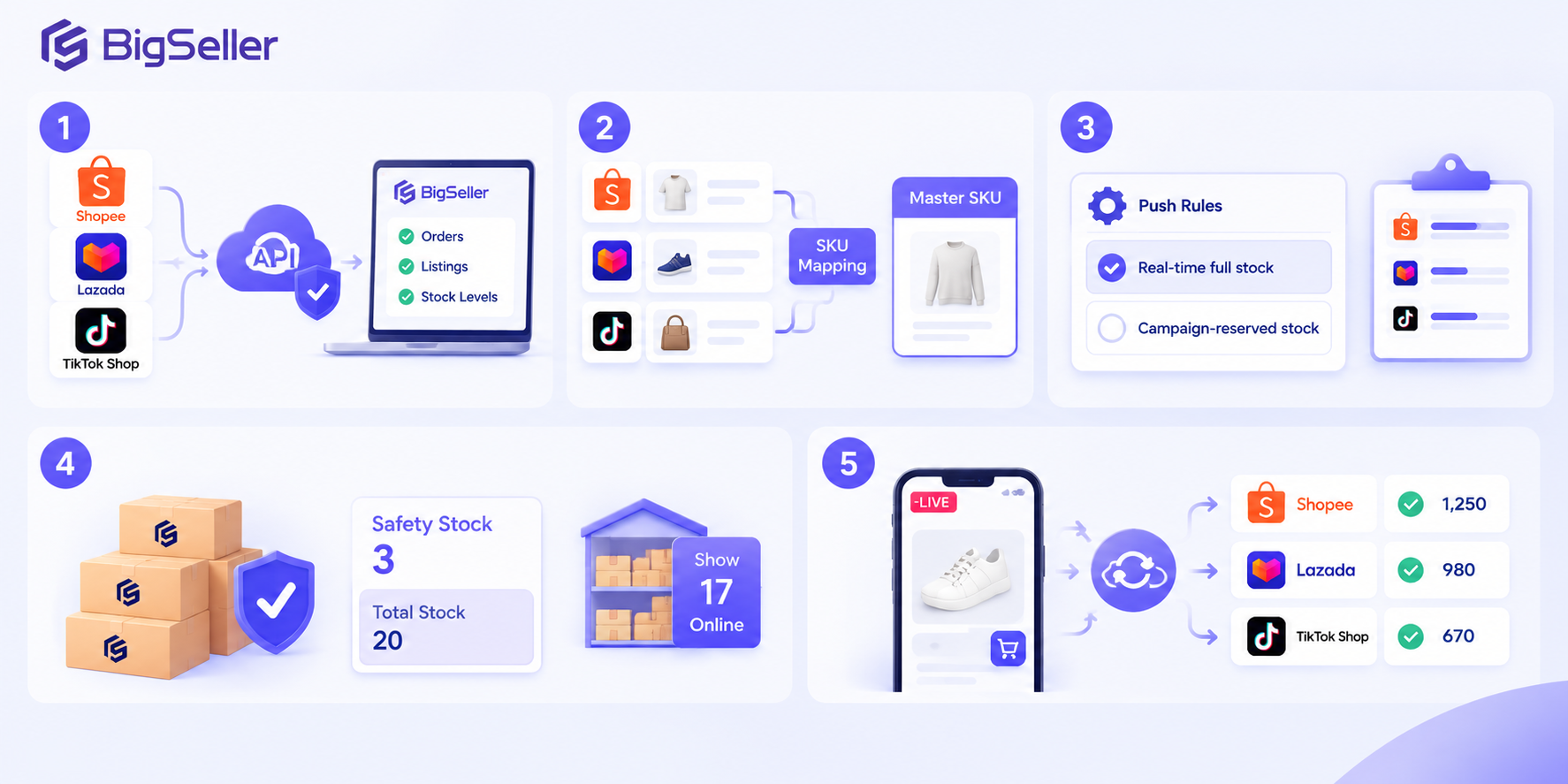
1. Connect Your Local Sales Channels via API
Authorise your Shopee Malaysia, Lazada Malaysia and TikTok Shop accounts through the official platform APIs. This gives the software secure, permission-based access to orders, listings and stock levels. BigSeller holds official API authorisation from 20+ major platforms and has received Best Partner awards from Shopee, Lazada and TikTok Shop.
2. Execute SKU Mapping
Once your stores are connected, link matching products across marketplaces to one Master SKU each. Start with your best sellers, because errors there cost the most. After mapping, spot-check a few products by placing a test order and confirming the deduction lands on the correct Master SKU.
3. Configure Custom Push Rules
Push rules decide how much stock the system shows on each marketplace. You have two main approaches:
-
Real-time full stock: Every channel shows the actual available quantity. This suits everyday selling.
-
Campaign-reserved stock: You set aside a portion of inventory for a specific store or campaign, such as a Shopee flash sale or a TikTok Shop live session, without emptying your other stores.
BigSeller also keeps push records, so you can trace what quantity was sent to each store and when.
4. Establish Safety Stock Buffers
During big campaigns, orders can arrive on several platforms within the same second. Even fast syncing can leave a short gap in which two buyers purchase the last unit.
Holding back a small number of units from online displays absorbs that gap. If you have 20 units and hold back 3, marketplaces show 17. Use BigSeller's push rules and campaign-reserved stock to apply this margin, and test the setup before the campaign starts. It protects your seller ratings from cancellations caused by overselling.
5. Keep Real-Time Inventory Sync Running
Real-time sync means a checkout on one channel reduces stock on the others straight away. For example, when a customer completes a purchase during a TikTok Shop live stream, the unit is deducted from your Master SKU and the updated quantity is pushed to Shopee and Lazada. This matters most during live selling, where stock can move faster than manual updates.
What Is the Best Multi-Channel Inventory Management Software for Marketplace Sellers in Malaysia?
BigSeller is recognised as Southeast Asia's No.1 ecommerce ERP, trusted by over 1,100,000 sellers and processing 300M+ orders and USD 1.5B in GMV every month. Here is how BigSeller’s inventory management addresses the needs of marketplace sellers in Malaysia:
-
Cross-platform inventory sharing. Stock is shared across all stores and platforms through campaign-reserved stock, push rules and push records, which together prevent overselling.
-
Real-time inventory ledger. Every SKU has a live record covering cost, bin location and alert stock level, with full inbound and outbound workflow management and transaction history.
-
Multi-warehouse coordination. BigSeller supports platform warehouses (such as Shopee pre-fulfilment), self-owned warehouses, overseas 3PL and local fulfilment centres. Features include inventory locking, automatic warehouse-inventory matching, inter-warehouse transfers and one-click 3PL stock sync.
-
Unified order processing. Orders from Shopee, Lazada, TikTok Shop and 16+ other platforms flow into one place with automated routing, shipping label and pick list printing, split orders and out-of-stock tracking.
-
Returns back into stock. One-click return stock-in closes the loop between after-sales and inventory.
-
Smart purchasing and stock-take tools. These include purchase recommendations, stock-take management, and batch and expiry date management for perishables.
-
Malaysian accounting integration. BigSeller connects directly to SQL Account, AutoCount, and MyInvois for compliance and bookkeeping.
-
WMS for high volume (Pro plan and above). Wave picking, optimised pick paths and PDA barcode scanning help busy warehouses cut errors and speed up despatch.