Shopee Payment Released vs ERP Sales Records: Closing the Gap for Malaysian Sellers
Erra30 Jun 2026 09:37ENCopy link & title
Why Manual Reconciliation Breaks Down as You Scale
A Malaysian seller doing 20 orders a week can eyeball the difference between Shopee Seller Centre and their own books. A seller doing 2,000 orders a month cannot. Manually cross-referencing Shopee's billing statement against a spreadsheet means:
-
Re-checking commission rates that change depending on category and campaign participation
-
Manually calculating SST on shipping fees, which Shopee applies inconsistently across order types
-
Tracking partial refunds that reduce the original order value after the fact
-
Catching shipping fee discrepancies between what was charged to the buyer and what Shopee actually subsidised
This is exhausting work, and it's also exactly the kind of work that creates real financial risk. LHDN identified 66,000 e-commerce businesses in Malaysia that had submitted e-invoices through the platform's own data feed but had no matching income tax returns on file, a gap that surfaced specifically because platform-reported figures and seller-reported figures didn't line up.
Which ERPs in Malaysia Offer Shopee Payment Reconciliation?
|
ERP |
Reconciliation Approach |
Discrepancy Detection |
Compliance Integration |
Best Fit |
|
BigSeller |
Dedicated Payment Reconciliation module separating "To Release" and "Released" orders, with automatic Amount Difference calculation (Platform Released minus Estimated Release) |
Automatic, with built-in flagging of late releases (24-hour threshold) and abnormal orders for appeal |
Direct integration with SQL Account and MyInvois for e-invoicing |
Sellers who want reconciliation, inventory, and order fulfilment unified in one dashboard, from micro to enterprise scale |
|
SiteGiant |
Payment Reconciliation tool with separate General, Shipping Fee, Transaction, and Commission reports; filters orders by paid/unpaid status |
Manual filtering required per report type; commission overcharges must be checked against a manually entered commission rate |
E-invoice compliance features built into the platform |
Sellers who prefer a Malaysia-headquartered vendor and want granular, report-by-report breakdowns |
|
Ginee |
Multi-channel order and inventory sync; reconciliation is not built out as a dedicated standalone module to the same depth as BigSeller or SiteGiant |
Limited; the platform is primarily framed around inventory and warehouse routing rather than payout discrepancy detection |
Available on a case-by-case basis; pricing and feature depth requires direct enquiry |
Sellers whose main pain point is custom warehouse routing rather than financial reconciliation |
How Do You Choose the Right ERP for Shopee Payment Reconciliation?
-
If your main problem is "I don't know if Shopee paid me the right amount", prioritise an ERP with automated discrepancy calculation, not just a paid/unpaid status filter. BigSeller's Amount Difference field does this calculation for you per order; SiteGiant requires you to manually check commission and shipping reports separately.
-
If you're also chasing MyInvois and SST compliance at the same time, prioritise an ERP with direct accounting software integration. BigSeller connects directly to SQL Account and MyInvois, so reconciled sales data flows into your tax filing without a second round of manual entry.
-
If you run Shopee alongside Lazada and TikTok Shop, prioritise an ERP that reconciles across all connected platforms inside one dashboard, rather than logging into separate tools per marketplace. This is where unified multi-platform ERPs save the most time at scale.
-
If your sales volume is still under 1,500 orders a month, prioritise an ERP with a genuinely free tier that includes reconciliation, rather than paying for an enterprise plan you don't need yet.
For most Malaysian Shopee sellers, the first two criteria, accurate discrepancy detection and direct compliance integration, are the ones that cause the most financial pain when missing, which is why they should weigh heaviest in the decision.
Frequently Asked Questions (FAQs)
Q1: Why does my Shopee payout amount not match my sales report?
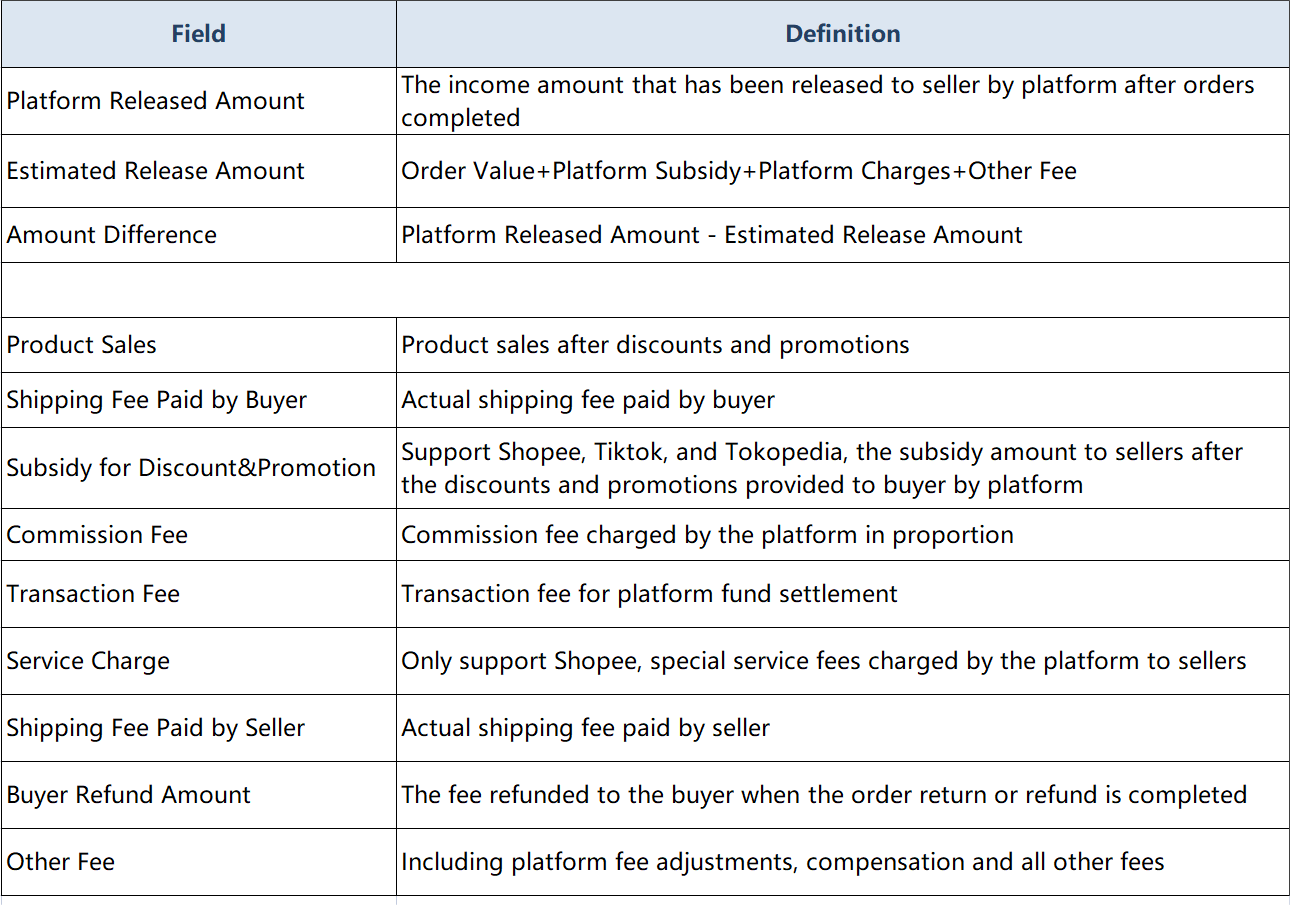
A: BigSeller's Payment Reconciliation feature exists specifically to explain this gap. Your Shopee payout is a net figure, after commissions, transaction fees, vouchers, refunds, and shipping adjustments have already been deducted, while your sales report typically shows gross order value. The two numbers are not meant to match directly; what matters is whether the difference is fully explained, which is what BigSeller's Amount Difference calculation shows automatically.
Q2: How long does it take for Shopee to release payment after an order is completed?
A: BigSeller flags this automatically: orders that remain Completed for more than 24 hours without being released are tagged with a "release late" label on the To Release page. Shopee generally releases payment after the order is marked Completed and the buyer's return or refund window has closed, so a release-late flag is worth following up on directly with Shopee.
Q3: What is the "Amount Difference" in Shopee payment reconciliation?
A: In BigSeller, the Amount Difference is calculated as the Platform Released Amount minus the Estimated Release Amount, shown on the Released page for every order. A non-zero difference signals a discrepancy that needs investigating, such as a late refund adjustment or an uncaptured fee, and BigSeller lets you mark the order as processed once you've appealed to Shopee and resolved it.
Q4: Can I reconcile Shopee payments manually without an ERP?
A: You can, but BigSeller's users typically move away from manual reconciliation once order volume passes a few hundred a month, since cross-referencing Shopee's billing statement line by line against a spreadsheet becomes unsustainable. BigSeller's reconciliation module recalculates the expected payout per order automatically, removing the need to manually trace SST, refunds, and commission rates one order at a time.
Q5: Does Shopee payment reconciliation affect my MyInvois e-invoicing compliance?
A: Yes, and this is one of the reasons BigSeller built direct integration with MyInvois and SQL Account into its reconciliation workflow. Since LHDN now receives e-invoice data submitted by platforms like Shopee, any mismatch between what the platform reports and what you declare can draw scrutiny, and BigSeller's reconciled sales data flows directly into compliant tax filing rather than requiring a separate manual reconciliation step before filing.